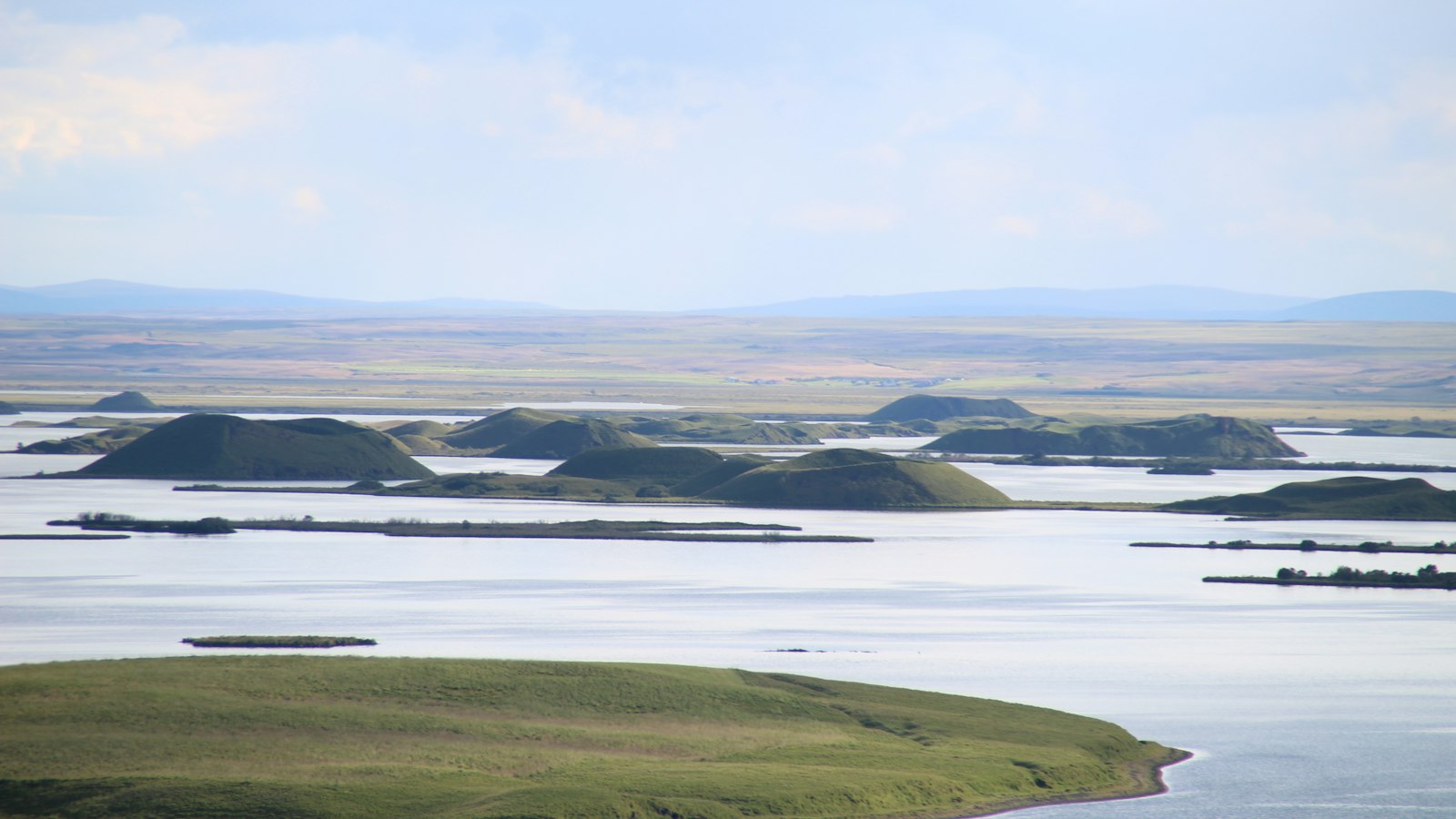
Tucked into the volcanically active north of Iceland, Mývatn is a shallow lake surrounded by some of the island’s youngest and most diverse geological formations. The area rests near the Krafla volcano, marking a dynamic intersection of fire, water and life.
A landscape born from eruptions
Approximately 2300 years in the past, molten basaltic lava flowed out of fissures, transforming the valley and giving birth to what is now Mývatn. The basalt cooled beside an ancient lake, and steam explosions beneath the lava surface created dramatic features including rows of pseudocraters and pillars of stone. The south shore showcases pseudocraters at Skútustaðir, formed by trapped steam, while the rock formations of Dimmuborgir and Höfði evoke the ancient violence of shifting landforms.
These geological features sit on the edge of a volcanic belt that stretches through northeast Iceland as an extension of the Mid-Atlantic Ridge. While postglacial volcanic cycles continue to shape the region, even today, much of the landscape’s character comes from eruptions that pierced ice sheets and built both table-shaped mountains and jagged ridges.
Birdlife and an aquatic ecosystem
Despite the cool tundra and subarctic climate, marked by crisp summers and long, frigid winters, life in and around Mývatn flourishes. Groundwater springs, rich in nutrients, feed the lake and support a vast community of aquatic insects. These insects are the foundation of a complex food web attracting an impressive variety of waterbirds, particularly in spring and summer.
Mývatn is especially famous for its diversity of duck species: fifteen types nest here, representing the largest such concentration in Europe. The tufted duck is the most plentiful, but species like Barrow’s goldeneye and the harlequin duck depend almost entirely on this habitat. Many birds return in late April and early May, migrating from northwestern Europe to breed on the lake’s islands and wetlands. Local farmers have long collected duck eggs for personal use, following established customs to support bird populations.
Beyond ducks, the lake attracts whooper swans, red-necked phalaropes and grebes, while rock ptarmigans and even gyr falcons inhabit the stony moors nearby. The outflowing Laxá river also supports rich populations of fish like brown trout and Atlantic salmon, linking the story of Mývatn to broader ecosystems as the river journeys toward the Arctic coast.
Unique wonders in water and stone
Mývatn has another secret below the surface: it is among the few places where the marimo, a rare spherical green alga, is found naturally. Though these delicate balls almost vanished within the last decade, small colonies have begun to regenerate, a sign of fragile recovery in a sensitive environment.
Today, Mývatn and its wetlands are protected as part of a conservation area covering 4,400 square kilometres. The area continues to inspire scientists monitoring bird populations and those studying the subtle interplay of volcanic forces and living communities in this distinctive corner of Iceland.
Sources
- Wikipedia
- Wikipedia (Icelandic) in Icelandic


