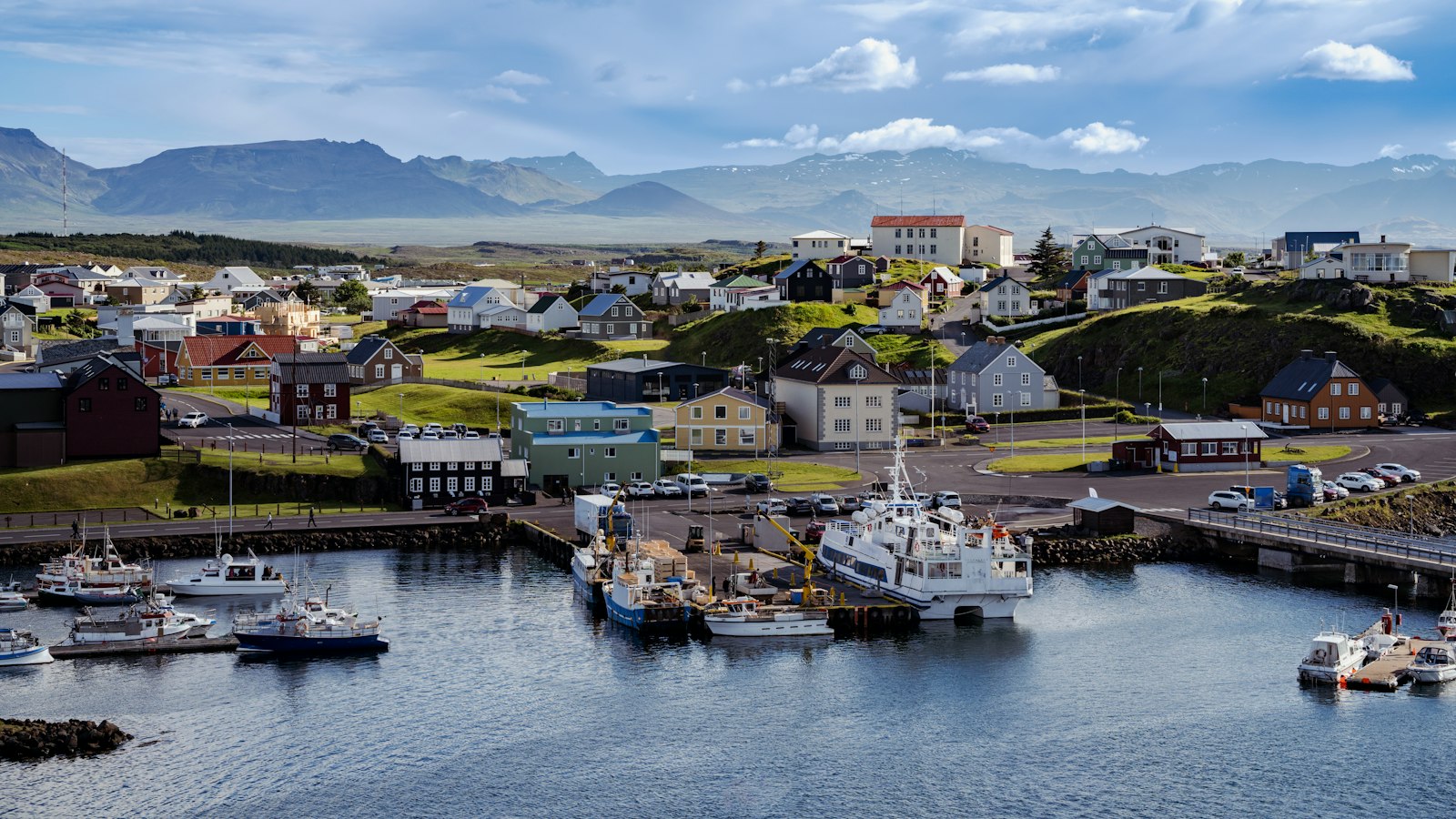
On the windswept west coast of Iceland, about 50 kilometres north of Reykjavík, lies the town of Akranes. Today, more than eight thousand people live here on the peninsula between the Hvalfjörður fjord and Leirárvogur bay, with the prominent Akrafjall mountain as a central feature. While it is now a growing port town, the story of Akranes stretches back well over a millennium.
Ancient roots and modern growth
Settlement in the area began in the 9th century, when two brothers, Þormóður and Ketill, arrived from Ireland. For centuries, Akranes was not a formal settlement but a cluster of farms and seafaring families. It was in the mid-17th century that a fishing village began to form at the tip of the peninsula.
The area’s development accelerated in the nineteenth century as more people arrived to take part in fishing and trade. By 1885, the settlement had grown significant enough that its rural administration was divided in two, reflecting the separate interests of coastal traders and the inland farming community.
Akranes gained official status as a market town (kaupstaður) in 1942, at which point it experienced its swiftest ever population growth. The name Akranes, which originally referred to the entire peninsula, became associated specifically with the town.
Economy, industry and daily life
Fishing remains the key livelihood in Akranes, as it has for generations. The town also serves as a central hub for the rural districts nearby. Industrial activity has grown significantly in recent decades. A cement factory began operating in the 1950s and remains a major employer. In 1998, an aluminium smelter began production at Grundartangi, just outside the town, marking another phase of industrial development.
A significant development in recent history was the completion of the Hvalfjörður Tunnel in 1998. At 5.77 kilometres in length, this underwater road route greatly improved access to Reykjavík and ended the need for a ferry crossing between the two towns. As transport connections improved, the town has continued to grow.
Akranes has a subarctic climate, with only July and August bringing average temperatures above 10°C. Despite the brisk weather, community life thrives. The town provides schooling options including preschools, two primary schools and a comprehensive secondary school. Akranes is also home to a school band, contributing to its cultural life.
A community known for football and the arts
Akranes boasts a proud football heritage. Íþróttabandalag Akraness (ÍA), the local team, has long ranked among Iceland’s best clubs. Notable footballers such as Ríkharður Jónsson and Siggi Jónsson hail from here, the former also managing and playing for ÍA. The town’s commitment to football is further expressed through Knattspyrnufélagið Kári, the second division club.
The arts have roots here too. The Atom poet Jón Óskar and writer Eva Björg Ægisdóttir are among Akranes’s most recognised cultural figures. This combination of sports, industry, and literary tradition helps define the spirit of a coastal Icelandic town that continues to grow alongside the waves.
Sources
- Wikipedia
- Wikipedia (Icelandic) in Icelandic


