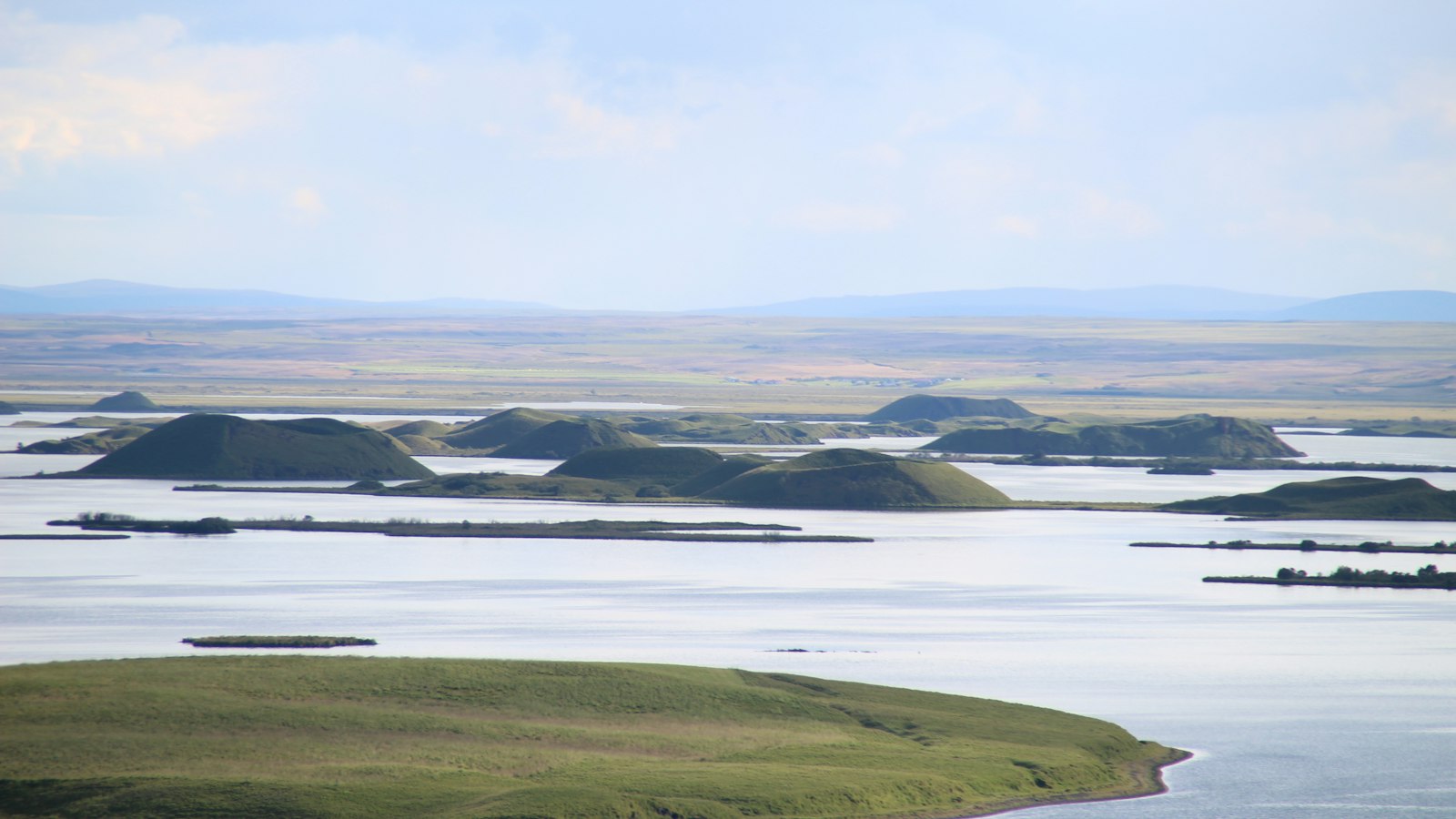
Iceland’s remote landscapes are not just defined by their volcanoes and glaciers, they are also home to species found nowhere else on Earth. Among these is Confluaria islandica, a species of tapeworm whose entire known existence is limited to Lake Mývatn in northern Iceland. This slender parasite infects only the horned grebe, a waterbird whose own story mirrors the island’s themes of isolation and unique adaptation.
A parasite shaped by island isolation
Unlike their continental relatives, Icelandic horned grebes face little competition or company from other grebe species. On the Eurasian mainland, several grebe species live side by side and frequently share parasites, a process known as parasite exchange. This overlapping of hosts usually prevents any one parasite from specialising too much. In Iceland, however, the horned grebe stands alone, not just as a species but as a population distinct from mainland birds both morphologically and ecologically.
This ecological separation has allowed Lake Mývatn’s grebes to develop their own set of parasites, a rarity in the animal world. Scientists have so far described two parasite species found only in these birds: Petasiger islandicus, a type of fluke, and Confluaria islandica, a tapeworm described in 2008. Both underline how isolated populations can accumulate entirely unique biological communities.
A closer look at Confluaria islandica
Confluaria islandica is a slender tapeworm, measuring between 40 and 57 millimetres long and just 0.2 to 0.3 millimetres wide. Its body, or strobila, gradually tapers and contains a complex arrangement of muscular and reproductive structures. The head (or scolex) is tiny, bearing suckers and a short, conical rostrum.
The parasite’s distinctive features include a muscular, thick-walled genital atrium divided into male and female canals, a uniquely structured rhynchus covered in specialised microscopic structures, and a very short, cylindrical copulatory organ that narrows at the tip. Its reproductive system boasts three compact lobed testes and a sacciform (sac-like) uterus that fills with large, oval eggs as it develops.
Confluaria islandica spends its life in the gut of its host, absorbing nutrients and completing its reproduction cycle entirely within the horned grebe. Its presence is so restricted that, despite studies of grebes elsewhere, it has not been recorded outside Lake Mývatn.
This hyper-local parasite is another example of Iceland’s tendency to foster life that is both isolated and intricate, shaped not only by geological forces but also by the quiet separation of lakes and bird communities among the island’s volcanic landscapes.