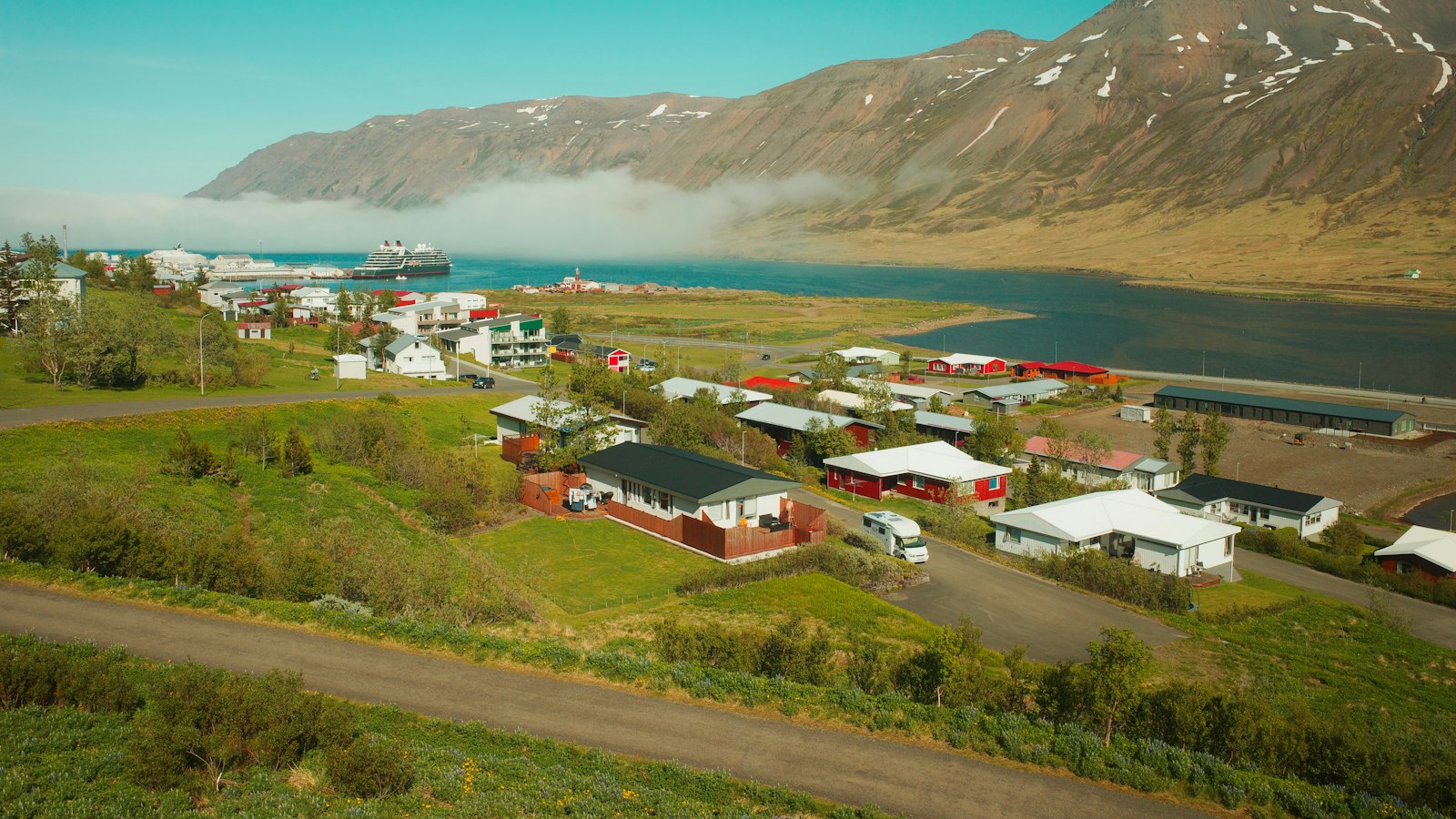
On the south bank of Dýrafjörður, framed by windswept mountains, the settlement of Þingeyri has quietly persisted as one of the Westfjords’ oldest communities. While its population was 246 at the beginning of 2019, numbers remain modest, with just over 260 residents reported by 2024. Despite its size, Þingeyri’s history weaves together assembly, trade, and fishing traditions that stretch back centuries.
Þingeyri’s name links to its likely role as the site of a local medieval assembly, the “þing.” Local lore and archaeological remains, such as the stone ruins of an old booth, lend weight to this association. Such gatherings fostered trade, decision-making, and community among the scattered farms of the peninsula.
From trading post to fishing hub
The settlement has been inhabited continuously since 1787 and became the first official trading post in the region. Already by the mid-19th century, a small township had begun to form. A warehouse from the 18th century still stands as a reminder of these trading foundations. This strategic location along the sheltered Dýrafjörður helped Þingeyri develop into a fishing centre, spurred in part by rich local fisheries.
International interest in Westfjords fishing emerged in the 19th century as well. While a French request to establish a fishing base at Þingeyri was declined, American fishermen used the harbour as their base for halibut fishing from 1884 to 1898. Fishing, processing, and related services have continued as the backbone of local life. The company Vísir was a mainstay until 2014, succeeded by Íslenskt sjávarfang.
Craft, community and modern links
Notably, Þingeyri hosts the oldest continuously operating machine workshop in Iceland: Vélsmiðja GJS, founded in 1913. Now part of the regional heritage museum, it still takes on select jobs, and the workshop has changed little since 1995.
The social fabric of the village includes the school, which marked its 110th anniversary in 2007, and Þingeyrarkirkja church. Construction of the church started in 1909 and it was consecrated in 1911. It was designed by Rögnvaldur Ólafsson, an architect from Dýrafjörður, with an altarpiece painted by the artist Þórarinn B. Þorláksson.
Þingeyri became part of the larger Ísafjarðarbær municipality in the mid-1990s, after a local merger. The vote in Þingeyri saw 130 in favour and 71 against, the lowest approval of the six communities involved.
For its small size, the village also holds a place in Iceland’s modern history: former president Ólafur Ragnar Grímsson spent part of his youth here with his grandparents. Today, a short distance away, the mountain Sandafell draws visitors and locals seeking panoramic views by foot or car.
Þingeyri’s climate lies between subpolar oceanic and continental subarctic, underscoring the hardy character of life at the edge of the North Atlantic.
Sources
- Wikipedia
- Wikipedia (Icelandic) in Icelandic


