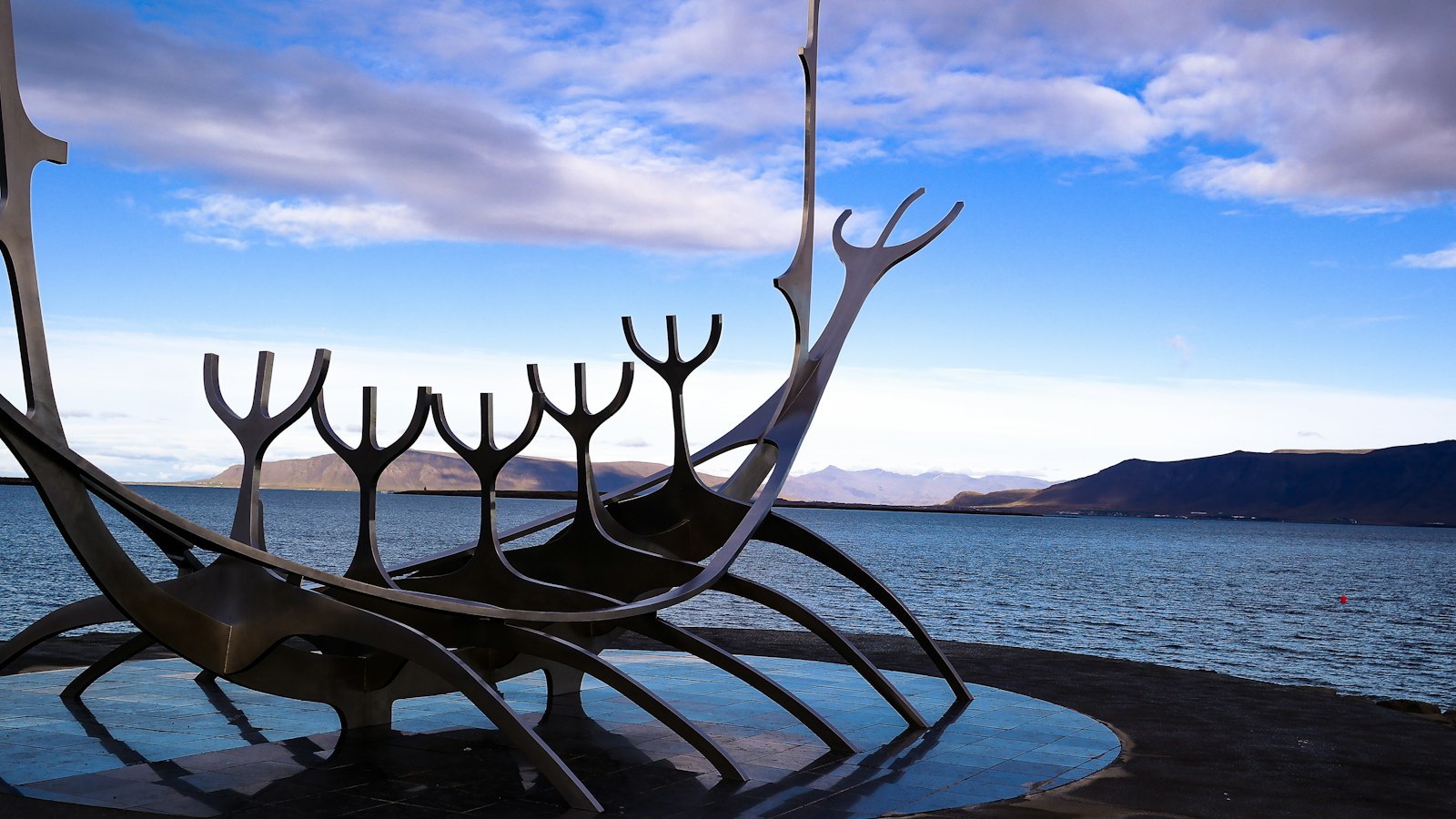
The lore of the sunstone, or sólarsteinn in Icelandic, offers a rare intersection of science and symbolism in medieval Icelandic culture. This enigmatic mineral appears not only as a physical object in church inventories and seafaring hypotheses, but also as a richly layered symbol in some of the most allegorical sagas of the Middle Ages.
A stone that showed the hidden sun
References to the sunstone date largely from the 13th and 14th centuries, with mentions in Icelandic sagas such as Rauðúlfs þáttr and Hrafns saga Sveinbjarnarsonar. The stone’s most intriguing description comes from Rauðúlfs þáttr, a tale that aligns the mineral with Saint Olav of Norway. According to this story, the sunstone could reveal the sun’s location in even the bleakest weather, when sky and snow hid any trace of its position. By holding the stone up to an overcast sky, an observer would see a light pattern through, on, or from the mineral. While the text’s exact meaning is debated, the underlying idea is that the sunstone allowed its user to determine the sun’s position when ordinary sight failed.
Details of the sunstone’s physical properties are rare in medieval texts, but its status as an object is reinforced by its listing in Icelandic and German church and monastery inventories from the 14th and 15th centuries. These listings suggest the sunstone was not only legend but also a valued possession, potentially used for more than symbolic purposes. Some propose it played a role in keeping canonical hours, an important aspect of monastic timekeeping, particularly in Iceland’s variable daylight.
Scientific theories and stubborn mysteries
Modern research has revived the hypothesis that the sunstone may have been used for navigation, especially by Viking seafarers in polar conditions. Danish archaeologist Thorkild Ramskou suggested in the 20th century that minerals known to polarize light, such as Iceland spar or cordierite, could let navigators find the sun’s azimuth with surprising accuracy, sometimes within five degrees. Recent studies have tested methods whereby a crystal functions as a polarizing filter, making visible the sky’s polarization pattern even when the sun is hidden or just below the horizon. Crystals may have helped sailors tell direction when a magnetic compass was unreliable, such as near the Labrador coast or during Iceland’s long summer twilight.
The idea remains debated. Experiments with modern Iceland spar have sometimes failed to reproduce the purported navigational cues, and the specific expertise required to use such minerals effectively has not been fully reconstructed. Yet the recovery in 2002 of a piece of Iceland spar, a transparent form of calcite, from a 16th-century shipwreck near Alderney hints that some tradition of using polarizing crystals outlasted even the adoption of the compass.
In medieval literature, however, the sunstone’s role is dense with allegory. In Rauðúlfs þáttr, the house that Saint Olav visits is itself a cosmic symbol, while Hrafns saga Sveinbjarnarsonar intertwines the sunstone with celestial visions. Scholars have linked the sunstone as a metaphor to the Virgin Mary, reflecting traditions where glass is compared to the virgin birth, allowing the sun’s ray through without breaking her purity. In these instances, the sunstone’s function as a material device blends with its power as a symbol of revelation and guidance.
Sources
- Wikipedia
- Wikipedia (Icelandic) in Icelandic