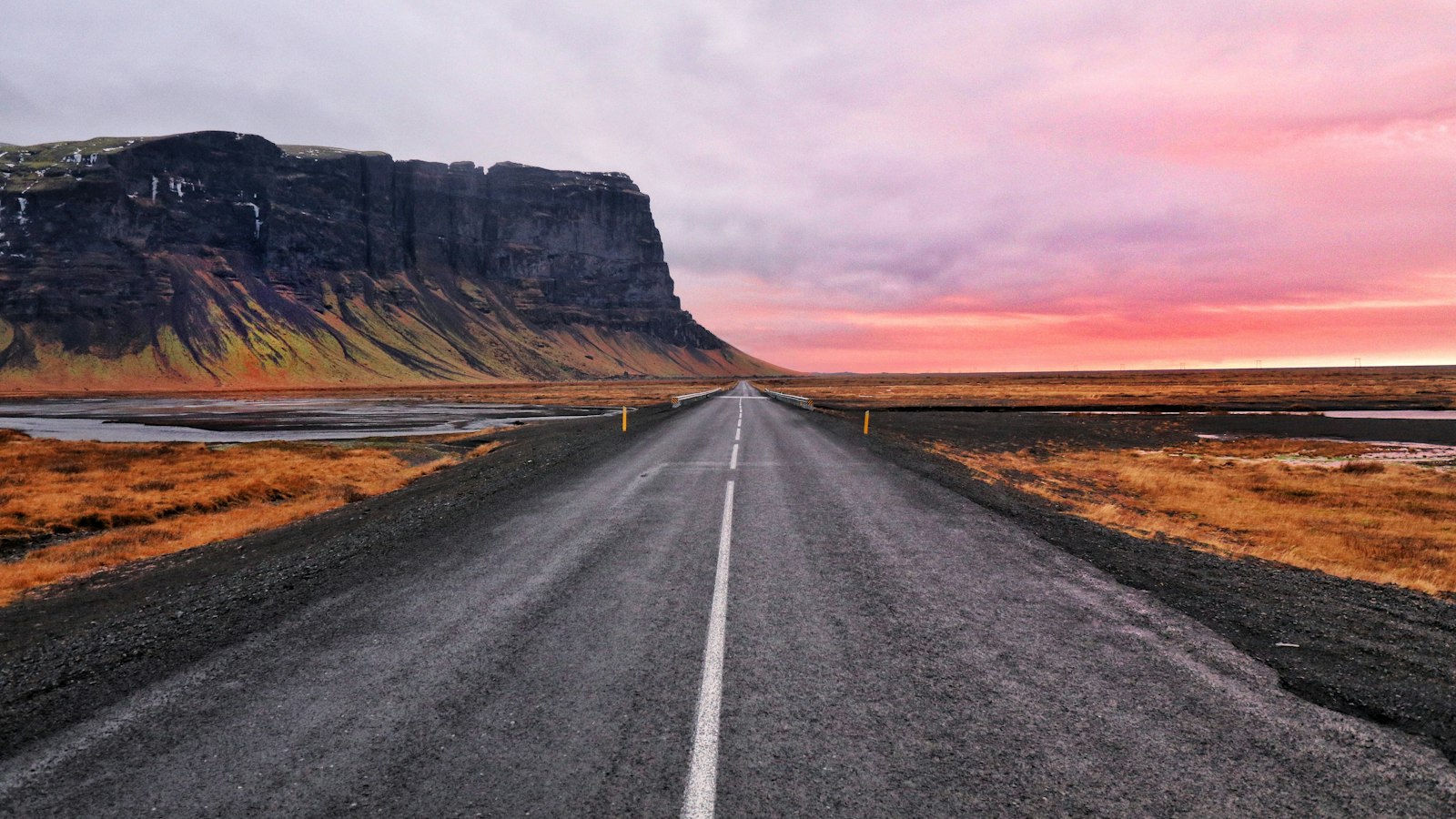
In southern Iceland, where the vast black sands of Skeiðarársandur spread out toward the horizon, a dramatic ridge called Lómagnúpur rises above the flat terrain. With sheer cliff faces reaching up to 671 metres, it is recognised as the highest vertical rock wall in the country, and stands as a striking boundary between the lowlands and the interior.
Layers of volcanic and glacial history
Lómagnúpur is not an ordinary peak. This north–south oriented ridge reaches its summit at 764 metres above sea level, formed primarily from palagonite, a volcanic rock created when lava interacts with water or ice. The mountain also reveals dark bands of pillow lava and impressive basalt columns embedded in its cliffs. These geological layers tell a complicated story: the lower strata are about 2.5 million years old, while the youngest upper layers are roughly 1.5 million years old. Over a million years, volcanic eruptions and glacial forces built up Lómagnúpur, slotting it firmly into Iceland’s long geological timeline.
At different times in its past, Lómagnúpur stood close to the sea. After the last ice age ended ten thousand years ago, the coastline reached the slopes of the mountain, where the pounding waves shaped its form and left marine traces. Since then, the rivers on the sands, including the Núpsvötn east of the mountain, have filled in ancient fjords, gradually extending the shore further south.
Earthquakes, landslides and cultural echoes
Lómagnúpur bears scars left by natural disasters. Two or three major landslides are evident on its flanks, with the most striking falling from a height of 600 metres down onto the sands during an earthquake in July 1789. Its massive debris field still lies near the modern Route 1, Iceland’s ring road, which now skirts the southern side of the mountain and plays a central role in connecting east and west Iceland.
Beyond the realm of geology, Lómagnúpur stands tall in Icelandic cultural memory. The Njáll saga, one of Iceland’s most famous medieval epics, tells how Flosi, who has killed Njáll, dreams of a giant striding from the mountain and calling his men to their fate. This scene resonates in Icelandic poetry as well; the writer Jón Helgason references Lómagnúpur’s brooding cliffs and the iron-staffed giant in a well-known poem, evoking the mountain’s dramatic place in both landscape and legend.
Sources
- Wikipedia
- Wikipedia (Icelandic) in Icelandic


