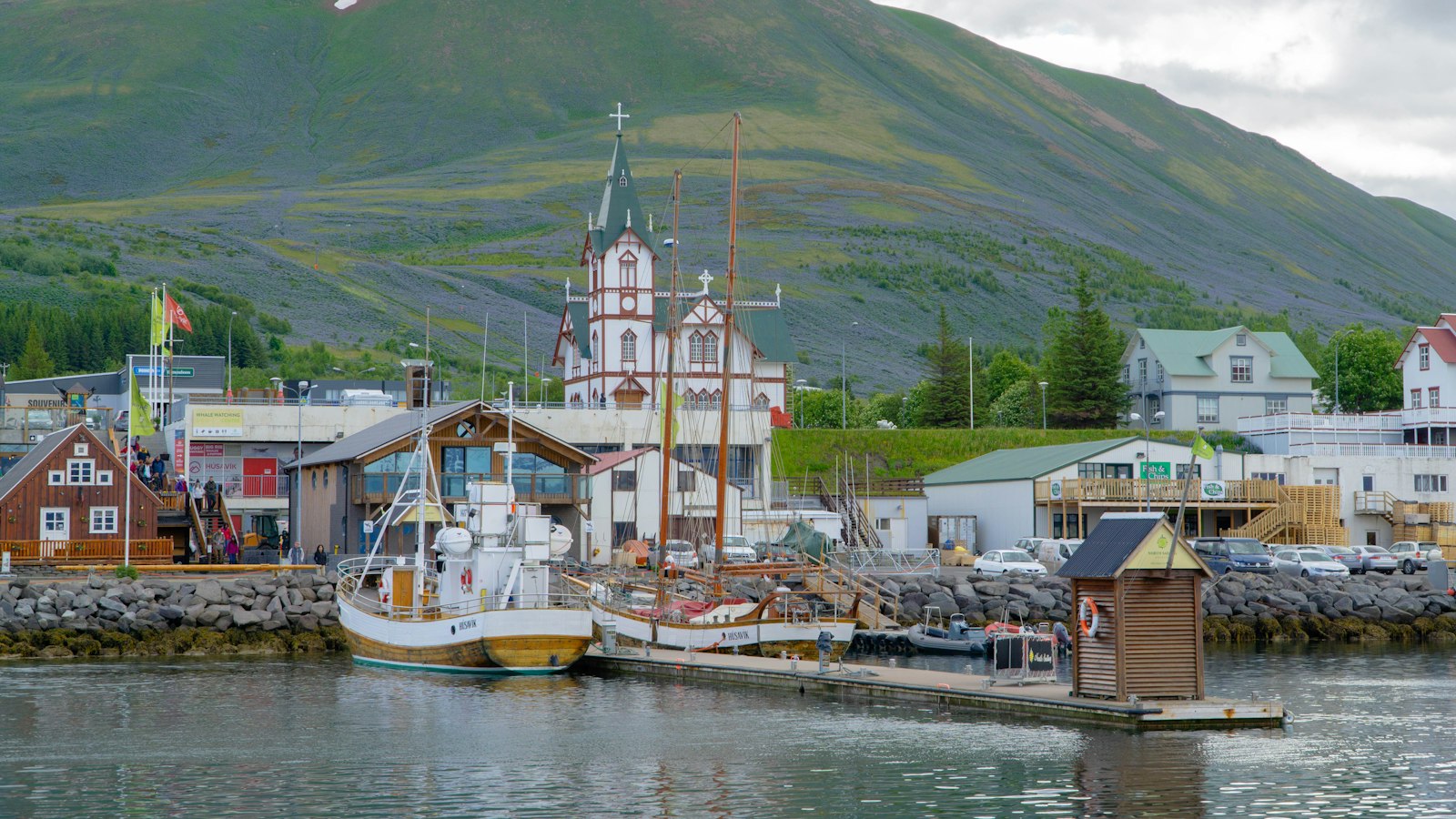
Húsavík stands on the northeast edge of Iceland, facing Skjálfandi bay, with a population of just under 2,500. This small town has a long and eventful past, its story woven into Iceland’s earliest recorded history and continuing through to today as a lively hub of northern life.
According to the medieval Book of Settlement, a Swedish Viking named Garðar Svavarsson spent a winter here around the year 870. When he moved on in spring, he left behind three people who went on to form a permanent community. The town’s name means “bay of houses”, likely referring to the original homestead, a rare presence in Iceland at that time.
Fishing and tourism have long provided the backbone of the local economy, joined by retail and small industries. For much of the late twentieth century, Húsavík also served as the shipping point for silica mined at Lake Mývatn, until operations ended in 2004.
Whale watching is a major draw for the town, since Skjálfandi bay attracts a variety of whale species. The Húsavík Whale Museum, located by the harbour, offers a closer look at marine life and local history. Other museums also tell the wider story of the area: one features everything from historic boats to the mounted polar bear that arrived on the nearby island of Grímsey in 1969; the Exploration Museum focuses on human journeys, including a monument to Apollo astronauts who trained in the region in the 1960s. The Eurovision Museum, which officially opened in 2022, celebrates the international song competition and the 2020 Netflix film that spotlighted the town.
Húsavík’s landmark is its wooden church, Húsavíkurkirkja, completed in 1907. The town’s schools include primary, secondary, and music education, with an active brass band. The local football club, ÍF Völsungur, once played in the national top league, and residents enjoy a range of recreational options, including hiking, swimming, and golf.
Traditions, daylight and global connections
A burst of colour arrives each mid-July, with thousands gathering for Mærudagar, or “Candy Days”. The festival brings music, food, and cheerful decorations, transforming Húsavík’s streets into a centre for celebration.
Húsavík experiences midnight sun each June, with daylight lasting around the clock for several weeks. In midwinter, daylight hours shrink to less than three, but complete darkness, or polar night, does not occur. The town sits beneath Húsavíkurfjall mountain, looking out toward distant islands and mountains across the bay, with vistas reaching as far as Grímsey on clear days.
Direct flights to Reykjavík once linked Húsavík Airport to the capital, but these ended after a new tunnel dramatically shortened travel time to Akureyri. Today, bus routes provide regular connections. International ties run deep, with sister city partnerships stretching across the Nordic countries, Greenland, the Faroe Islands, and as far as Maine in the United States.
Sources
- Wikipedia
- Wikipedia (Icelandic) in Icelandic


