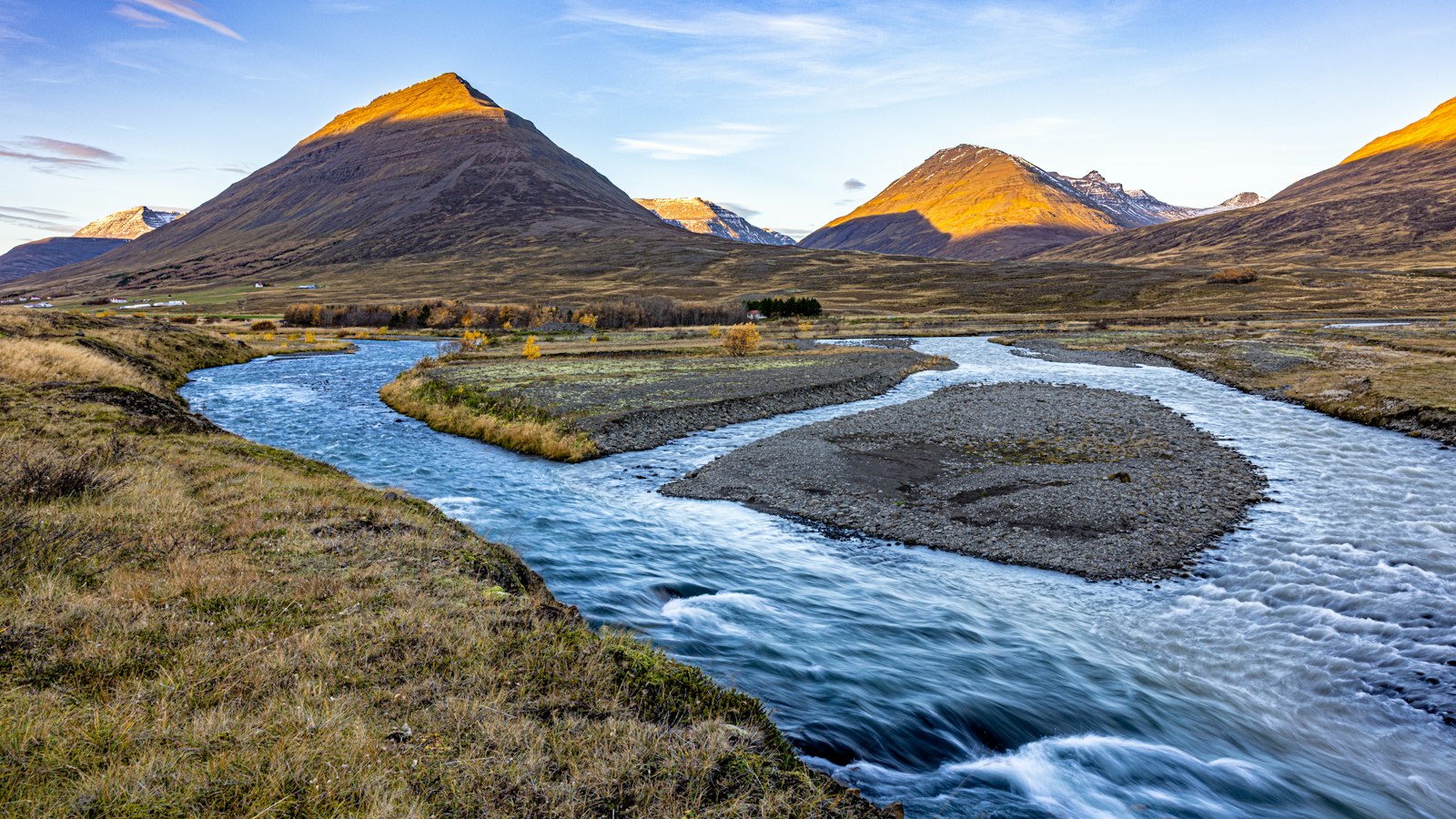
In the north of Iceland, a striking conical spire rises above the Drangafjall ridge, serving as both a geological landmark and a touchstone for local legend. Known as Hraundrangi, a name derived from the nearby Hraun farm, this peak stands out against the sky with its pointed summit, found where the valleys of Öxnadalur and Hörgárdalur meet.
A relic of volcanic and glacial history
Hraundrangi’s formation is rooted in a dramatic geological past. The slender rock tower, remaining from an original formation called Háafjall, was shaped over centuries after much of the mountain collapsed in a large rockslide. What endures today is a column of lava, an unusual feature whose peak covers less than half a square metre. From its base at the ridge, the spire rises 80 metres, reaching 1,075 metres above sea level.
Despite its solitary presence, the crest is sometimes mistakenly called Hraundrangar, a plural form. However, the spire is unique, offering a distinct outline viewable from both surrounding valleys. On the Öxnadalur side, it is most commonly referred to by its full name.
Climbing, poetry and myth
For many years, Hraundrangi was believed to be impossible to climb. That changed on 5 August 1956 when Finnur Eyjólfsson and Sigurður Waage from Iceland, together with United States Air Force Lieutenant Nicholas Clinch, made the first documented ascent. Local tradition held that a treasure was hidden on its summit, but the climbers reported no such discovery.
Hraundrangi is also embedded in Icelandic literature. The poet Jónas Hallgrímsson, born at the Hraun farm beneath the peak, referenced the spire in his final work, ‘Ferðalok’ (‘Journey’s End’). In its verses, he connects the landscape with themes of longing and transition, while alluding to oral tales about the saga hero Grettir the Strong, who, according to legend, reached the top and left personal items there as proof, Hraundrangi was at times called Grettisnúpa, or Grettir’s Crag.
The spire’s silhouette is familiar in Iceland’s cultural imagery. Since October 2013, it has appeared as a background motif on the 10,000 krónur banknote, honouring Jónas Hallgrímsson and symbolically tying together poetry, language and landscape.
Sources
- Wikipedia
- Wikipedia (Icelandic) in Icelandic


