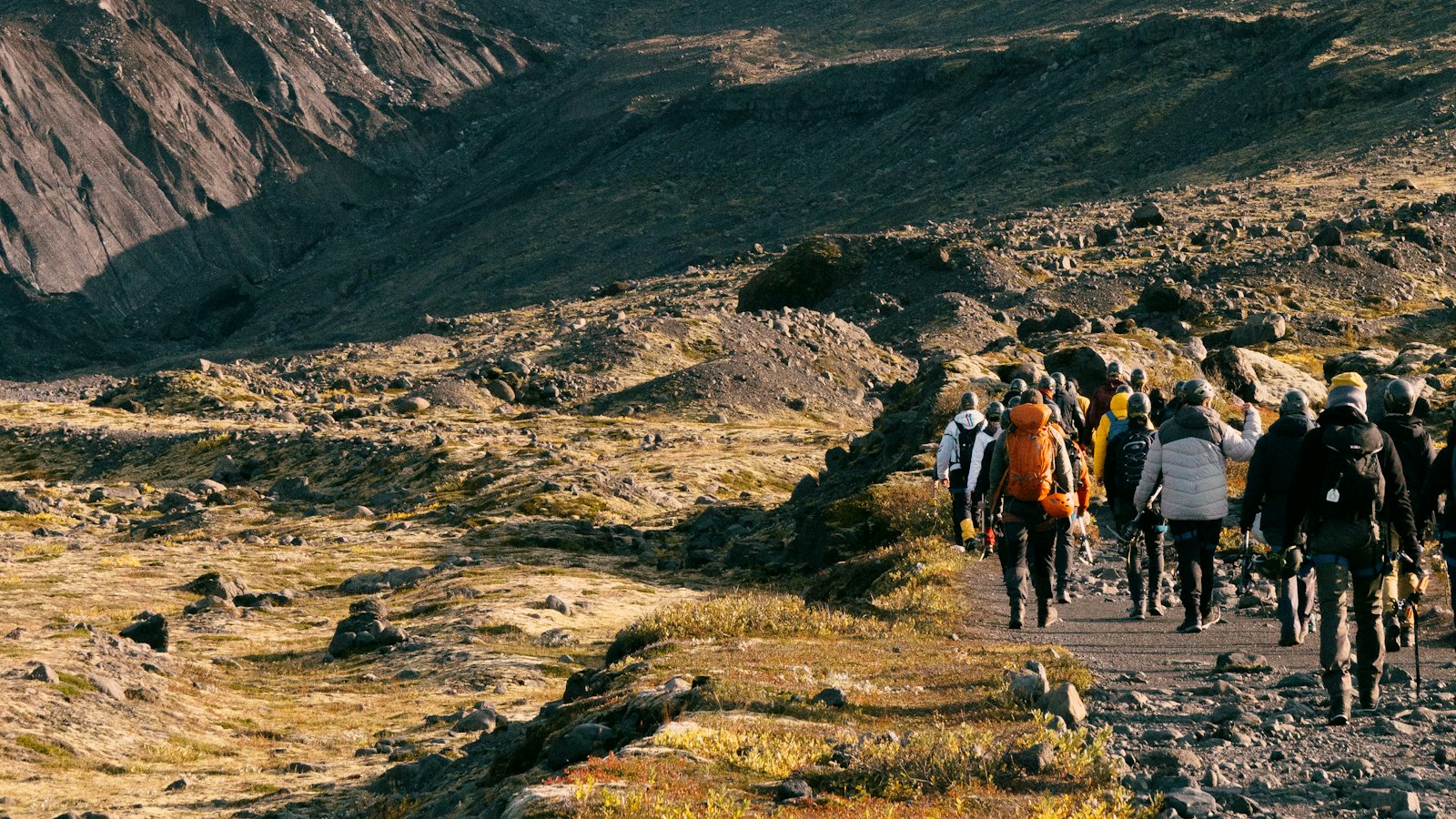
In the heart of Iceland’s highlands, a duo of prominent volcanoes lies beneath one of the country’s broadest ice masses. The Hofsjökull volcanic system, sometimes known as Hofsjökull-Kerlingarfjöll, spans an expanse between major geological boundaries. Though its surface glistens with ice, deep heat and ancient geological forces are at work.
Iceland’s largest hidden crater
The main central volcano, Hofsjökull (meaning “temple glacier” in Icelandic), is notable as Iceland’s largest currently active central volcano. Its vast glacier, atop the volcano itself, measures roughly 900 square kilometres. Beneath the icecap, a deep volcanic caldera, between six and seven kilometres wide and about 600 metres deep, forms part of the hidden landscape. The icecap’s highest point reaches 1,782 metres. Around the caldera, rocky peaks, nunataks, rise above the ice, some standing as high as 1,628 metres, with the rim itself likely slightly higher still.
Kerlingarfjöll, another central volcano to the south, has a history of erosion and uplift. Though it has not seen eruption in recent millennia, it remains chemically complex, with both basalt and rhyolite deposits. Its age is estimated between 68,000 and 350,000 years, giving it a presence grounded in a much earlier volcanic era.
Geology and gentle rumblings
The Hofsjökull volcanic system is marked by intersecting fissure swarms: long cracks in the earth’s crust, extending notably northward and southward from the central volcano, crossing the barren interior of Iceland for up to 40 kilometres in the north and 30 in the south. These fissure zones show evidence of both ancient volcanic activity and current geological stress, radiating away from the central system. Periodic earthquake swarms have occurred on the flanks of the Hofsjökull volcano in recent decades, though the overall activity is considered modest for Iceland.
A striking event took place in the summer of 2013 when a flood of meltwater (known as a jökulhlaup) loaded with sulfurous materials burst from the glacier, forming a new ice cauldron near the northeast edge of the caldera. Yet, the last eruption of flowing lava in this region occurred somewhere between 3000 and 4500 years ago, just north of the present-day ice cover. The surrounding landscape preserves evidence of even older lava flows dating back up to 7,000 years.
Geothermal action continues beneath the ice and in the unfrozen highlands, with hot springs and heated ground near Hofsjökull and extending to Kerlingarfjöll, hinting at ongoing subterranean energy.
All this takes place where major tectonic plates and microplates converge. The area sits at the junction of the North American and Eurasian plates, as well as the Hreppar microplate. With the Iceland hotspot supplying deep thermal energy, the Hofsjökull system represents a quiet powerhouse, demonstrating the interplay of ice, fire, and shifting crust in Iceland’s interior.


