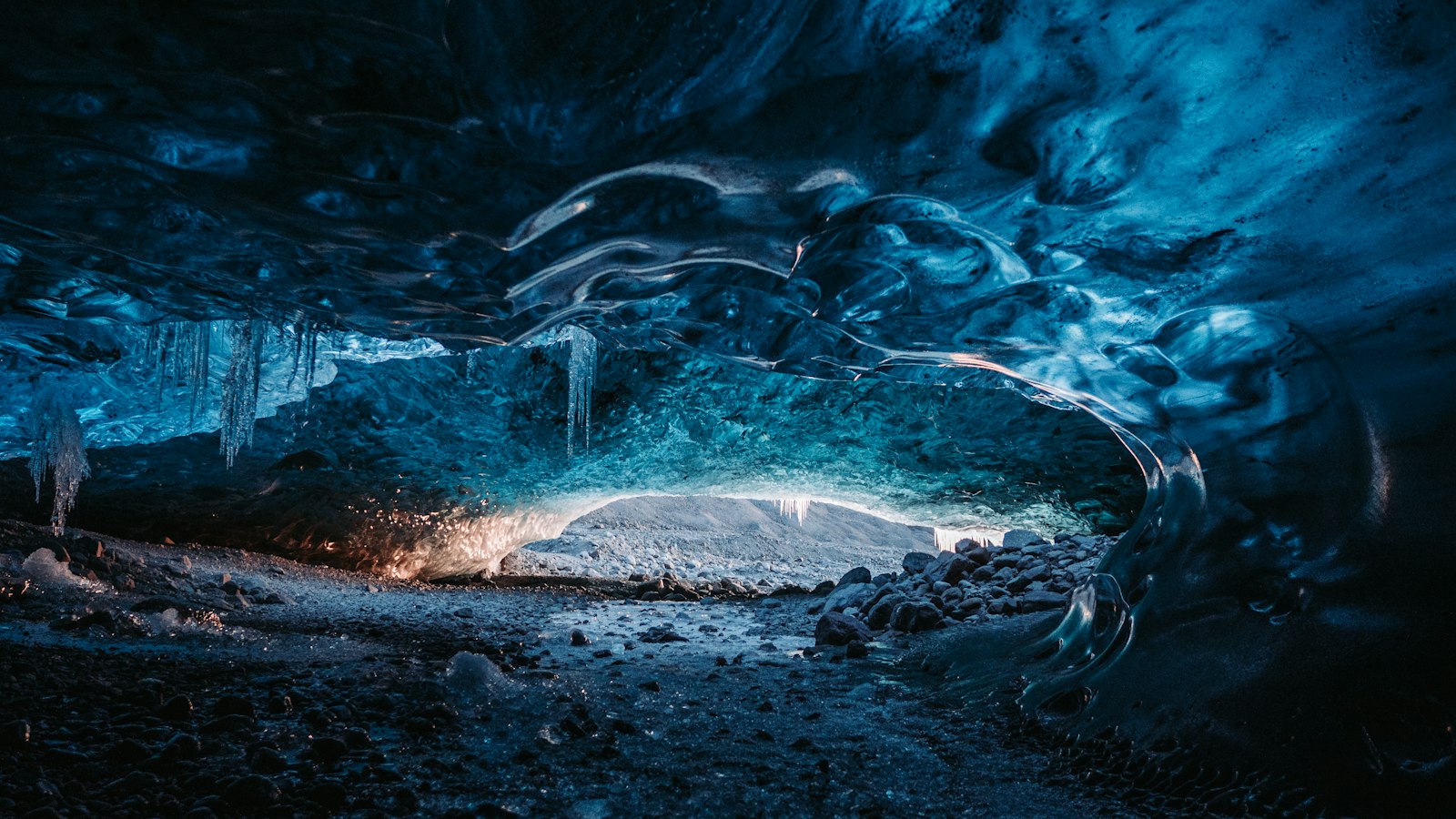
Hidden beneath the massive Vatnajökull ice cap in southeast Iceland is Grímsvötn, an active volcano that holds the record for the country’s most frequent eruptions. Its Icelandic name means “Grímur’s waters,” referencing both its partially subglacial location and the folklore that surrounds it. The volcano sits entirely under the glacier’s northwestern sector and reaches an elevation of 1,725 metres.
Cycles of ice and fire
Grímsvötn’s central caldera is submerged beneath the glacier, where volcanic activity constantly interacts with deep layers of ice. These eruptions are often explosive, as hot basaltic magma meets vast stores of meltwater. A hallmark of Grímsvötn’s activity is the recurring phenomenon known as jökulhlaup, catastrophic glacial floods. These outbursts can be triggered when geothermal heat or eruptions melt ice, causing huge volumes of water to accumulate until the pressure abruptly lifts the overlying glacier, releasing a torrent downstream. Such floods have repeatedly washed over the lowland sandur plains and occasionally forced closures of critical infrastructure like Iceland’s main ring road.
Scientific monitoring at Grímsvötn is intense, in part due to its turbulent history. From 7600 years ago, studies show the volcanic system has averaged around seven major eruptions per century. Major events have occurred as recently as 2011, when the volcano produced an ash plume that reached 20 kilometres high, spreading ash over much of northern Europe and causing travel disruptions.
Volcanic systems and legendary tales
Grímsvötn is part of a much larger volcanic system, linked to the famous Laki fissure, which saw a devastating eruption in 1783–1784. The Laki event created lava flows that blanketed large parts of southeastern Iceland and impacted climate across the northern hemisphere. The Grímsvötn system also connects with the Thordarhyrna (Þórðarhyrna) central volcano, and there is some evidence of geological interaction with nearby Bárðarbunga, another subglacial volcano.
Geochemical research distinguishes the lavas of Grímsvötn from those of its neighbours, although recent history has revealed complex interactions between their magma systems. The area is also home to subglacial lakes that, due to constant volcanic heat, remain liquid year-round. In 2004, scientists discovered unique bacteria surviving in these hidden waters, prompting speculation about analogues on other icy worlds like Mars.
The volcano’s name appears in sources from the sixteenth century, though the origins are debated. Folktales collected in the nineteenth century tie Grímsvötn to a legendary outlaw named Grímur, who is said to have survived in the wilderness by its waters, defending himself against trolls. Today, these stories are classified as myth, but they remain a colourful thread in Iceland’s cultural tapestry.
Sources
- Wikipedia
- Wikipedia (Icelandic) in Icelandic


