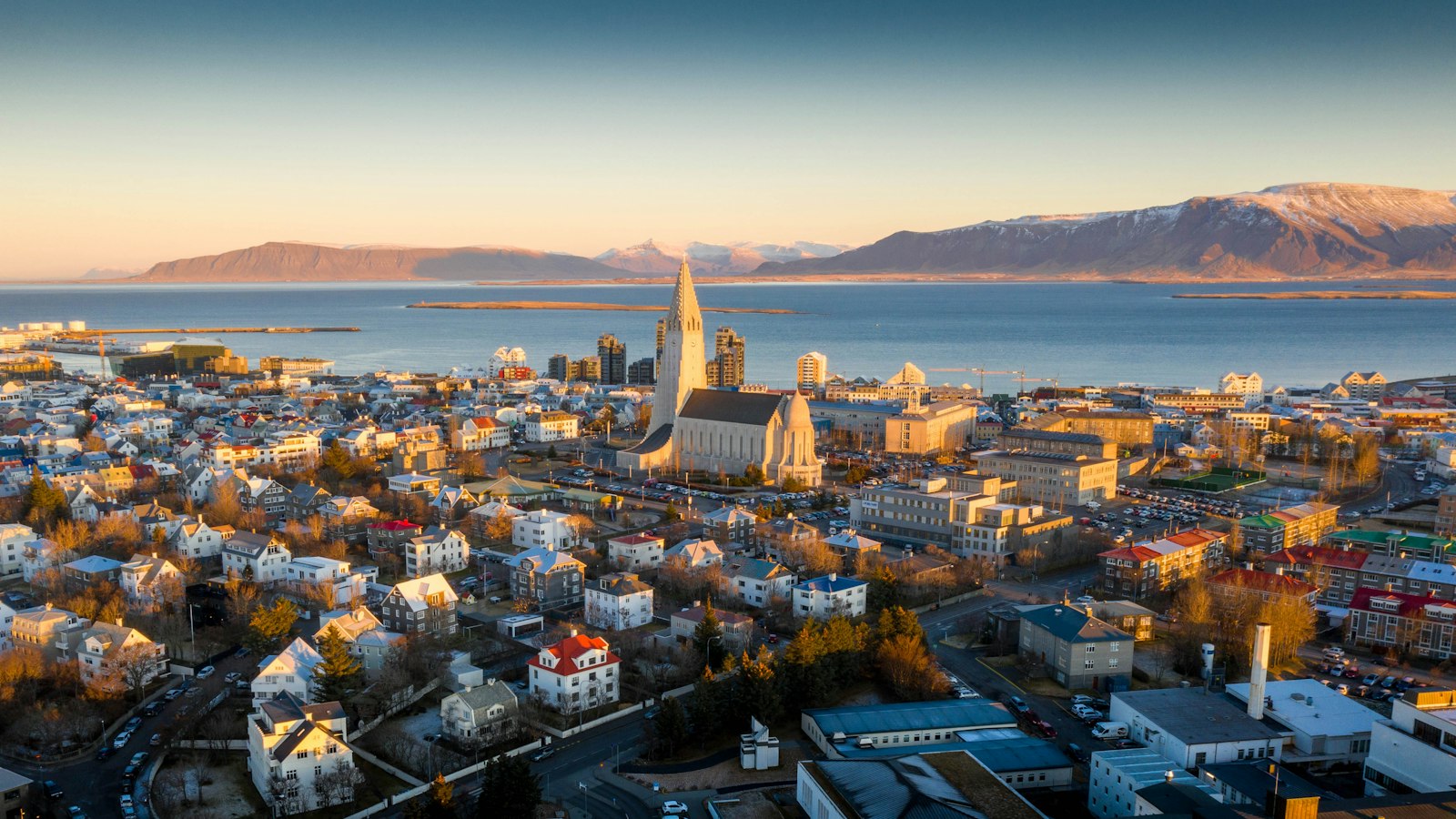
Austurvöllur lies in central Reykjavík, a green square bordered by some of the city’s most important streets and historic buildings. Its location has made it a natural centre for gatherings, discussions and moments of collective expression among residents of Iceland’s capital.
Public gatherings and daily life
This open space is especially lively during warm spells, when people of all ages fill its grassy areas and outdoor seating at nearby cafés. Establishments on Vallarstræti and Pósthússtræti, flanking the square, often set out tables as soon as the weather allows, and the gentle hum of conversation and laughter carries across the lawns. Along with the Parliament House (Alþingishúsið), Reykjavík’s oldest church Dómkirkjan, and the elegant Hotel Borg, a variety of restaurants and bars line the square, contributing to its role as a communal living room for the city.
Austurvöllur’s current boundaries are defined by four streets: Vallarstræti, Pósthússtræti, Kirkjustræti and Thorvaldsensstræti. Thorvaldsensstræti recalls the artist Bertel Thorvaldsen; a statue of him once occupied the centre of the square before being replaced by the large bronze statue of Jón Sigurðsson. Sigurðsson, who led Iceland’s independence movement, is a highly symbolic presence, facing the Parliament building.
Independence, protest and public memory
Austurvöllur has repeatedly served as the city’s political pulse. Its proximity to Alþingishúsið has often made it the natural location for demonstrations, some of which have become part of the nation’s collective memory. In 1905, thousands assembled here to protest plans for new radio towers. Later in the twentieth century, on 30 March 1949, the square was the site of riots following a decision to join NATO, a moment when police used teargas to disperse crowds.
Most recently, Austurvöllur played a central role during the economic crisis that struck Iceland in 2008. Every Saturday, the organisation Raddir fólksins (Voices of the people) gathered here, calling for the resignation of the government and changes at major national institutions. The protests only ceased after the government stepped down.
The square’s size was once much greater than it is today. In the early 1700s, it stretched all the way from Aðalstræti in the west towards a creek in the east, and from the northern edge near Hafnarstræti down toward Tjörnin pond in the south.
Austurvöllur remains a living part of Reykjavík, where past and present unfold in daily life and public events alike.
Sources
- Wikipedia
- Wikipedia (Icelandic) in Icelandic


