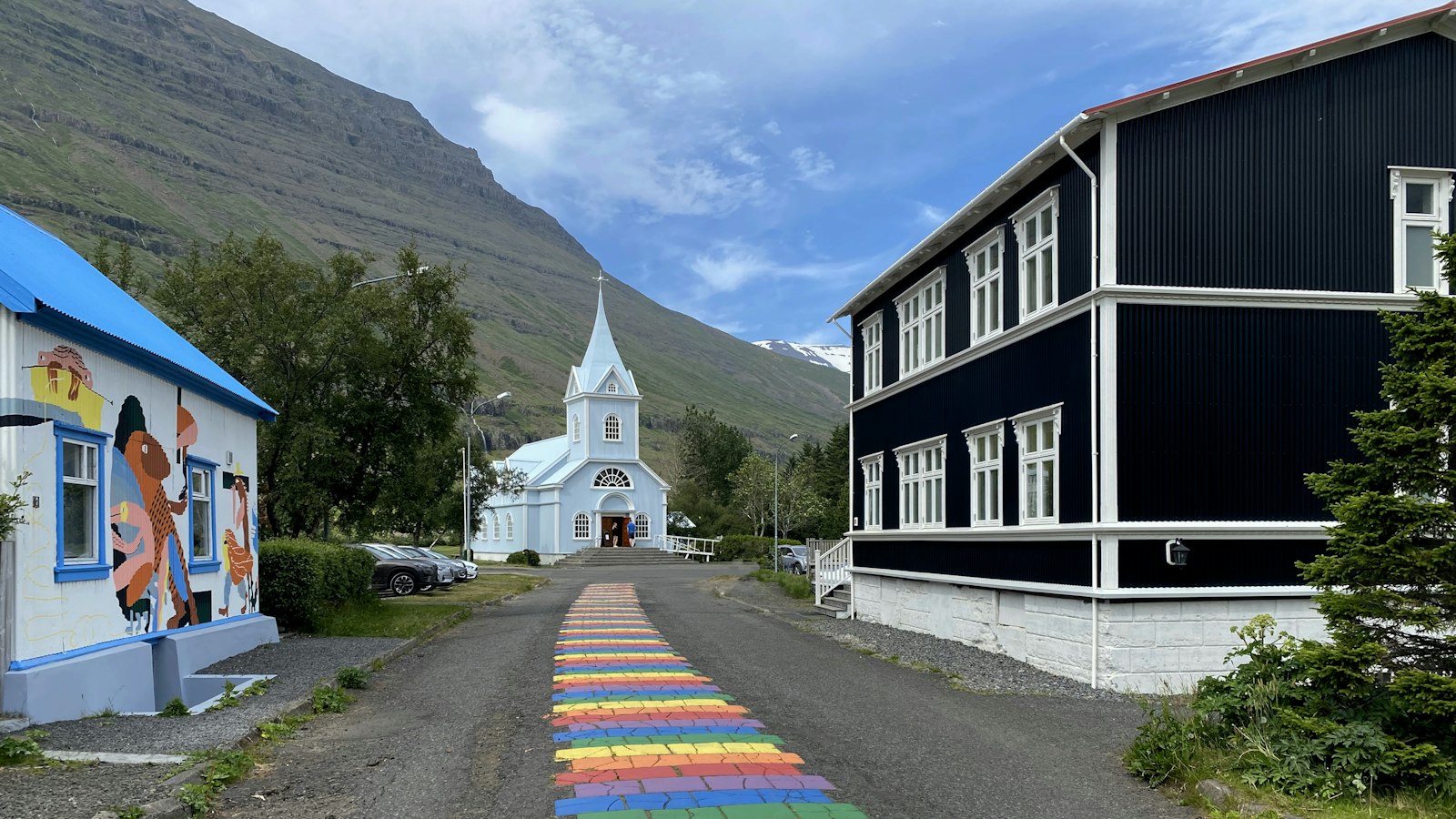
At the end of a long, narrow fjord in Iceland’s east, Seyðisfjörður occupies a unique place in the country’s cultural and historical landscape. Surrounded by peaks on nearly every side, with Mt. Bjólfur rising to the west and Strandartindur to the east, the town sits at the innermost point of its namesake fjord. Although home to only around 650 people in 2024, Seyðisfjörður is known well beyond its population size for its vibrant art scene, its wooden buildings, many with Norwegian heritage, and an enduring connection to sea and land.
A harbour between worlds
The fjord’s natural harbour has long shaped Seyðisfjörður’s role as a transport link. It is the sole Icelandic port welcoming the weekly MS Norröna car and passenger ferry from Denmark and the Faroe Islands, making this the only regular seaway for travellers and vehicles between Iceland and mainland Europe. Since the cable made landfall here in 1906, the town has also held a role as a communications gateway, with the first telegraph link to Europe landing in the town and enabling international messages.
The human story in Seyðisfjörður reaches back to Iceland’s earliest centuries. The fjord’s original settler was Bjólfur, who gave his name to the western mountain. Settlements expanded in the 19th century, when Norwegian fishermen arrived and constructed some of the area’s signature colourful wooden houses. Close by, the now-deserted Vestdalseyri saw the establishment of the world’s first industrialised whaling station by American Thomas Welcome Roys in the mid-1860s, a brief but significant period in north Atlantic maritime history.
Community, creativity and challenge
Much of modern Seyðisfjörður’s life centres around the arts. The Skaftfell Center for Visual Art has become a focal point for exhibitions, international collaborations, and contemporary art, inspired in part by the renowned Swiss artist Dieter Roth, who lived and worked here until his death in 1998. The town has also been home to the LungA Art Festival and LungA School, drawing artists, students and audiences from across Iceland and beyond.
Beyond art, the Technical Museum of East Iceland explores the country’s journey into modernity, housing exhibits on the region’s early advances in electricity, communications and engineering. The Fjarðarselsvirkjun plant, completed in 1913, was not only the first high-voltage alternating current (AC) power station in Iceland but also a lasting part of the town’s infrastructure, with a distribution network for lighting and home use setting local and national milestones.
Seyðisfjörður’s history is also marked by resilience in the face of nature’s force. In December 2020, a series of major mudflows hit the town after relentless rain, a record 570 mm fell within five days. The event destroyed several historic houses and forced a temporary evacuation of all residents, with extensive recovery and new protections later enabling most to return.
Though fishing remains a part of daily life, the town’s economic focus has shifted in recent years. Tourism now weaves together with heritage and creativity, all within landscapes shaped by waterfalls, steep passes, and reminders of past industry. Seyðisfjörður’s setting and energy continue to attract filmmakers, artists, and volunteers to its streets, galleries and hikes, reinforcing its reputation as both a crossroad and a home.
Sources
- Wikipedia
- Wikipedia (Icelandic) in Icelandic


