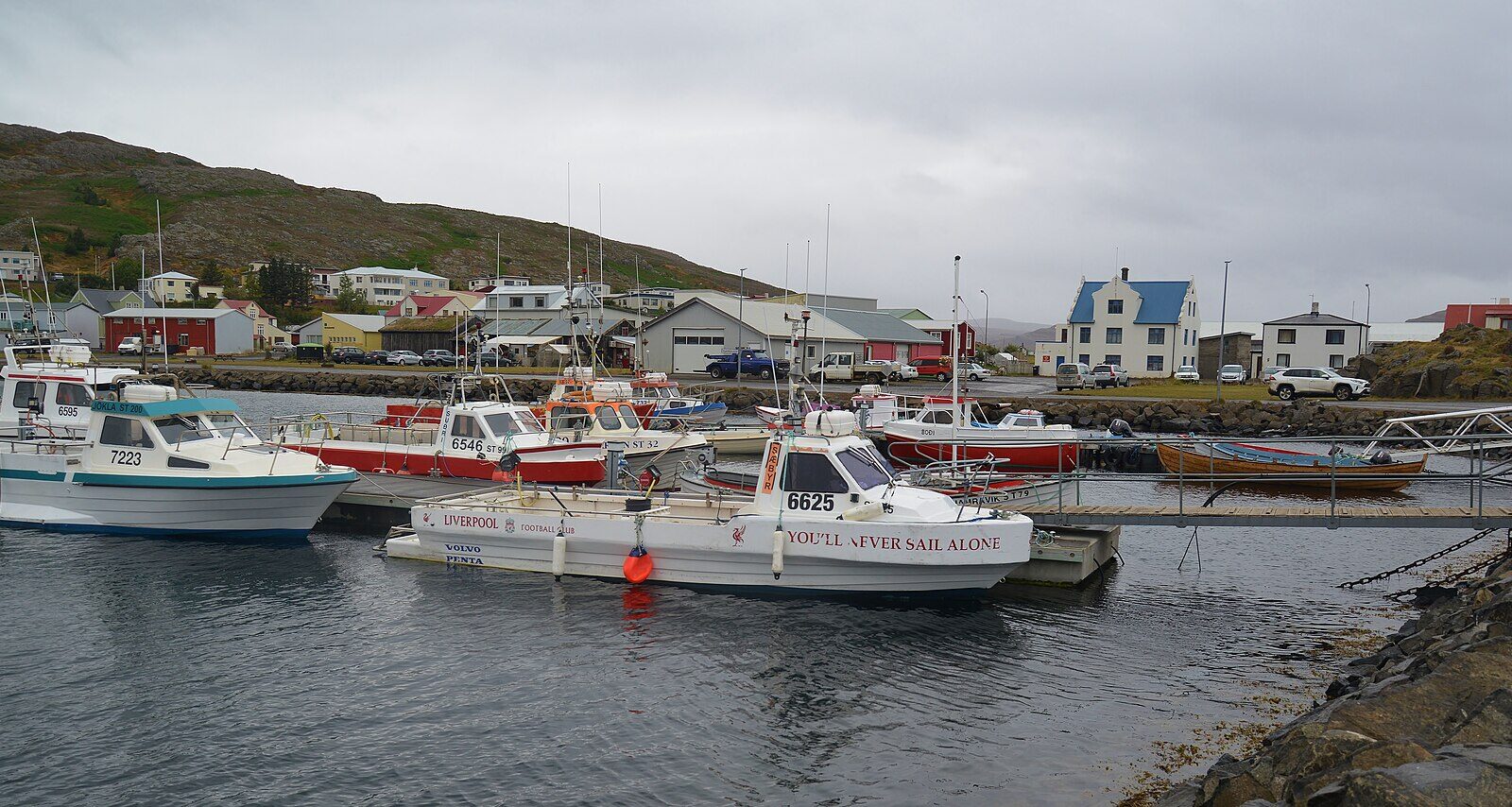
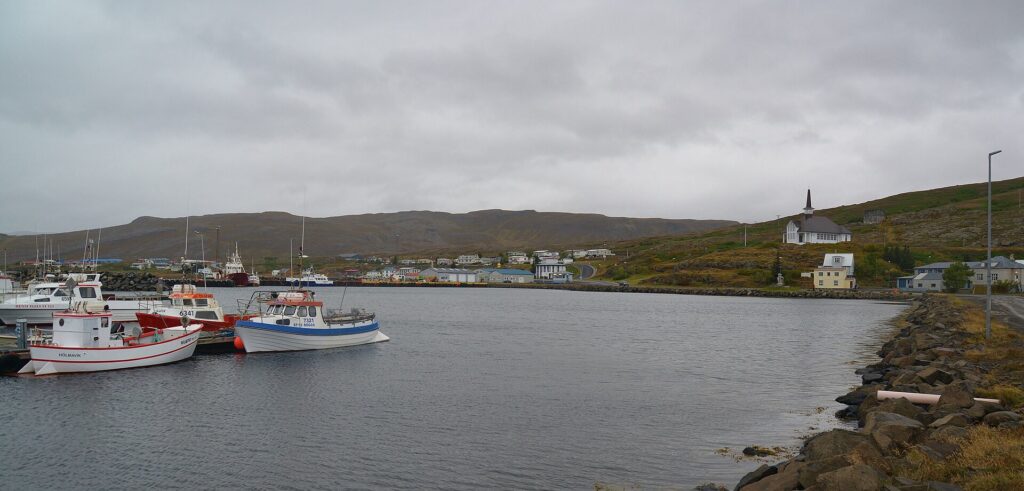
Hólmavík, in the municipality of Strandabyggð, stands on the western edge of Steingrímsfjörður in the Westfjords (Vestfirðir) region of northwest Iceland. As the largest settlement on the Strandir coast, its population is modest, 320 people as of 2018. It acts as the primary trading and service hub for its surroundings, playing a crucial role along a coastline known for its rugged isolation and offering attractions such as the Museum of Icelandic Sorcery and Witchcraft.
From fishing outpost to county centre
The origins of Hólmavík date to the 19th century, when it was primarily a site for seasonal habitation and trade. Before a formal settlement developed, the area was used by small tenant farmers. Town-building accelerated after 1883, when two families moved from nearby Kollafjörður to establish new homes by the fjord. The hamlet soon attracted commerce: from the mid-1800s, local merchants began conducting trade directly from ships anchored nearby. This makeshift trading set the foundation for the development of Hólmavík as an official trading post in 1890.
Permanent commercial buildings appeared by the end of the 19th century. In 1897, a Norwegian merchant named R. P. Riis constructed a shop, soon followed by others. When two piers named for their owners were erected around 1900, the facilities transformed the settlement into a focal point for fishing, commerce and services for the surrounding countryside.
Economic life and industry
For most of its existence, Hólmavík’s economy has been anchored by the twin pillars of trade and fishing, a pattern reflected throughout many Icelandic coastal towns. In the years following World War II, declining fish stocks led to economic difficulties and a decrease in population. However, the development of shrimp processing along with a gradually diversifying local economy bolstered prospects around 1970, and since then, residents have benefited from more stable employment. In recent years, tourism has joined fishing and services as a pillar of the local economy, with an active tourism information centre now present in the town.
Major employers today include the local health care centre and Vilji, a fish processing operation. While a slaughterhouse operated until 2000, modern facilities such as a swimming pool (built in 2004) and the branch offices of the Westfjords Power Company and the national road authority have helped sustain the village. Hólmavík once maintained branches of two banks, but only one remains open today.
A hub for folklore and sorcery studies
Hólmavík’s appeal for visitors lies not only in its landscape and maritime legacy but also in its status as a centre for research and remembrance of Iceland’s magical traditions. The town attracts particular attention for its Museum of Icelandic Sorcery and Witchcraft (Galdrasýning á Ströndum), an institution dedicated to the region’s history of folk magic and the complex period known as the Witchcraft Era. Unlike similar waves of persecution in mainland Europe, 17th-century witch trials in Iceland mostly targeted men, especially in the Westfjords, with around one hundred burnings reported nationwide over a span of thirty years.
The museum documents these stories through displays of recreated objects, such as the so-called ‘necropants’, alongside broader explorations of folk beliefs and practices. The University of Iceland’s Folklore Research Institute also maintains a presence in Hólmavík, investigating local legends and customs. Folklore is a significant part of the village’s identity: tales of ghosts, supernatural beings and practical witchcraft have long persisted in the isolated valleys and fjords of the Strandir region.
Culture, daily life and visitor experience
Though small, Hólmavík offers community resources uncommon for towns of its size, including schools, a modern swimming pool, and several guest accommodations. The swimming pool is notable for being the only one in the region without geothermal heating, using conventional methods instead. The municipal authorities in Strandabyggð actively foster local sports and cultural events, ensuring a lively annual calendar and a varied local arts scene.
Several well-known Icelanders have links to Hólmavík, including the poet Stefán frá Hvítadal, whose family played a role in the early history of the village, and the musician Gunnar Þórðarson, a member of the band Hljómar. The artist Einar Hákonarson also keeps a studio and residence in the town.
For visitors, Hólmavík is both a practical base for exploring the wider Strandir coast and a destination in itself. Campgrounds, restaurants, and tours (including opportunities for sailing, hiking and horseback riding) are available. Whale watching is a notable attraction: orcas and humpback whales may be observed from shore or by boat in Steingrímsfjörður, and the calm waters offer a comfortable setting for those new to marine tours.
Folklore, sheep and the landscape
Beyond the town, the region’s isolation has fostered the endurance of folktales, as well as practices tied to sheep farming, which has historically sustained Icelandic communities. The Sheep Farming Museum, about a ten-minute drive from Hólmavík, explores this relationship, including temporary exhibits on the lives of Iceland’s rural population, encounters with polar bears from Greenland, and the elusive world of elves.
Nature also plays a central role in daily life. The hills of Kálfanesborgir provide a straightforward walk from the town, rewarding those who climb them with panoramic views over the fjord. Several neighbouring destinations, like Drangsnes with its seaside geothermal tubs, are within reach and contribute to the vibrancy of the region’s tourism economy.
Transport, connections and geology
Hólmavík is served by a local airport, although scheduled flights have not occurred since 1997. Bus services operated by Strætó, the capital area’s bus company, connect the region with other parts of Iceland. The town’s development has been shaped by its geographical location between mountains and sea, resting on land originally belonging to the Kálfanes farm.
The area surrounding Hólmavík also presents geological interest: former mining of lignite and iron ore took place near the farms of Húsavík and Tröllatunga to the south, where Tertiary fossils have also been collected.
Sources
- Wikidata
- Wikipedia (English)
- Wikipedia (Icelandic) in Icelandic
- Strandabyggð (municipality website)
- Visit Westfjords
- Visit Iceland
Image: Barry Marsh from London, England / Wikimedia Commons (Public domain), original (resized) Illustrative image.
Facts last reviewed 28 October 2026. Published 28 October 2026.