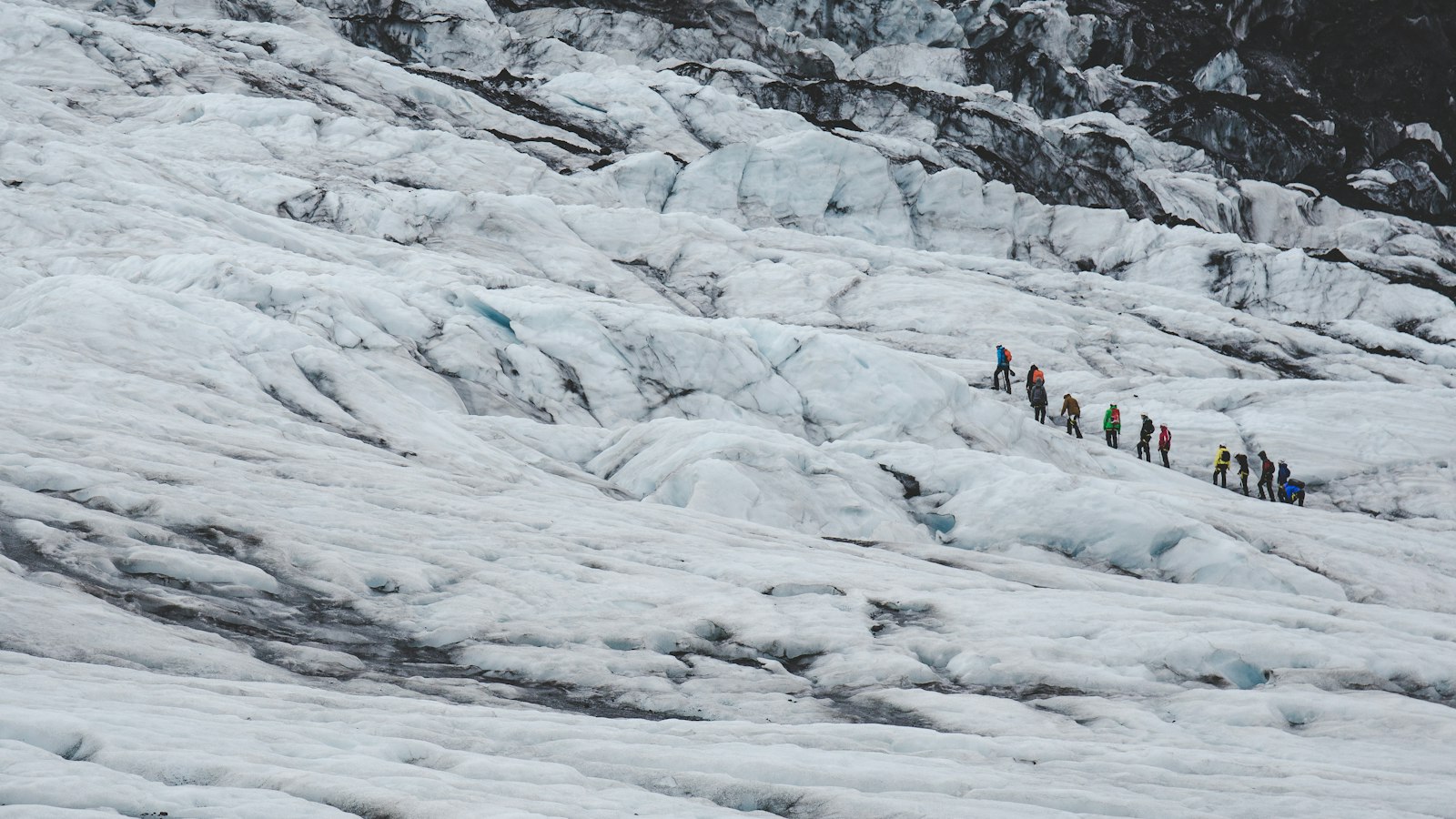
Þórisjökull, or Thóris’s glacier, stands as a smaller icy giant near the southwest side of Langjökull in western-central Iceland. Reaching 1,350 metres in height, this glacier and volcano bears not only geological interest but also a name filled with Icelandic legend.
Geology shaped by ice and fire
The mountain beneath Þórisjökull tells a story stretching back to the Ice Age. Classified as a tuya, a type of volcano formed by eruptions under thick glaciers, it is largely composed of hyaloclastite rock, created by magma meeting ice or water. This process marks it as a rare witness to the powerful interplay between fire and ice that shaped Iceland over tens of thousands of years.
Geologists have uncovered volcanic fissures beneath its glacier, confirming Þórisjökull as part of the active Prestahnúkur volcanic system. Studies here and at neighbouring formations such as Stóra‐Björnsfell and Litla‐Björnsfell have offered valuable parallels for scientists investigating volcanic landforms on Mars, since these Icelandic volcanoes also formed beneath ancient ice.
Landscapes, names and stories
Set between the mighty Langjökull and the shield volcano Ok to the east, Þórisjökull is bordered by the upland valley Kaldidalur, whose name translates as “cold valley.” Kaldidalur has served as an important highland route for centuries, lying in the foreground of the glacier’s icy mass. North-west of Þórisjökull stands Ok, while between the glacier and Geitlandsjökull lies Þórisdalur.
The glacier’s name, Þórisjökull, has mythic roots. It is drawn from a troll named Þórir, a figure from Grettis Saga, who was said to live in a nearby cave. Such ties between natural features and folklore are common throughout Iceland’s interior, linking landscapes to stories passed down through centuries.
Though today Þórisjökull covers an area of 32 square kilometres, it was once probably part of the larger Langjökull glacier. Its separation occurred sometime after the 18th century. Researchers continue to explore areas south of Þórisjökull, focusing on volcanic landforms and the region’s role as a geological analogue for other planets.
Sources
- Wikipedia
- Wikipedia (Icelandic) in Icelandic


