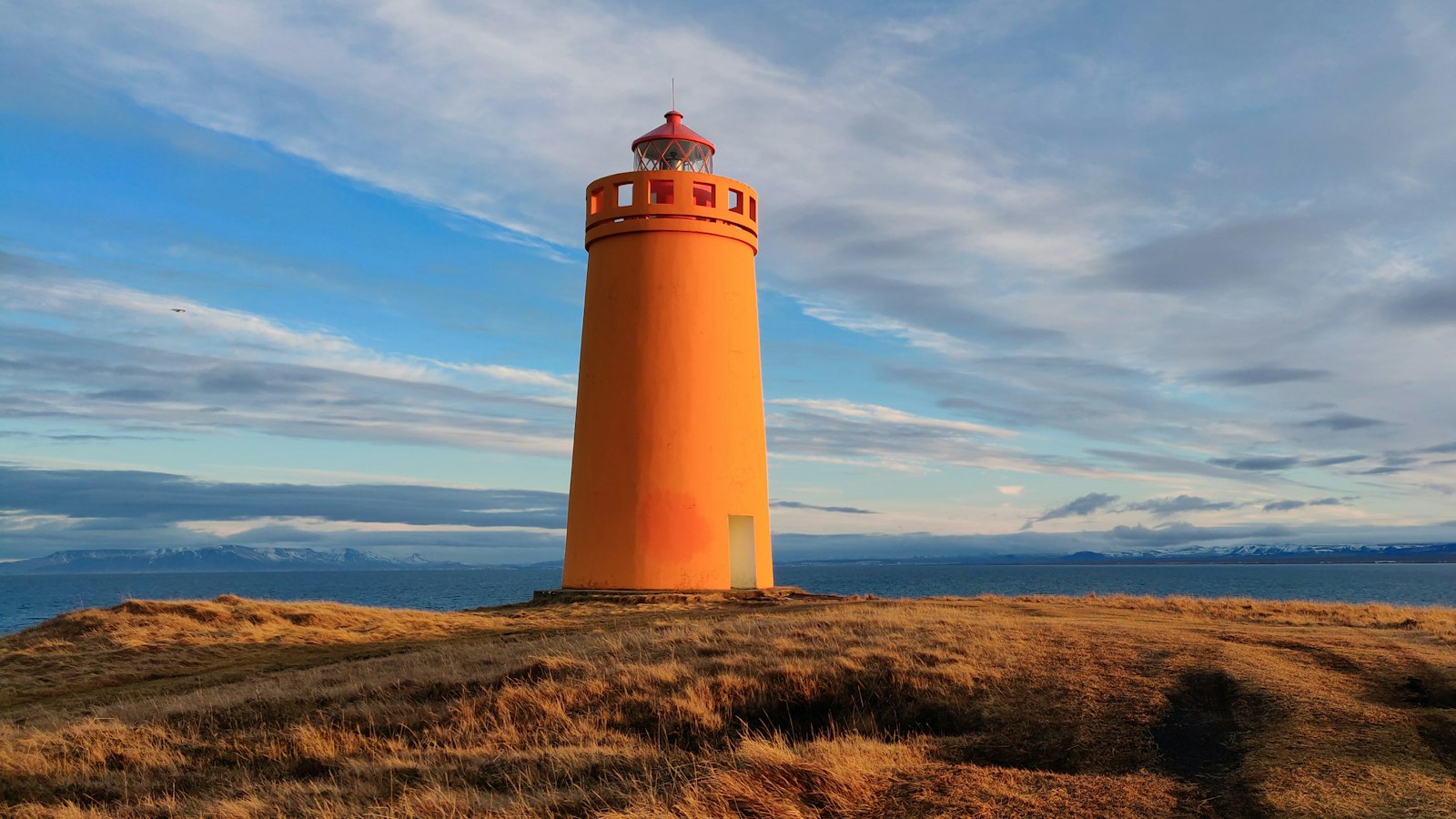
Near the eastern end of Iceland’s Southern Peninsula, the area known as Garðskaði is marked by two imposing lighthouses called Garðskagaviti. Together, these silhouettes stand as reminders of both a turbulent coastline and the nation’s evolving relationship with both the sea and its Danish rulers.
A history shaped by Denmark and the sea
Efforts to build a lighthouse at Garðskagi began as early as 1878, when Iceland was still governed by Denmark. Although the Danish king had promised support for the project, his government hesitated, suggesting that the location was too inhospitable and not trafficked enough by ships to merit an expensive lighthouse. The Danish state eventually agreed to fund only the light mechanism, leaving construction to Iceland. Early attempts to substitute a protective wall with lights quickly failed, battered down by relentless waves.
By 1895, Iceland’s fishing community pressed for a more robust beacon, and both Icelandic and Danish governments contributed financially. The Royal Danish Lighthouse Commission oversaw construction, completing the lighthouse in 1897. Built with iron-reinforced concrete, the structure measures 11.4 metres, and today it remains the second-oldest concrete building in the country. A kerosene lamp and catadioptric rotating lens magnified and swept the light far out to sea, but the lighthouse’s exposed site brought new difficulties. Erosion quickly threatened its foundation, forcing the addition of a footbridge in 1912 and then a concrete platform in 1925. Despite these measures, heavy storms often left the lighthouse shaking.
Adaptation and preservation
Rising concerns about erosion and visibility led to the construction of a larger replacement lighthouse in 1944. Designed by engineer Axel Sveinsson, this version stands 28.6 metres tall and is positioned 215 metres further from the eroding shoreline. Its tower, cylindrical and robustly walled, was originally finished with light-coloured quartz, later coated with white sealant for protection. The new lighthouse drew its lighting mechanism from its predecessor, becoming more effective as its range increased from 13 to 15.5 nautical miles. An electric system replaced the original lamp in 1946, and a quadruple rotating lens was introduced in 1960. The building also came equipped to receive radar signals, a modern touch for its time.
Close by, a keeper’s residence built in 1933 served until 1979 and remains as a testament to decades of vigilant service. Both lighthouses, their walkways and associated outbuildings were granted protected status as a cultural heritage site in 2003, ensuring the preservation of their unique story.
Since 1995, the younger lighthouse and its surroundings have housed the Garðskagi Heritage and Maritime Museum. Here, visitors find a collection of 60 restored engines and maritime artefacts, including a nine-metre, six-oared boat of the Engey island style dating from 1887. This vessel once belonged to Gunnar Hámundarson’s fishery, acknowledged as the oldest operating fishing company in Iceland. The museum’s exhibitions link farming, fishing and navigation, providing a living connection to the community’s past and ongoing relationship with the sea.
Sources
- Wikipedia
- Wikipedia (Icelandic) in Icelandic


