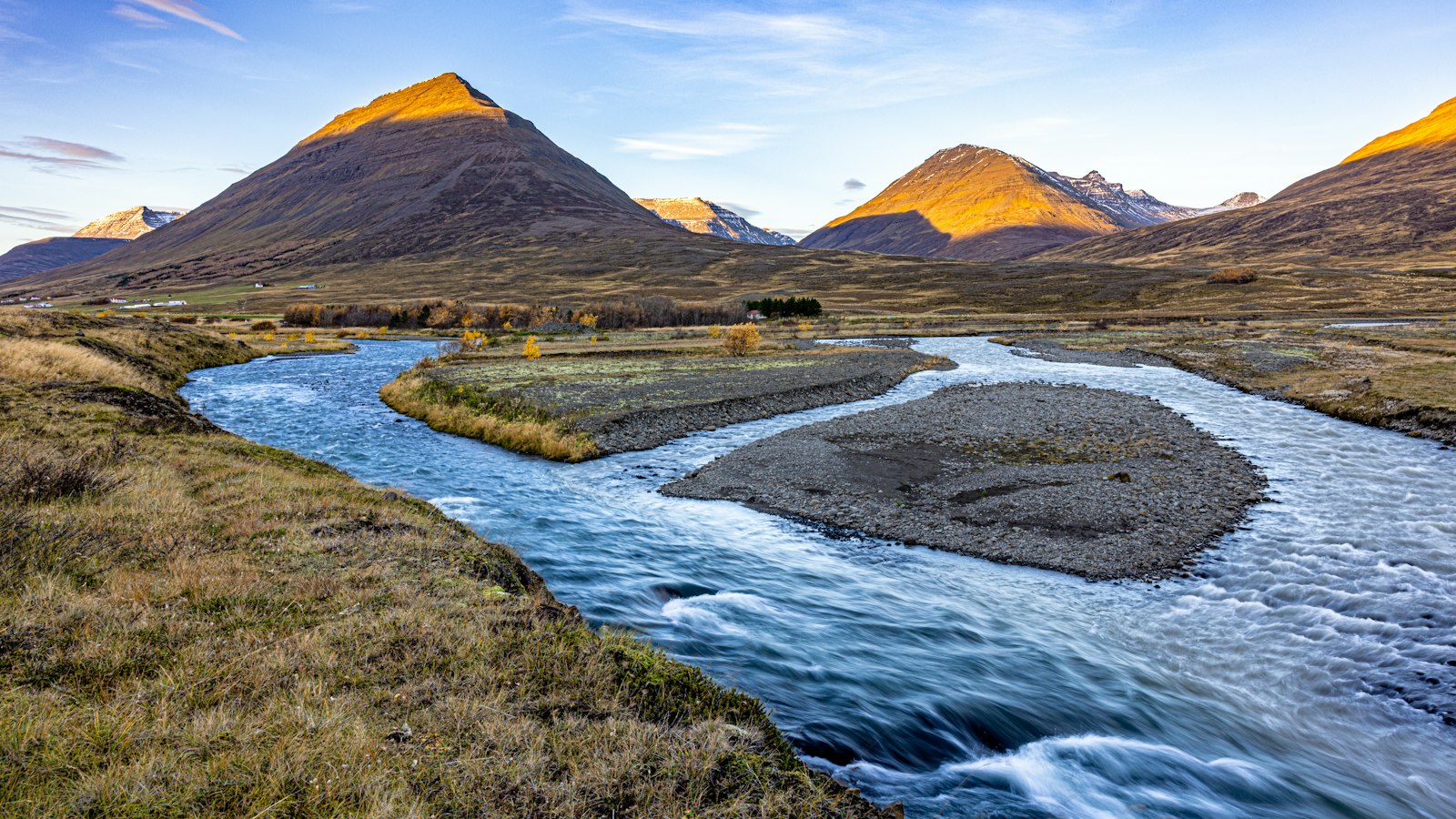
Vatnsskarð is a mountain pass in northern Iceland that quietly links two historic counties, Húnavatnssýsla and Skagafjörður. Though perhaps unassuming at first glance, this pass is layered both with natural features and human stories that reveal the complex web of Icelandic geography and culture.
A landscape marked by water and stone
Isolated farms and abandoned homesteads dot the slopes and valleys around Vatnsskarð. Just north stands the mountain Grísafell, while to the south rises Valadalshnúkur, both watching over a narrow corridor shaped by glacial and volcanic forces. The main road that circles Iceland, Route 1, threads through this passage, following a route used for centuries.
A defining feature of the pass is Vatnshlíðarvatn, a lake that nearly straddles the Húnavatnssýsla-Skagafjörður county line. Water flows into the lake along a stream that locals know as Arnarvatnslækur or Sýslulækur, the ‘county line stream,’ reflecting its function as a boundary. Just east of the lake, this administrative border is still clear in the landscape.
From the lake, river Vatnsskarðsá emerges, fed partly by the Valadalur valley to the south. The river travels eastward, plunging over Gýgjarfoss waterfall before changing its name to Sæmundará as it meanders past Sæmundarhlíð. The area’s blend of rivers, valleys, and highland exposures form a tight ecosystem, shaping daily life and travel.
Legends, literature, and lasting marks
Vatnsskarð is not just a crossing of landforms but of stories. According to regional folklore, a wanderer known as Magnús sálarháski, whose nickname means ‘distress of the soul’, once thwarted the census takers by lying the entire day across the county-dividing stream. His act prevented him being counted in either county, adding a touch of Icelandic whimsy to civil recordkeeping.
On the eastern side of the pass, the small hill Arnarstapi stands close to the highway and appears in Icelandic sagas. Þórðar saga hreðu recounts a dramatic fight here, with Þórður battling six men, testament to the area’s place in local lore. Beneath this hill lies Brekkhús, once used as a sheep shed and a residence for farmworkers. The poet Hjálmar Jónsson from Bóla passed away in this humble house in 1875, tying Icelandic literature to the landscape.
A monument to poet Stephan G. Stephansson now stands on Arnarstapi, commemorating his childhood in the area. From this point, visitors can take in broad views over the valleys and fields, a sweep of land that has shaped both nature and narrative. Not far away, a panoramic viewpoint invites quiet reflection. The Icelandic Meteorological Office also maintains a weather station in Vatnsskarð, a reminder that the meeting of northern weather patterns still shapes life here, just as much as streams, farms and legends.
Sources
- Wikipedia
- Wikipedia (Icelandic) in Icelandic


