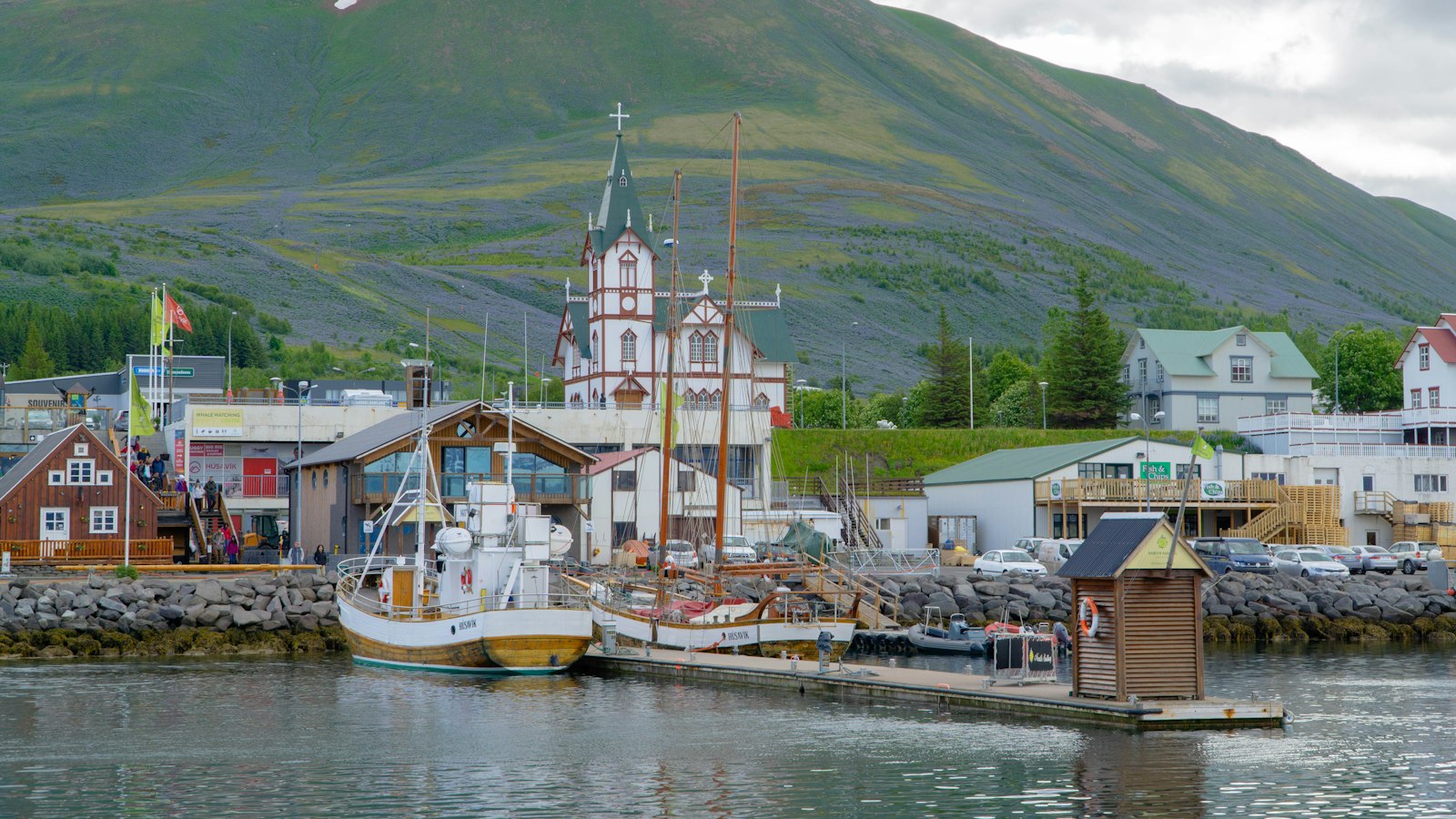
Skjálfandi Bay in northern Iceland offers a meeting point of geology, history and wildlife. Its name, which means “trembling” in Icelandic, may suggest a legacy of earthquakes or shifting land. The bay displays some of the traits of a fjord, shaped by retreating glaciers that carved the landscape during past ice ages.
The bay receives water from two main rivers. Skjálfandafljót begins as a glacier river, bringing mineral-rich run-off from Iceland’s ice caps. Laxá is a freshwater river renowned for its salmon population, from which the river gets its name (“Salmon River”). A section of Laxá enjoys international protection through the Ramsar Convention, recognising the ecological importance of its wetlands.
Wildlife above and below the waves
Skjálfandi is noted for its abundance of marine life. Many whale and dolphin species are found in its waters, alongside a diversity of birdlife along the coasts and islands. The smaller of its two islands, Lundey (meaning “island of the puffins”), hosts a dense summer colony of puffins on its cliffs. Lundey is situated about 8.3 kilometres north of the main town.
The larger island, Flatey, lies near the bay’s western mouth. Once a thriving settlement, Flatey still contains a group of houses, a school and a church, remaining as a quiet echo of rural life. The village on Flatey was eventually deserted, and since 1967, the island has had no permanent residents. No ferry serves the island today.
Traces of ancient settlement
People have lived by Skjálfandi Bay for over a millennium. Garðar Svavarsson, one of the earliest Scandinavians to live in Iceland, spent the winter around 860 CE at Skjálfandi after building himself a house there. However, he left after the winter, leaving behind his slave, Náttfari, who continued to farm the land. Náttfari was later forced to move further along the bay to Náttfaravík after being chased away by another Norse settler.
On the shoreline today sits the town of Húsavík, also looking across to dramatic mountain ranges such as Víknafjöll and Kinnarfjöll. Peaks on the far side of Skjálfandi Bay reach up to roughly 1,200 metres, snow-covered for much of the year, completing the panorama of land, sea and history.
Sources
- Wikipedia
- Wikipedia (Icelandic) in Icelandic


