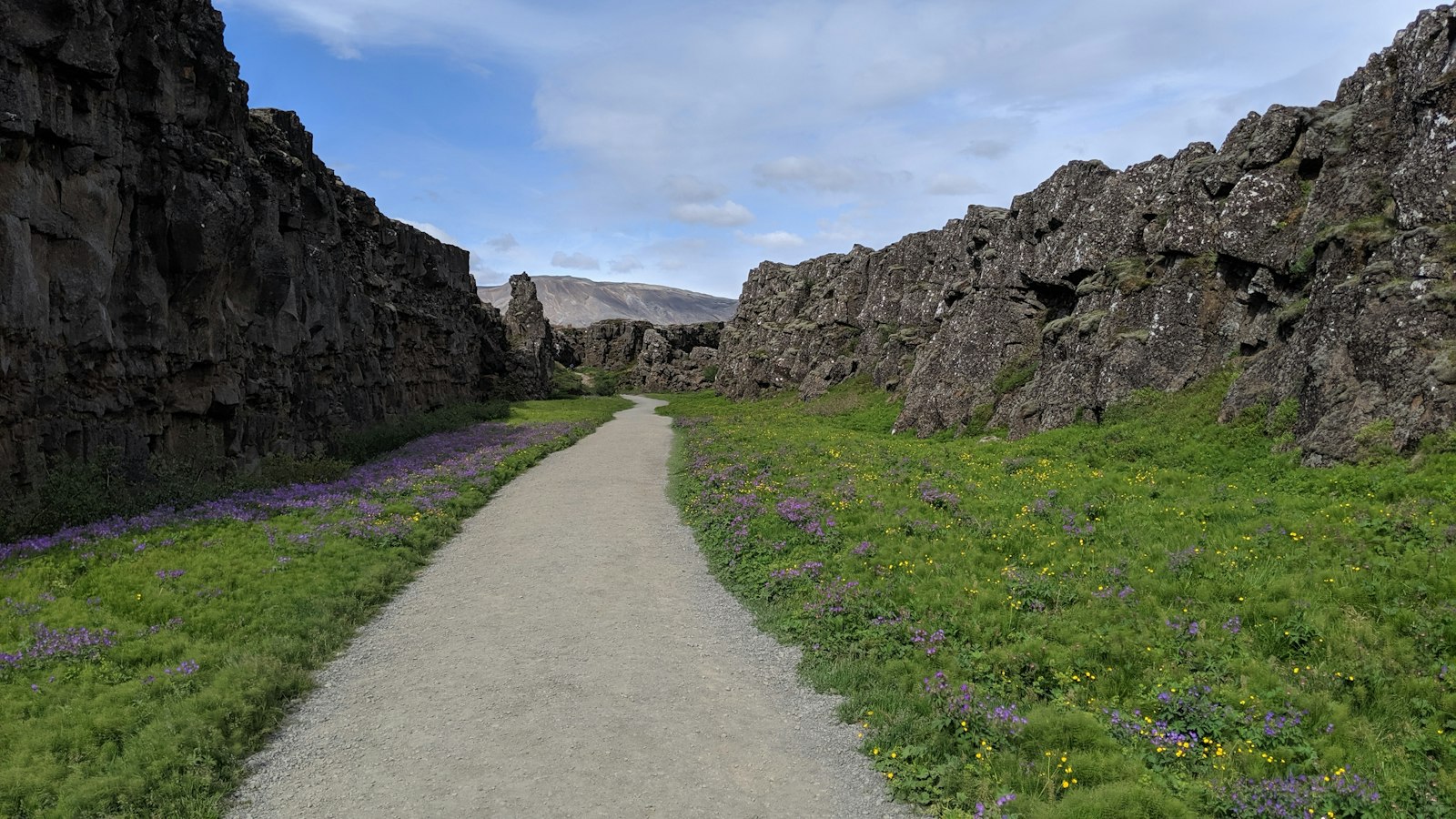
Below the waters of Þingvallavatn Lake in southwest Iceland lies Silfra, a dramatic fissure marking the divide between the North American and Eurasian tectonic plates. This rift, located in Þingvellir National Park, is the visible result of slow but significant geologic processes shaping Iceland’s landscape.
A landscape defined by shifting plates
Silfra’s origins are tied to the Mid-Atlantic Ridge, a divergent tectonic boundary where two massive plates pull away from each other at around two centimetres per year. Over centuries, the tension from this movement is occasionally released by strong earthquakes, cracking the ground and leaving fissures throughout the Þingvellir valley, with Silfra as one of the largest and deepest.
The fissure itself reaches depths of around 63 metres and lies on the rim of Þingvallavatn Lake. As rocks and boulders tumble into these widening cracks, they sometimes create underwater caves within Silfra’s structure.
Glacial water filtered by volcanic rock
Silfra is more than a geological border; it is also a remarkable hydrological feature. The water here comes from Langjökull, Iceland’s second largest glacier, located about fifty kilometres to the north. Meltwater from Langjökull used to feed directly into the lake, but thousands of years ago, lava flows from the Skjaldbreiður volcano blocked the route. Now, the glacial water travels underground, filtered through porous lava rock for decades, between thirty and one hundred years, before emerging through springs at the base of Silfra.
This journey makes the water exceptionally clear and drinkable. The purity of Silfra’s water is renowned, offering rare visibility of the fissure’s depths and rock formations.
While Þingvellir is famed for its role in Icelandic history, as the site of the original Althingi parliamentary gatherings dating back to 930 CE, it is also a site where visitors can walk between two continents. The ancient stone booths of the assembly still stand on the same landscape that is continuously shaped by grinding plate movements.
Life in cold, clear waters
Despite the freezing temperatures (between 2 and 4 degrees Celsius), some creatures thrive in Silfra’s environment. The amphipod Crymostygius thingvallensis can be found only in Þingvallavatn and its fissures, including Silfra. Occasionally, Arctic Char fish move into the fissure during their brief mating season, but the only fish to permanently inhabit the depths is the Dwarf Char, a subspecies that keeps to the darkness below.
Sources
- Wikipedia
- Wikipedia (Icelandic) in Icelandic


