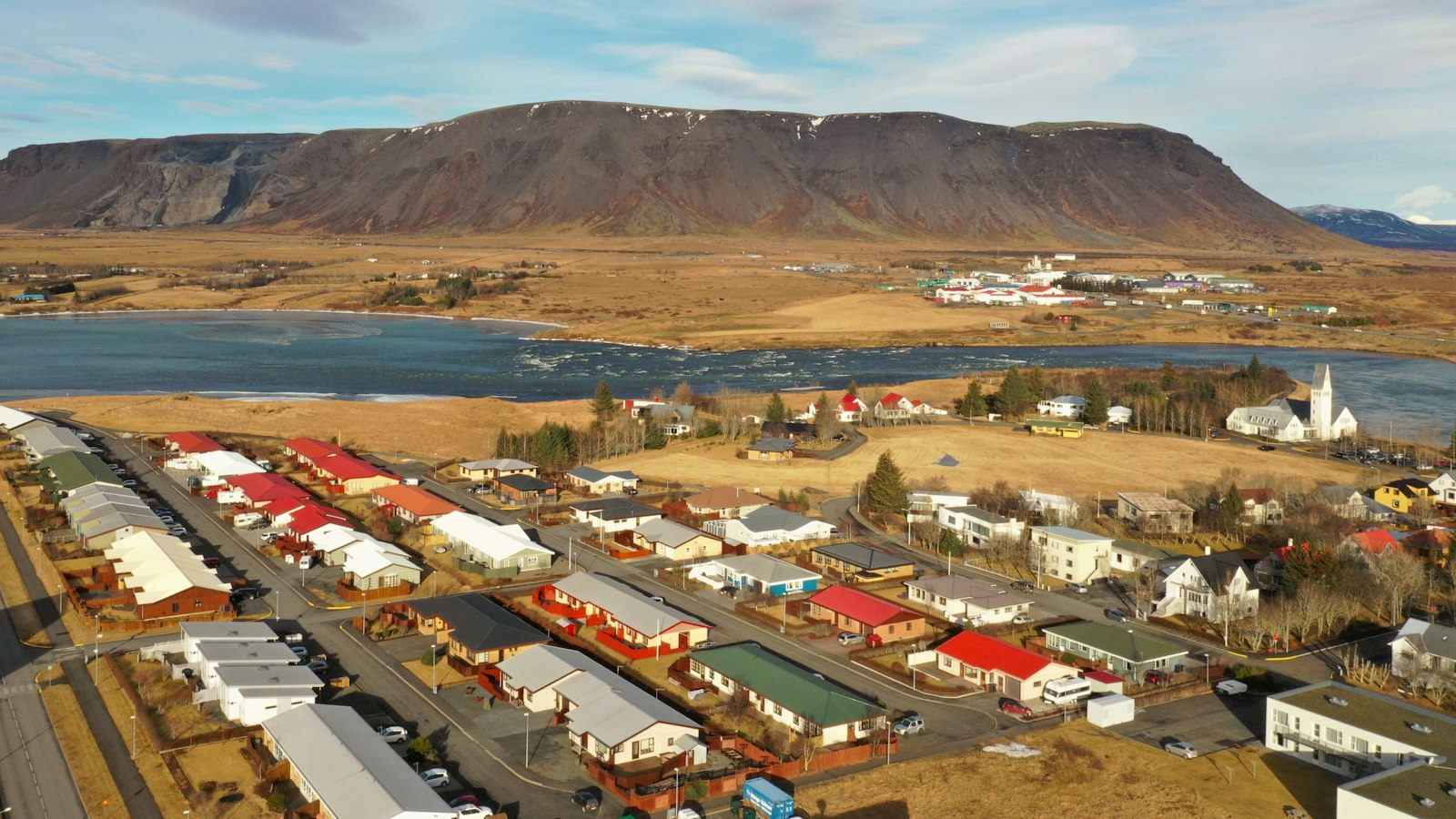
On the banks of the Ölfusá river, about 50 kilometres southeast of Reykjavík, sits Selfoss, the major town and administrative heart of the Árborg municipality. With a population of 10,420 in 2025, it has become the leading residential and commercial centre in South Iceland. Route 1, the country’s ring road, cuts through Selfoss, making it a significant stop for travel between Hveragerði and Hella.
From farmstead to crossroads
The area around Selfoss has seen habitation since the time of settlement in Iceland. According to the Íslendingasögur (Sagas of Icelanders), Ingólfur Arnarson, often considered Iceland’s first settler, spent the winter of 873–74 under the nearby Ingólfsfjall mountain. The first formal settlement of what is now Selfoss is credited to Þórir Ásason after the year 1000.
For centuries, the area remained primarily rural farmland. Its transformation began at the close of the 19th century, when the first suspension bridge over the Ölfusá river was completed in 1891. This engineering feat, led by Tryggvi Gunnarsson, was a milestone not just for Selfoss but for all southern Iceland. The town quickly developed around this newfound connection, becoming a nexus for services supporting the region’s farms.
A centre for industry, education and sport
Industry and commerce flourished following the bridge’s opening. By 1900, just 40 people lived in Selfoss, but the population grew rapidly. Companies like Mjólkurbú Flóamanna (a dairy producer) and the general store Kaupfélag Árnesinga became the largest employers for decades. By 1950, Selfoss counted around 1,000 residents, and since 2000 the population more than doubled to over 10,000.
The town’s infrastructure kept pace, hosting one of Iceland’s largest colleges, FSU Fjölbrautaskóli Suðurlands. Sports culture runs deep: since 1936, UMF Selfoss has been the main multi-sport club, supporting handball, football and basketball, among other sports. The men’s handball team won the national championship in 2019, with the women’s football team capturing the Icelandic Football Cup in the same year.
Tradition and transformation
August brings “Sumar á Selfossi” (“Summer in Selfoss”), an annual festival where neighbourhoods showcase ribbons in distinct colours and locals host stalls selling homemade goods. Music, performances and a community fete on the library’s grassland culminate in a fireworks display.
The influence of the bridge endures. The original worker’s lodge, Tryggvaskáli, is Selfoss’s oldest building, having served as a rest stop, a first schoolroom, and later a site for practical services such as the early telephone exchange and bank. A new pedestrian-friendly town centre, opened in 2021, draws inspiration from historical architecture across Iceland. Its highlight is a recreation of the Old Dairy building from 1929, now serving as a food hall and gathering space.
Selfoss’s story is one of resilience and renewal. The town weathered a significant earthquake in 2008, which caused damage but no loss of life among residents. Today, Selfoss continues to adapt, expanding its centre, supporting local culture and serving as a vital link in the south of Iceland.
Sources
- Wikipedia
- Wikipedia (Icelandic) in Icelandic


