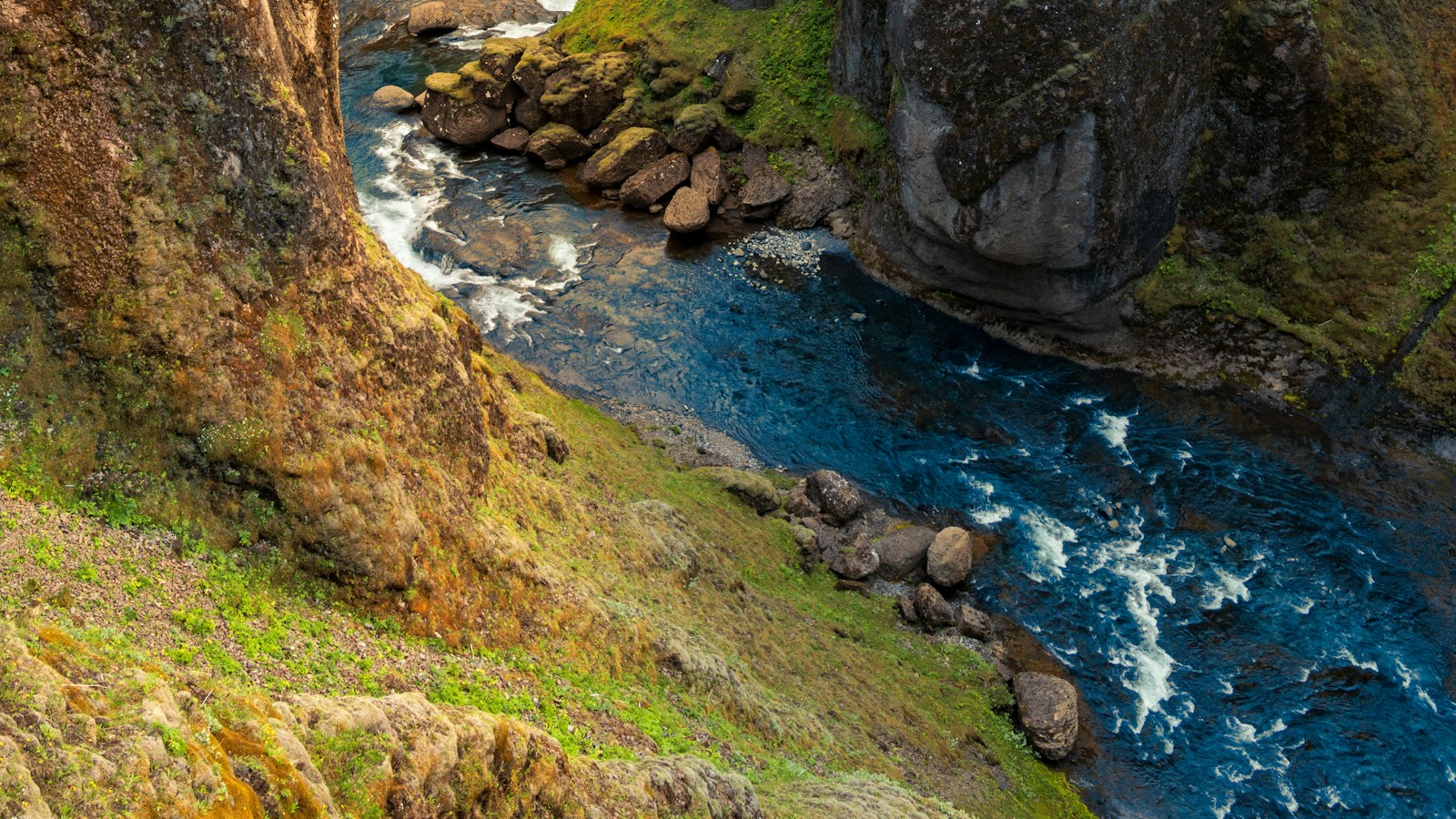
On the mossy plains and low hills about 20 kilometres northwest of Þingvallavatn, an unassuming lake called Stíflisdalsvatn gives rise to the river Laxá í Kjós. From this source, the river crosses the green valleys of Kjósarhreppur for approximately 20 to 25 kilometres before finding its way to Laxárvogur, a sheltered cove where fresh and saltwater meet in the wide Hvalfjörður fjord.
A river shaped by salmon and waterfalls
The lifeblood of this river is its salmon, whose presence has shaped not only the ecology but also the human story of the region. Salmon enter the river from the fjord and journey upstream, facing the challenge of several waterfalls along their migration route. Brown trout and sea trout also make these waters their home, benefitting from the gravel beds and cold, oxygen-rich currents.
One of the river’s defining features is the Þórufoss, a striking curtain of water plunging 18 metres just a short distance after the river leaves Stíflisdalsvatn. The falls are a stronghold and a barrier for migrating fish, who must leap upstream during their late-summer run. A little over six kilometres farther on, the river tumbles over Pokafoss, a smaller but spirited cascade, before finally travelling towards the cove and passing yet another small fall, Kvíslafoss.
Legacy of scientific curiosity
The significance of Laxá í Kjós stretches beyond its picturesque setting. In 1884, the area witnessed Iceland’s first experiment with artificial salmon propagation. Spearheaded by Danish scientist Arthur Feddersen and supported by Reverend Þorkell Bjarnason from Reynivellir, this pioneering effort involved collecting live salmon, 13 females and 18 males, from Laxá í Kjós and its main branch, Bugða. Special hatching boxes were installed in the river, marking a remarkable early attempt to safeguard local fish stocks. This event linked the river with the beginnings of modern fisheries science in Iceland.
Several tributaries feed Laxá í Kjós, each adding their flows and character. The Bugða is the primary branch, but other smaller rivers, Svínadalsá, Hálsá, and Þverá, join below Þórufoss, helping to support a diverse aquatic habitat.
The Þórufoss has also touched popular culture, serving as a backdrop in the television drama Game of Thrones, where it appeared as the setting of a memorable encounter between a dragon and a herd of goats.
Sources
- Wikipedia
- Wikipedia (Icelandic) in Icelandic


