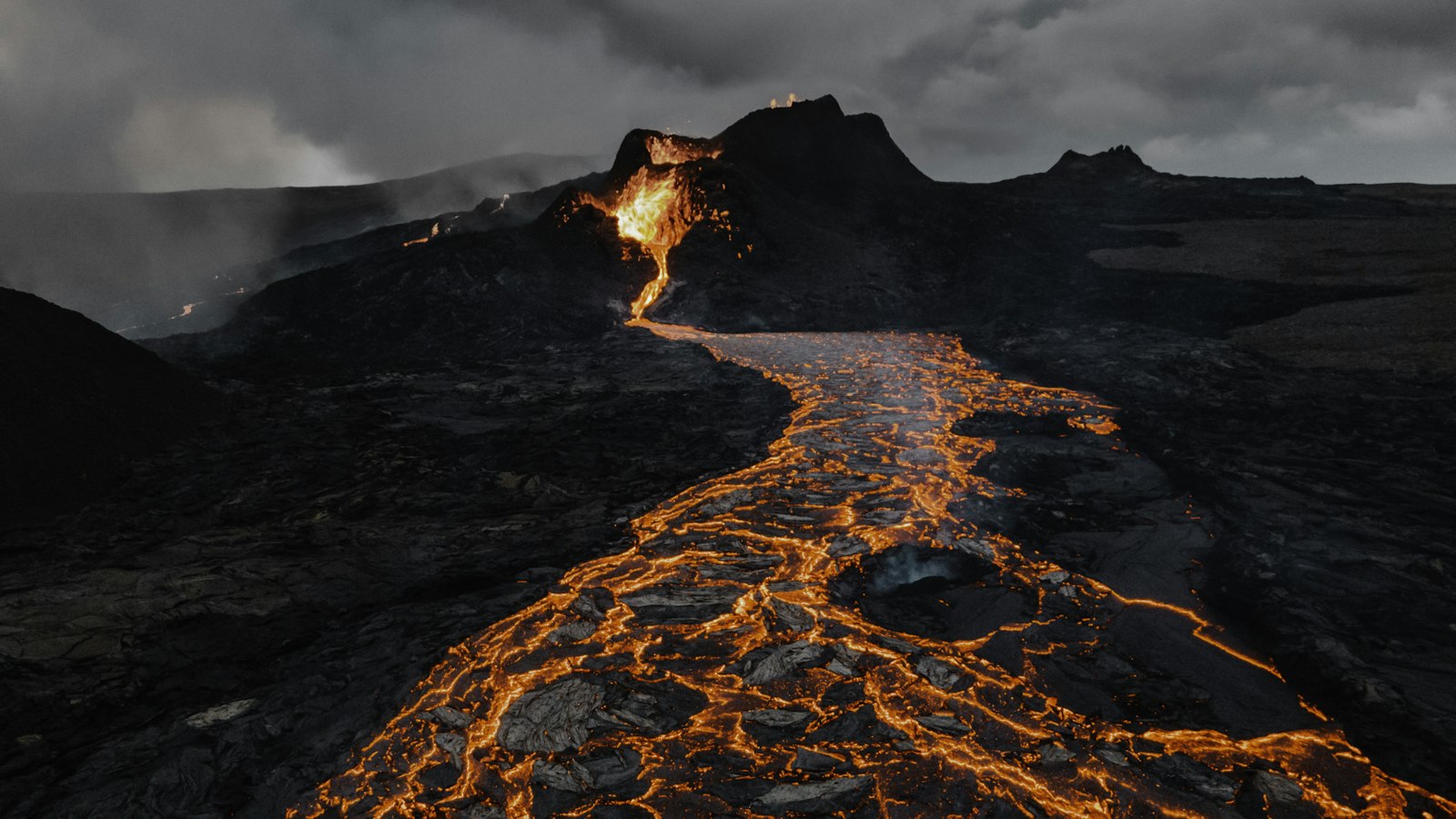
Volcanoes are woven into the very fabric of Iceland, both literally in the island’s geology and in its culture and history. This island in the North Atlantic stands directly over the Mid-Atlantic Ridge, where tectonic plates drift apart, while also sitting atop a powerful mantle hotspot. The combination results in frequent volcanic eruptions and an ever-changing landscape.
A complex mosaic of volcanic zones
The arrangement of volcanoes in Iceland is far from random. Most are grouped within distinct rift zones, known as the Neovolcanic Zone. This includes belts that run from the Reykjanes peninsula in the southwest up to the northern volcanic areas, as well as eastern and central regions. Two smaller belts, the Öræfi and Snæfellsnes, play a less prominent but geologically interesting role. These belts, often connected by seismic or transform zones, show how the island’s crust is being pulled and shifted in several directions.
Over 30 active volcanic systems lie within these zones, each made up of fissure networks and, in many cases, central volcanoes, stratovolcanoes or shield volcanoes with magma chambers beneath them. In total, nearly thirty volcanoes have erupted since the end of the last Ice Age. Since Iceland’s human settlement around AD 874, thirteen different volcanic systems have produced eruptions, some with global consequences.
Eruption types and landscape formation
Iceland’s volcanic systems produce a range of eruptions. Fissure vents often create vast fields of flowing basaltic lava, a process dominated by so-called flood basalt events. In relatively calm eruptions, smooth-surfaced pāhoehoe lava flows, called helluhraun in Icelandic, spread across the land. More viscous, jagged flows known as apalhraun (ʻAʻā in Hawaiian terminology) are rough and difficult to cross.
Where magma meets water, eruptions can turn violent and explosive, forming tephra, crater rows, or even wide maars and tuff rings. The chemical makeup of each eruption, shaped by the interplay of tectonic movements and the hotspot, creates a spectrum: from the mainly tholeiitic basalts found across the island, to more silica-rich lavas in particular belts, especially in the rare explosive eruptions of volcanoes like Öræfajökull.
In some cases, single shield volcanoes have erupted just once, these have a monogenetic character, though in other volcanic regions of the world, such as Hawaii, shield volcanoes may erupt many times over thousands of years. In Iceland, most major lava flows since the last glaciation are basaltic: 92 percent basalt, with much smaller proportions of andesite and rhyolite.
Volcanic history and global impact
Eruptions in Iceland are not just local events. The Laki fissure eruption of 1783–1784, known in Icelandic as Skaftáreldar, is the deadliest in Iceland’s history. It released enormous amounts of lava, gases, and ash, with consequences felt across Europe and beyond. The largest lava eruption in recorded human history, however, occurred at Eldgjá, another event that helped shape both the landscape and history of the island.
Disruptive eruptions have interfered with life on the island and far beyond, closing airspace or damaging farmland. Over the last 500 years, Icelandic volcanoes have produced about one-third of the world’s lava output, a scale unmatched even by Hawaii in some periods. This fiery productivity ebbs and flows in cycles, reflecting the deep, ongoing dialogue between Earth’s crust and the forces beneath.
Sources
- Wikipedia
- Wikipedia (Icelandic) in Icelandic


