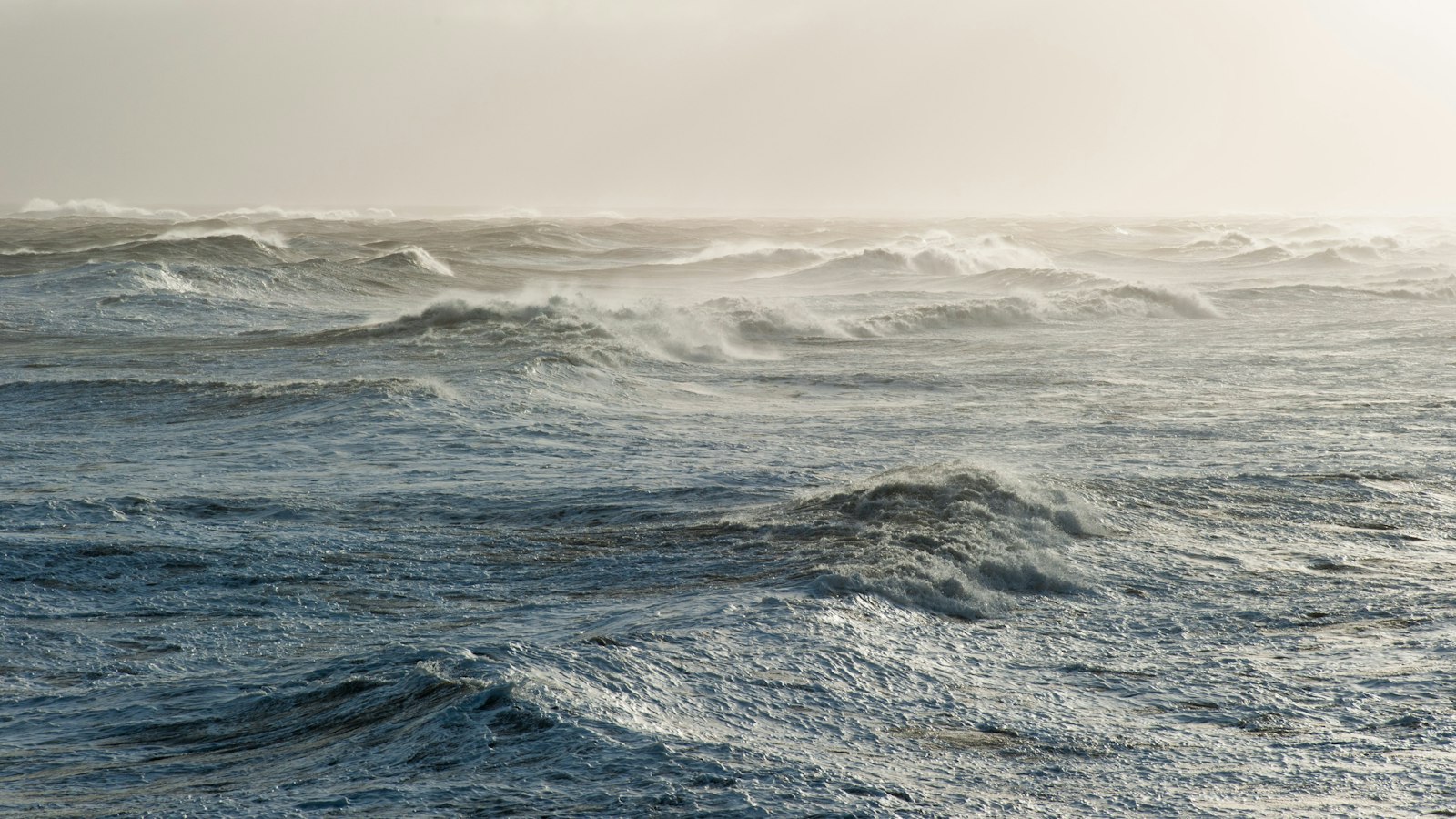
Separating Greenland and Iceland, the Denmark Strait is a vast channel connecting the icy waters of the Arctic with the deeper blue of the Atlantic Ocean. Its expanse stretches for 480 kilometres, marking one of the crucial gateways between the north and the south of the world’s oceans.
Geography, currents and the hidden waterfall
At its narrowest, the strait measures 290 kilometres across, lying between Iceland’s remote Hornstrandir peninsula (Straumnes) and the harsh Blosseville Coast of eastern Greenland (Cape Tupinier). The International Hydrographic Organization defines this area as the dividing line between the Arctic and North Atlantic, tracing a boundary from Straumnes to Cape Nansen on Greenland.
Beneath the surface, the Greenland–Iceland Rise forms a submerged ridge, with the shallowest point at 190 metres in depth. Here, the East Greenland Current flows from the Arctic down into the Atlantic, carrying not just cold water but also icebergs that drift south, sometimes far into the North Atlantic. These waters are known for rich fisheries, providing key resources for the surrounding nations.
What many may not realise is that the Denmark Strait is home to what scientists describe as the world’s largest underwater waterfall. This cataract moves enormous volumes of cold, dense water downwards from the Greenland Sea into the Atlantic, flowing along the western edge of the strait and profoundly influencing wider ocean currents.
A site of conflict at sea
While the Denmark Strait’s main legacy may be in shaping Icelandic and North Atlantic nature, its isolated waters have also felt the impact of world history. On 24 May 1941, during the Second World War, the Battle of the Denmark Strait unfolded between British and German naval forces. In a dramatic exchange, the German battleship Bismarck, on a mission to threaten Allied supply routes, met the British battlecruiser HMS Hood and the battleship HMS Prince of Wales.
The sinking of HMS Hood, with the loss of nearly all her crew, marked one of the Royal Navy’s greatest wartime tragedies. Bismarck, though triumphant in the initial clash, did not escape unscathed. Damaged in the fight, the German vessel was hunted down and sunk days later in the Atlantic. The heavy cruiser Prinz Eugen, sailing with Bismarck, managed to evade pursuit and return to Europe.
Today, the Denmark Strait stands as both a natural boundary and a reminder of pivotal moments in history, linking Iceland not just to nearby Greenland, but to the wider story of the Atlantic and Arctic Oceans.
Sources
- Wikipedia
- Wikipedia (Icelandic) in Icelandic


