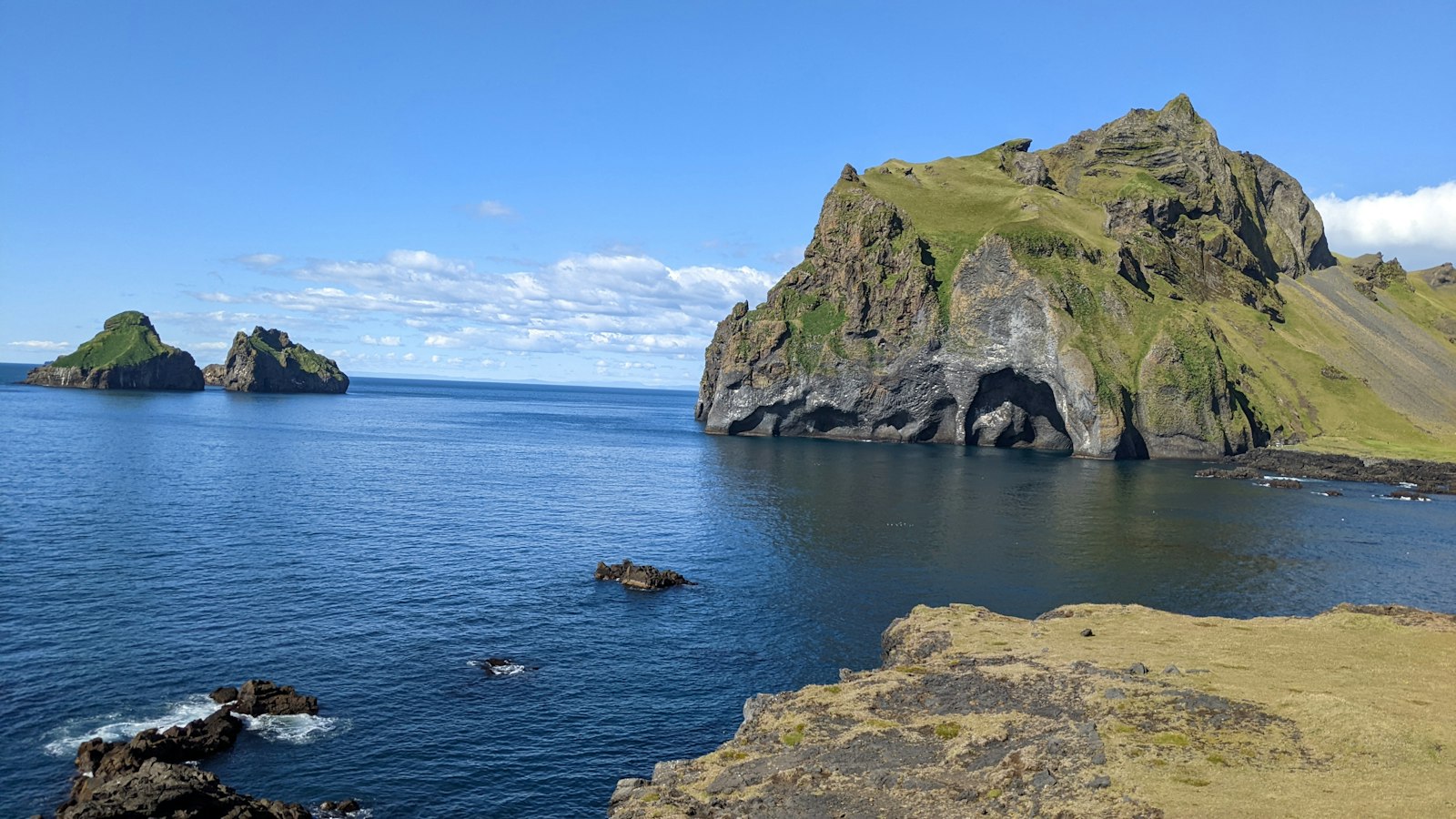
Thirteen kilometres off Iceland’s south coast, Heimaey stands out as the country’s largest and only populated island in the Vestmannaeyjar (Westman Islands) archipelago. With an area of 13.4 square kilometres, the island’s history and landscape intertwine in a story that spans settlement, disaster and resilience.
Layers of land and time
Heimaey’s formation reflects the powerful geological forces that shape Iceland. The northern part of the island, including cliffs and peaks such as Heimaklettur and Miðklettur, originated at the end of the last ice age, likely 10,000 to 12,000 years ago. In places like Háin and Fiskhellar, there are signs of even older landforms that may reach back 110,000 to 120,000 years.
The island has grown through repeated volcanic activity. Younger craters in Stórhöfði and Stakkabót, which are around 5,000 to 6,000 years old, have added to the island’s mass. Between cliffs such as Klifið and Heimaklettur, the accumulation of earth and lava eventually formed the Eiðið, a natural isthmus creating a sheltered harbour, the lifeline for Heimaey’s community.
Even today, about a third of Heimaey is uninhabitable due to the volcanic landscape. Most residents live in the south and around the base of Helgafell, bounded to the east by Eldfell and its lava fields, and to the west by the steep Ofanleitishamar.
Historic tests and community spirit
The story of settlement on Heimaey goes back over a millennium. Tradition records Herjólfur Bárðarson as the first permanent settler around the year 900, establishing a farm in Herjólfsdalur (Herjólf’s Valley). However, archaeological finds from 1971 suggest people were living here even earlier.
Isolation sometimes left Heimaey vulnerable. In 1627, three pirate ships from the Barbary Coast (territories now part of Morocco and Algeria) raided Iceland’s southern coast and islands. Unlike Grindavík on the mainland, where residents escaped into lava fields, Heimaey’s population faced brutality. Nearly half were killed or captured and sent to Algeria, churches were burned and two pastors were taken, with one killed.
Some stories from this time linger in Icelandic memory. Guðríður Símonardóttir, called Tyrkja-Gudda (Turkish-Gudda), was kidnapped from her home and enslaved in Algeria, then ransomed back a decade later. Her life has come to symbolise survival and cultural encounter in Icelandic history.
The eruption that changed everything
On January 23, 1973, the dormant volcano Eldfell erupted dramatically. As fissures split open and lava flowed towards the harbour, the island’s population of around 5,000 was evacuated in one night, largely by fishing boats. For months, ash buried homes and lava threatened the town and its vital port. The eruption destroyed half the settlement but efforts to cool and divert the flow with six million tons of seawater succeeded in saving the harbour. The crisis lasted until July, leaving the island both wounded and physically larger than before, Heimaey’s area increased by over two square kilometres.
Today, life on Heimaey revolves around the sea, with the harbour still central to the local economy and community. The island is also home every summer to millions of nesting puffins, adding another layer to its identity shaped by nature.
Sources
- Wikipedia
- Wikipedia (Icelandic) in Icelandic


