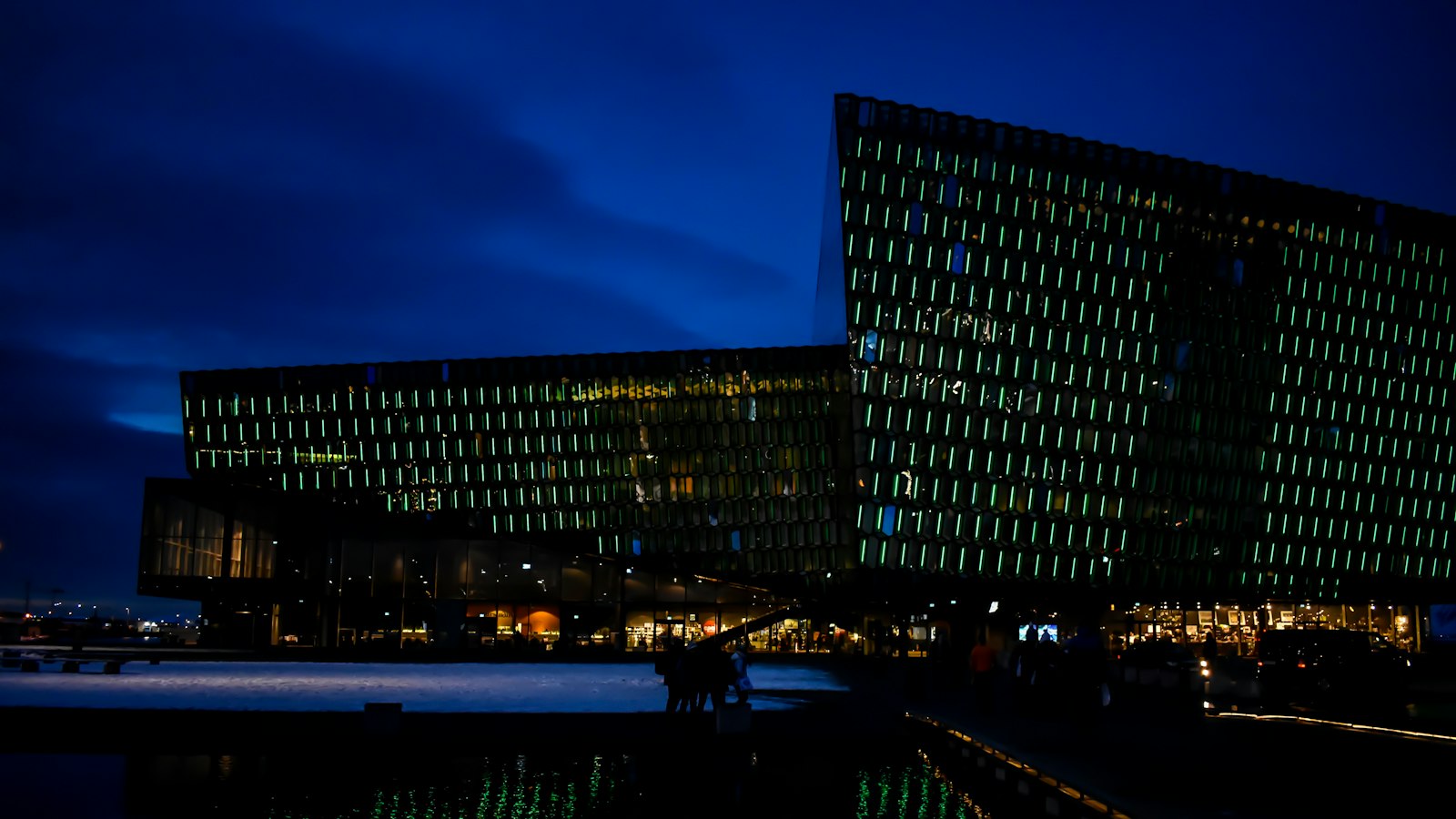
At the eastern edge of Reykjavík’s harbour, the geometric form of Harpa stands out against sea and sky. This concert hall and conference centre, whose name means “harp” in Icelandic, became the city’s first purpose-built venue devoted to music when it opened on 4 May 2011. Today, Harpa is a central gathering spot for musical, artistic and political events in the capital.
Architecture inspired by Iceland’s landscapes
Harpa’s striking façade is made of coloured glass panels, their shapes and reflections echoing the appearance of Iceland’s basalt columns. This outer skin wraps around a steel structure, an idea conceived by the Danish firm Henning Larsen Architects and Danish–Icelandic artist Ólafur Elíasson. The glass is more than decorative. Each of the 714 LED lights embedded in its surfaces can be programmed for artistic effects, turning the building itself into a shifting light installation.
As part of its 10th anniversary in 2021, the façade hosted twelve new light works, one for each month, created by Elíasson. Harpa’s light system has also been opened to other artists, with interactive works such as a playable version of the game Pong displayed for city festivals.
A symbol of renewal amid economic upheaval
Plans for Harpa were first part of a larger redevelopment project along the harbour, which included the World Trade Center Reykjavík and a major hotel. Construction began in 2007, but the following year Iceland’s financial crisis brought everything to a halt. With the concert hall only half finished and most of the city’s building activity on pause, the government stepped in to fund completion.
Harpa was briefly known as Reykjavík’s Concert Hall and Conference Centre. Its official name was chosen in December 2009 on the Day of Icelandic Music. By the time it opened in 2011, thousands visited during its festival days, underscoring its meaning for the nation.
Harpa is 28,000 square metres in size. Its largest auditorium, Eldborg, can seat between 1,600 and 1,800 spectators, with three other halls and large open spaces for varied uses. The building is jointly owned by Iceland’s state (54 percent) and the city of Reykjavík (46 percent).
Cultural life and international events
Home to the Iceland Symphony Orchestra, Harpa also welcomes the Icelandic National Opera beginning in 2026. It has held performances by choirs, orchestras, and guest artists, as well as major conferences such as the annual Arctic Circle Assembly and the Council of Europe summit in 2023.
Not just a concert venue, Harpa has appeared in literature, television, and film: in a 2009 novel as an unfinished construction, as the backdrop for key scenes in international television series, and in recent feature films. The space continues to introduce innovations, such as the Volcano Express attraction, offering immersive journeys through Iceland’s volcanic geology with sensory effects.
Sources
- Wikipedia
- Wikipedia (Icelandic) in Icelandic


