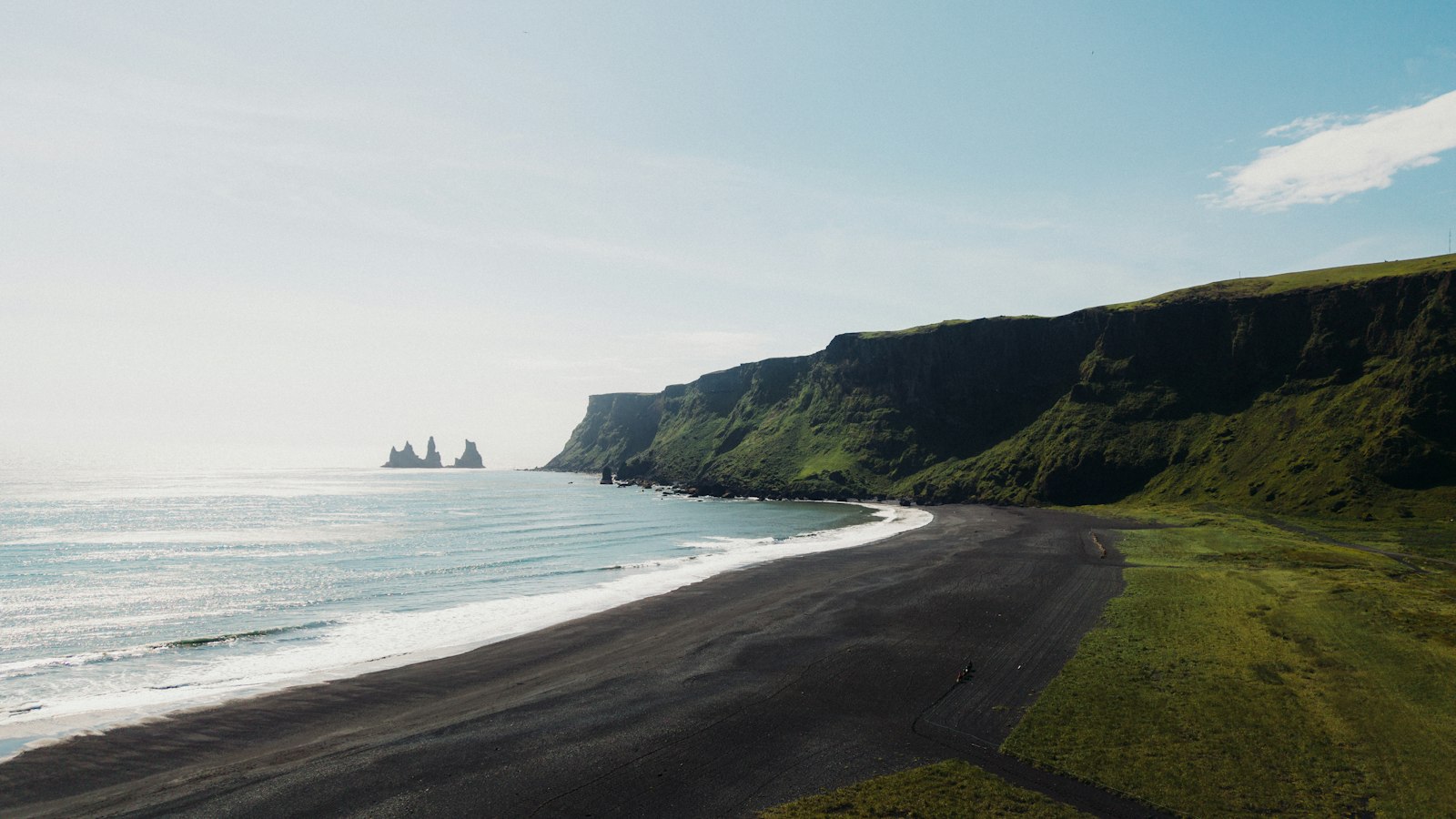
Rising abruptly from the southern coast near the village of Vík, Dyrhólaey forms a striking promontory that stands out both for its geological past and for the wildlife that flourishes on its steep cliffs. The name Dyrhólaey, meaning “door hill island” in Icelandic, refers to the dramatic natural arch that faces the open Atlantic and has given the peninsula its distinct character.
A promontory shaped by fire and sea
Once isolated from the mainland, Dyrhólaey has its origins in a volcanic eruption that occurred about 100,000 years ago during the Pleistocene. This event produced a tuff headland that now rises some 120 metres above sea level, surrounded by the restless North Atlantic. Walkers standing at its highest point can observe a sweeping view, from Mýrdalsjökull glacier looming to the north to the jagged black columns of Reynisdrangar emerging from the sea eastward. On clear days, the coastline stretches far in both directions, westward toward Selfoss and east over the sands of Kötlutangi, the southernmost point of mainland Iceland, although many have long thought Dyrhólaey itself held this title.
Just offshore, striking basalt stacks bear names like Háidrangur, a near-vertical rock column that towers 56 metres above the crashing waves. In 1893, Eldeyjar-Hjalti Jónsson made the first ascent of Háidrangur, installing ladders and chains for later use in collecting seabirds and eggs. Other sea stacks, such as Lundadrangur and Mávadrangur, complete this rugged seascape.
Life around the cliffs and the lighthouse
Dyrhólaey forms part of a birdwatcher’s paradise, especially in the warmer months when large numbers of Atlantic puffins gather to nest among the cliffs. Since 1978, the area has been protected, recognising not only the importance of its ecosystem but also its role in Iceland’s natural heritage.
The peninsula is also home to a lighthouse, constructed in its present form in 1927 after replacing an earlier steel structure from 1910. Designed by architect Guðjón Samúelsson, the concrete tower and adjoining keeper’s house stand as sentinels at the promontory’s summit. The beacon, among the brightest in Iceland, sends out a white flash every ten seconds and was staffed by resident keepers until 2015.
Beyond geology and wildlife, Dyrhólaey carries a mark in aviation history. In October 1993, pilot Arngrímur Jóhannsson and MP Árni Johnsen flew a small aircraft through the sea arch not once but three times, inscribing another chapter in the evolving story of this southern headland.
Sources
- Wikipedia
- Wikipedia (Icelandic) in Icelandic


