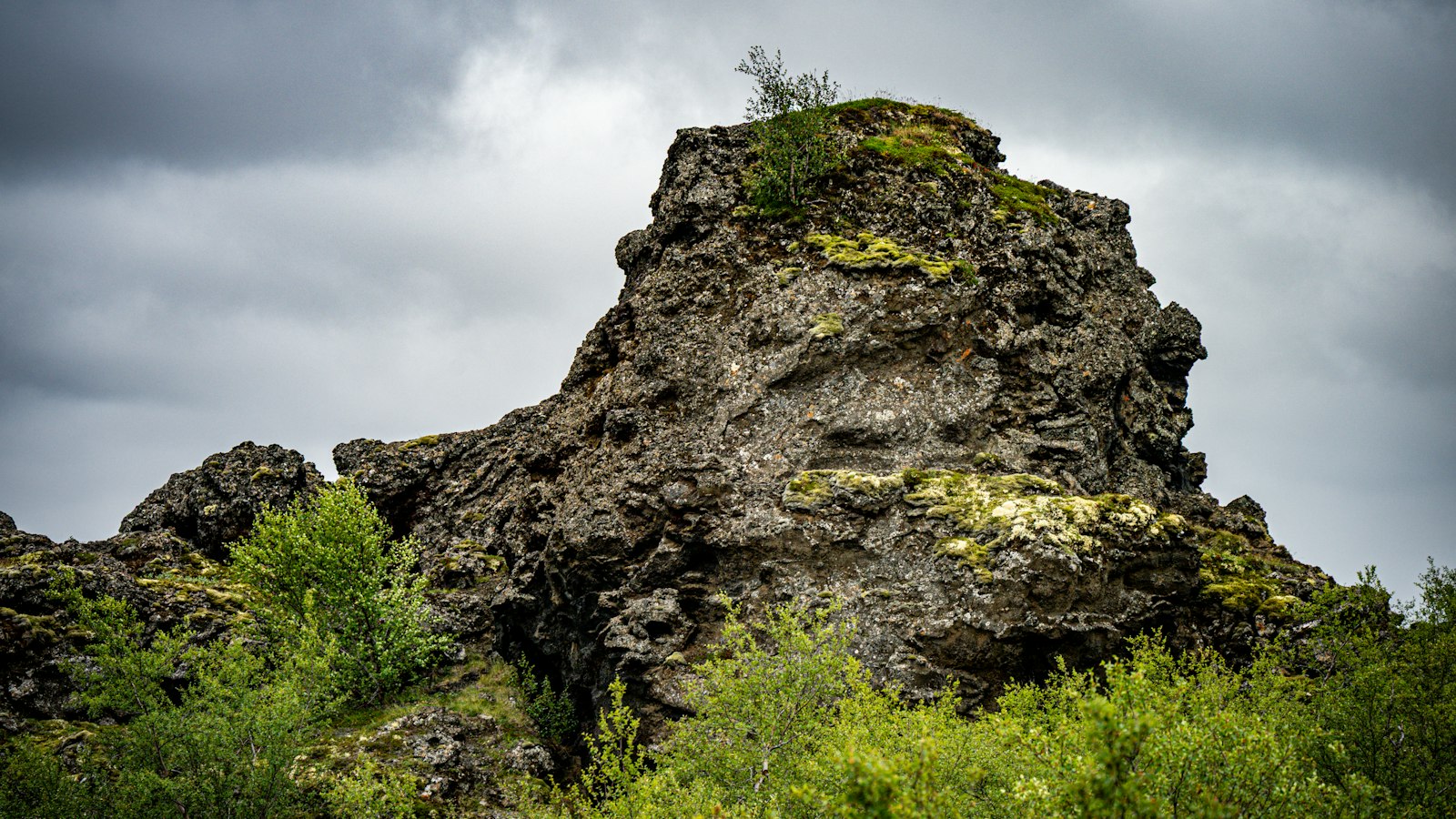
East of Mývatn, a distinctive landscape unfolds: Dimmuborgir, an Icelandic term meaning “dark cities” or “dark castles.” This region is shaped by a combination of volcanic forces and unusual geological processes, carving out a site unlike any other in the country.
Creation beneath a lava lake
Dimmuborgir owes its dramatic appearance to a volcanic event about 2,300 years ago. Lava streamed in from an eruption in the Þrengslaborgir and Lúdentsborgir crater rows, filling a basin that once held a small lake. When the hot lava met the water-saturated earth below, the results were explosive. The marshy ground began to boil, sending steam and vapour surging upward through the molten rock.
This interaction shaped pillars ranging from the thickness of drainpipes to several metres in diameter. As the lava cooled on the surface, it formed a crust, sometimes even a roof, above the still-molten rock below. When the lava eventually flowed out or continued on its downward path toward lower ground near Mývatn, the top crust and parts of the surface collapsed, but the hollow columns remained. Some stand close to ten metres tall, a silent measure of the lava lake’s depth.
The current landscape at Dimmuborgir exists below the surrounding land, marked by intriguing hollows, chambers, and pillars. Some of these formations are large enough for a person to stand inside, resembling rooms in a crumbling fortress or ancient ruins, hence the name’s reference to cities or castles.
Folklore, legend and cultural echoes
Icelandic folklore adds another layer to Dimmuborgir’s mystique. Some stories suggest it serves as a threshold between the Earth and infernal realms. Nordic Christian tales even claim that this was where Satan landed after being cast from heaven, leading to references such as “The Catacombs of Hell.”
Cultural references reach into the present as well. The Norwegian band Dimmu Borgir took its name from this locale. Dimmuborgir’s unique shapes and atmosphere have also drawn film crews, including for the widely known series Game of Thrones, where its lava fields appeared as the wildling camp of Mance Rayder.
Among the area’s many rock formations, Kirkjan stands out. Its name means “the church,” and the formation is famous for its vaulted lava roof open at both ends, remarkably similar to a natural cathedral.
Sources
- Wikipedia
- Wikipedia (Icelandic) in Icelandic


