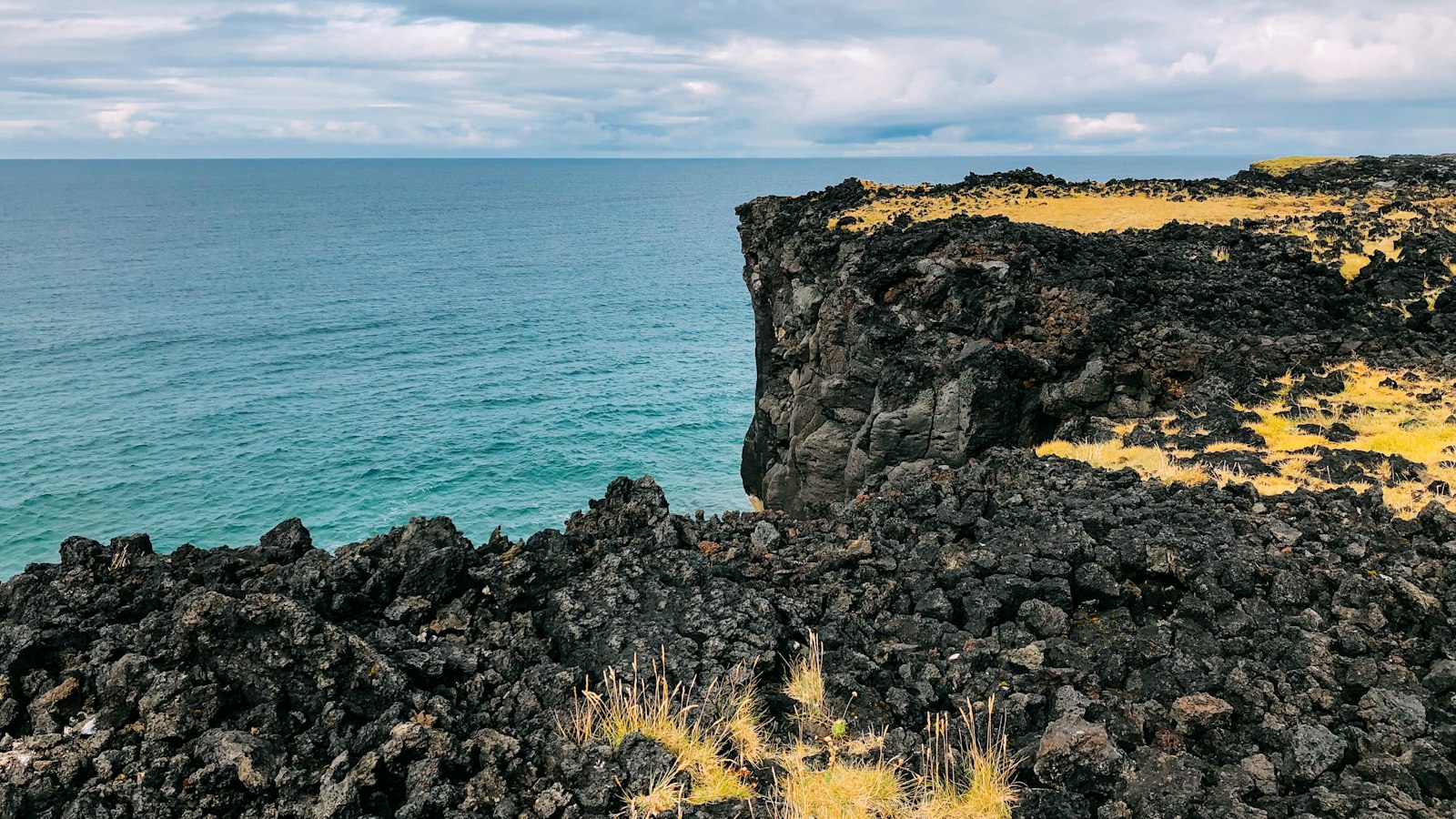
On Iceland’s rugged western Snæfellsnes Peninsula, Djúpalónssandur stands out as a place shaped by both volcanoes and centuries of fishing heritage. Situated some 200 kilometres northwest of Reykjavík, this pebble and black sand beach lies within the protected boundaries of Snæfellsjökull National Park, near the well-known Snæfellsjökull glacier and volcano.
Djúpalónssandur marks a meeting of land and sea, bordered by jagged lava fields formed by eruptions of Snæfellsjökull. The terrain is characterised by dramatic sea stacks, steep cliffs, and the powerful surf of the North Atlantic, creating a landscape both harsh and compelling.
Geology and coastal forms
The shore is dominated by millions of smooth, black volcanic pebbles called Djúpulónsperlur, or “Pearls of Djúpalón,” shaped by the tides and time. These stones are a distinctive natural feature, locally valued and traditionally left untouched so the beach retains its unique character.
Approaching the sea requires crossing the Dritvík lava field, known as Dritvíkurhraun, which showcases natural rock sculptures like Gatklettur, a lava arch with a name meaning “hole rock.” Folklore weaves around many of these sites: a nearby cave is called Draugahellir, or the “Ghost Cave,” while Tröllakirkja, or the “Troll Church,” is a rock fissure in the cliff wall. The place names themselves hint at the supernatural atmosphere that has lingered here.
Remnants of daily life at sea
During the 18th and 19th centuries, Djúpalónssandur was the hub of a busy fishing village. Just to the west lies Dritvík, which became one of Iceland’s most important seasonal fishing stations, with as many as 60 boats at its peak. Reminders of that era remain on the landscape, including the scattered iron of the British trawler Epine GY7, shipwrecked here in March 1948. Fourteen men lost their lives in the accident, a sobering echo of the risks faced by local seafarers.
Near the black sands, four lifting stones, Steinatök, speak of the community’s daily life. Each stone has its own name and set weight: Amlóði (23 kg), Hálfdrættingur (49 kg), Hálfsterkur (100 kg), and Fullsterkur (154 kg). Prospective fishermen once had to demonstrate strength by lifting at least the Hálfdrættingur, making these stones a lasting monument to the demands of fishing life.
Freshwater ponds found above the pebble banks give the bay its name, Djúpalón, or “Deep Ponds.” The landscape, full of hidden stories and carved by both humans and the environment, has also attracted filmmakers drawn to its unearthly vistas.
Sources
- Wikipedia
- Wikipedia (Icelandic) in Icelandic


