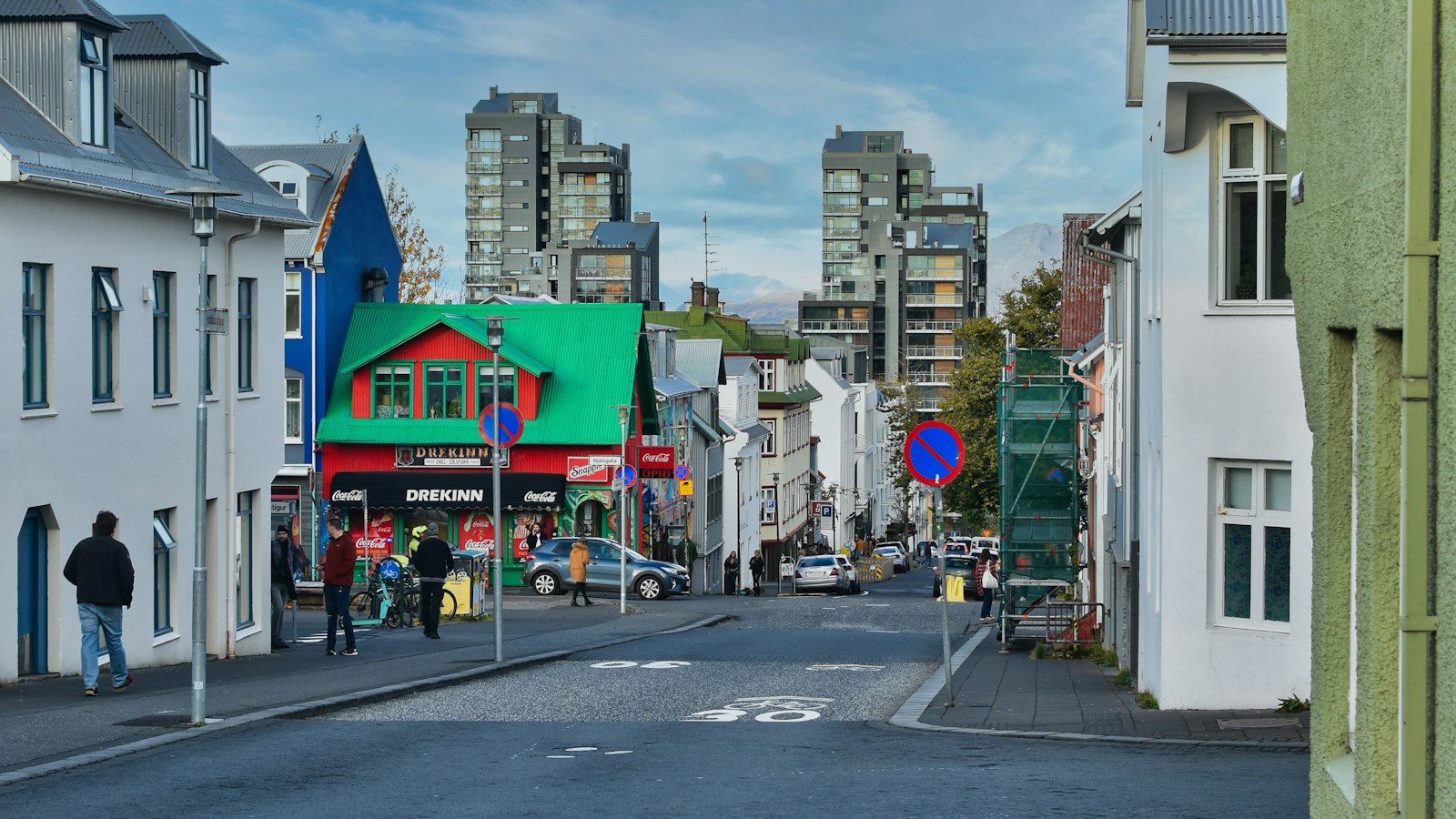
In the centre of Reykjavík, Lækjargata traces a line from the city pond (Tjörnin) to the sea. Its name comes from the Icelandic word “lækur,” meaning stream, marking the path once taken by an open waterway through what is now the heart of the capital.
A street of early Reykjavík
The land around Lækjargata was far different in the city’s earliest days. During the settlement period, it belonged to the farmers of Vík and was part of the marshy expanse known as Austurvöllur. In 2015, archaeologists uncovered the remains of a turf building from the 10th or 11th century at 10–12 Lækjargata. Stretching 22 metres in length with a hearth over five metres long, it hints at the area’s long human presence.
By the late 1700s, Reykjavík itself was just beginning to take shape. When Reykjavík Cathedral was constructed in 1787 next to Austurvöllur, two houses appeared nearby along what would become Lækjargata. One, to the south-east of the cathedral, was a turf farmhouse called Kirkjuból (“church dwelling”), later renamed Lækjarkot (“stream cottage”).
At the time, the street was named Heilagsandastræti, or “Holy Spirit street”, a nod to its early residents: Bishop Helgi Thordersen and the cathedral priest Ólafur Pálsson. As Reykjavík grew, so did the street, stretching south beside the stream to Tjörnin pond.
Water crossing and urban development
For decades, the stream was both landmark and nuisance. In the first years of Reykjavík, it flowed between stone-edged banks, with at least three bridges crossing its path. Lækjargata, then, was considered the only truly wide street in Reykjavík’s centre.
Open sewers fed into the stream. When it ran exposed, residents jokingly called Lækjargata “the fragrant path” due to the smell. In 1828, a bridge spanned the stream, encouraging the growth of Lækjartorg square and the opening to Bankastræti, another key street. The wooden house that replaced the old Lækjarkot in 1887 became known as Lækjargata 10a.
In 1911, the stream was redirected below ground, doubling the width of the street above. The transformation marked a broader urbanisation of Reykjavík. Lækjargata soon bordered institutions at the heart of Icelandic public life. In 1846, number 7 on the street became the new site for Menntaskólinn í Reykjavík, one of Iceland’s oldest educational establishments.
Literature, too, preserves memories of the stream. In “Innansveitarkronika” by Halldór Laxness, Lækjargata’s waterway is described as home to sticklebacks, and sometimes even eels making their way from the Sargasso Sea to Tjörnin behind Alþingishúsið (the Icelandic parliament) and the cathedral.
Sources
- Wikipedia
- Wikipedia (Icelandic) in Icelandic


