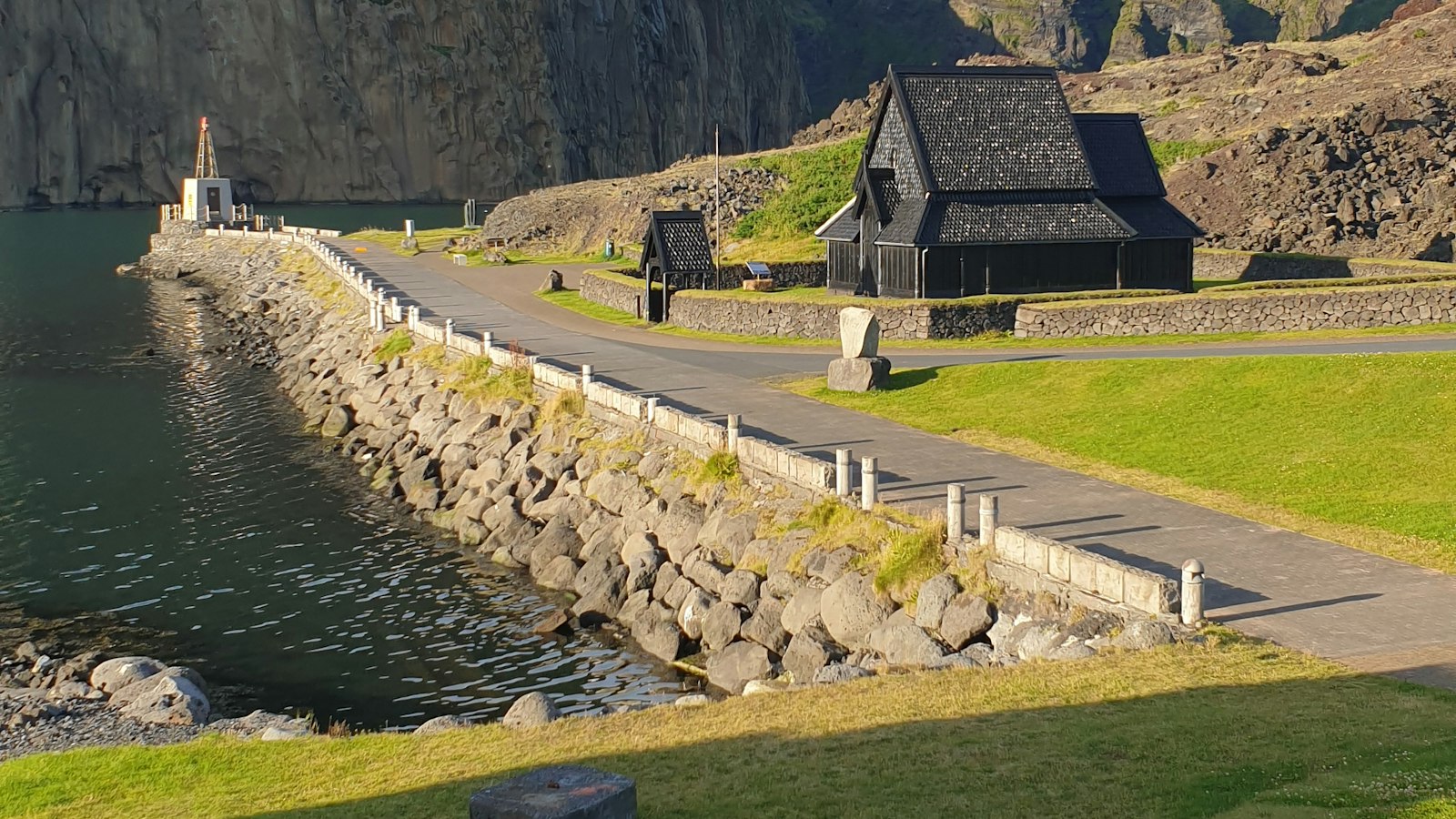
A unique wooden church rises near the harbour in Vestmannaeyjabær, on the island of Heimaey in Iceland’s Vestmannaeyjar archipelago. Known as the Heimaey Stave Church (Stafkirkjan), it reflects not only Iceland’s religious past but also centuries of architectural tradition from another corner of the North.
Symbol of an ancient connection
The presence of the stave church on Heimaey is closely tied to a significant turning point in Iceland’s history: the year 1000, when the country formally adopted Christianity, under the influence of the Norwegian king Olav Tryggvason. On the thousandth anniversary of that conversion, Norway presented Iceland with a remarkable gift, a faithful replica of the Haltdalen stave church, a structure dating to the 1170s. While the earliest Christian building in Iceland was a post church, a simpler wooden type, the stave church evokes the medieval ecclesiastical forms once widespread in Norway.
The building was completed at a site called Skansinn by the harbour, an area reshaped by lava from the 1973 eruption of the volcano Eldfell. It stands on newly formed ground, the product of natural forces that are as much a part of Heimaey’s story as its human history.
Craftsmanship across the sea
Construction began not in Iceland, but in Lom Municipality in Norway. Materials were chosen from various regions: timber from Røros, shingles from Odalen, and ironwork from Vågå, among others. The effort stretched from 1998 to 2000, overseen by Elisabeth Seip, a professor specialising in cultural heritage research. Once finished, the church was transported across the North Atlantic, its shipping arranged free of charge by the Icelandic company Eimskip.
To meet the challenges of Heimaey’s exposed and often stormy conditions, the design included a wooden gallery circling the outside. This feature, drawn from other historic stave churches, adds strength and stability to the building against the winds common to the Vestmannaeyjar.
Inside, the altar is adorned with a replica of the St Olav frontal, a medieval Norwegian masterpiece now kept at Nidaros Cathedral. The altar piece, commissioned by the National Church of Norway, adds another layer of historical resonance to the structure, recalling both religious and artistic ties between the two countries.
Supported by both Norwegian and Icelandic government grants, as well as private sponsorship, the project was as much a diplomatic gesture as a heritage effort. Since its consecration and opening in July 2000, the stave church has offered a place to reflect on distant connections, historical change, and the ongoing presence of old traditions in a landscape shaped by fire and sea.


