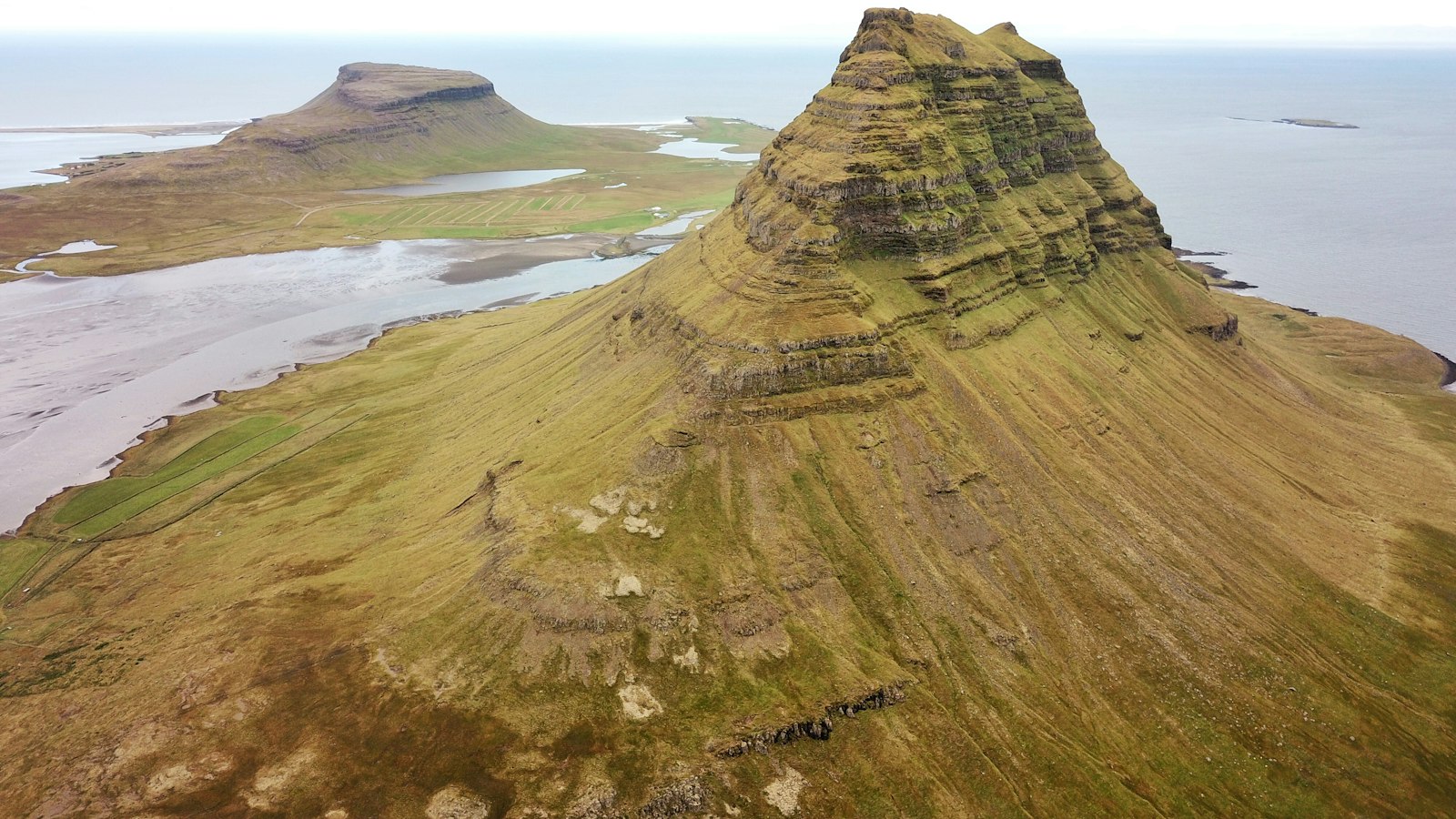
Positioned west of Borgarfjörður, Snæfellsnes is a peninsula that stands out for both its geography and the stories that have shaped it. Flanked by Faxaflói to the south and Breiðafjörður to the north, this region forms a natural link between ocean, mountain, and myth. Its wide, dramatic landscapes reflect the volcanic forces that created it, dominated by a central mountain chain.
A volcano at the heart of legends
The peninsula’s most unmistakable feature is Snæfellsjökull, an imposing stratovolcano rising 1,446 metres above sea level. At the summit, a glacier crowns the mountain, making it visible from Reykjavík on clear days, about 120 kilometres away. This peak has secured a place in literature as the entrance to the fantastical journey in Jules Verne’s novel, where it serves as the gateway to the centre of the Earth. Beyond fiction, the area around Snæfellsjökull is protected as one of Iceland’s national parks, now also recognised as a UNESCO biosphere reserve as of 2025.
Snæfellsnes was one of the key settings for the Laxdœla saga, an iconic medieval text. Historical figures such as Guðrún Ósvífursdóttir and Snorri Goði are linked to these landscapes, grounding the peninsula’s wild scenery in the lives and struggles of early Icelanders.
Natural richness and sustainable efforts
Ecologically, Snæfellsnes is distinctive for its diversity in both flora and fauna. Over 320 species of flowering plants and ferns are found here, including the uncommon Ligusticum scoticum, which in Iceland grows only on the west side of the peninsula. Wetlands along the southern shore are comparatively undisturbed, supporting a variety of plant life and providing habitat for wading birds. Birdwatchers may spot up to 13 wader species and more than 60 types of nesting birds, including puffins at the peninsula’s western edge in summer, as well as populations of white-tailed eagles and short-eared owls.
Nearby Breiðafjörður is known for its robust marine ecosystem, with seaweed and kelp forests that sustain Iceland’s largest communities of seals and seabirds. Killer whales and other large marine mammals are often seen offshore. After decades of decline, seal hunting stopped across Iceland in 2019, contributing to wildlife resurgence.
The only native land carnivore in Iceland up to modern times, the arctic fox, is found in two distinct populations here; in Snæfellsjökull National Park, hunting of the species has been banned since 2001. The arrival of the American mink, which escaped domestication in the 1930s, has since impacted the local ecosystems. Among rodents, the wood mouse is particularly numerous in this region.
A peninsula of communities
Several coastal villages and towns rely on fishing, reflecting a tradition as old as settlement itself. Along the north coast are Stykkishólmur, Grundarfjörður, Ólafsvík, Rif, and Hellissandur, while Arnarstapi and Hellnar are small communities on the southern side. The area’s cultural landmarks include the Ingjaldshóll Protestant church. Near Hellissandur, the longwave radio mast holds the title of tallest structure in western Europe.
In 2008, Snæfellsnes became a trailblazer for sustainable communities when it joined EarthCheck, the international certification programme. By reaching this benchmark, it stood out as the first European and Icelandic area to do so, and joined only a handful of similar regions globally.
Sources
- Wikipedia
- Wikipedia (Icelandic) in Icelandic


