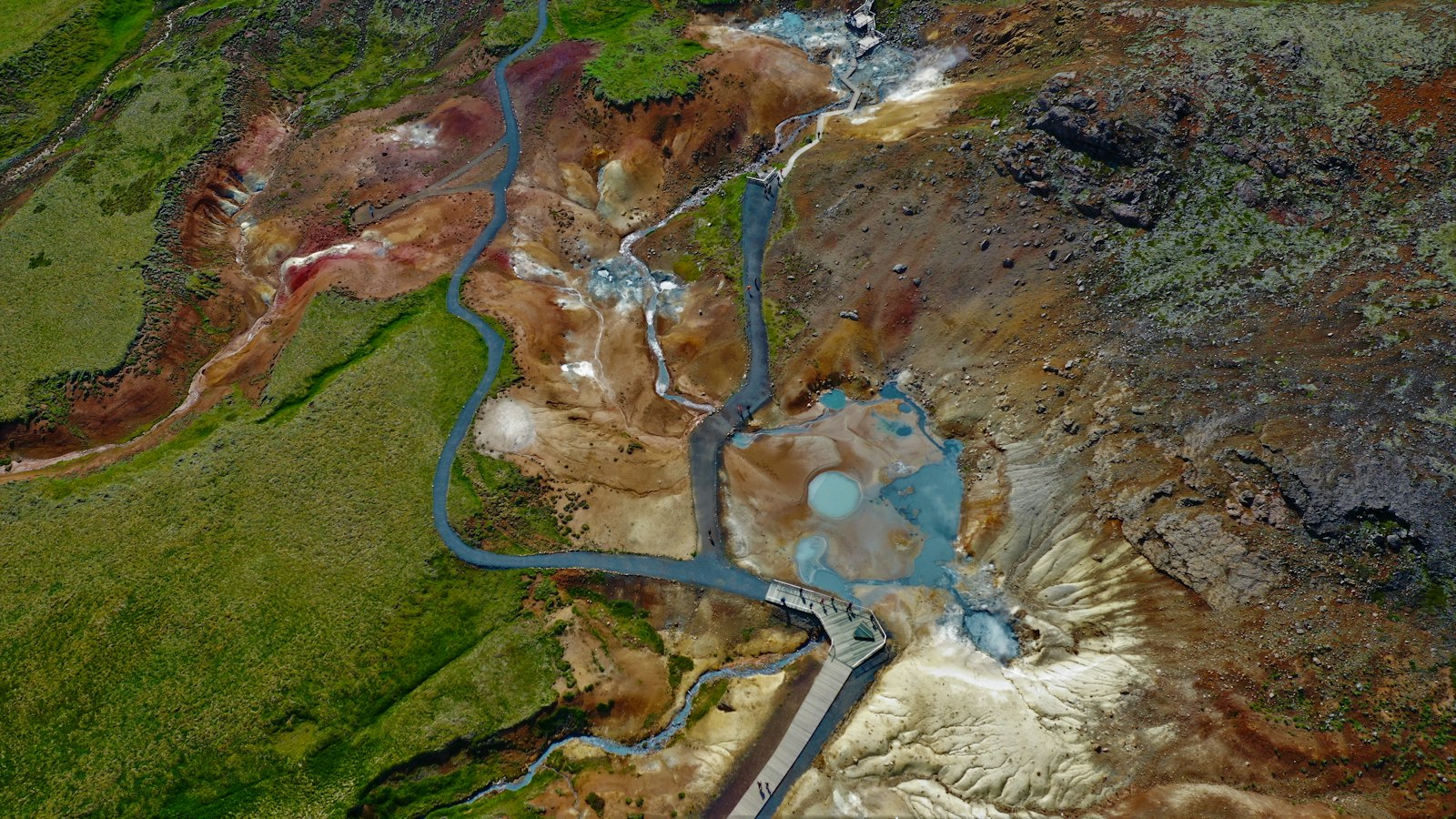
On the southwest tip of Iceland, where the Reykjanes peninsula meets the restless Mid-Atlantic Ridge, lies a landscape more alive than most. Seltún Hot Springs (Icelandic: Seltúnshverir), also known as Krýsuvík-Seltún, is a place where the earth’s internal energy bubbles to the surface, shaping everything from the land’s texture to its distinctive colour palette.
A tapestry of minerals and mud
Seltún’s ground steams, hisses and oozes, a result of its placement within the Krýsuvík volcanic system. Here, superheated waters rise through deep cracks and emerge as boiling springs, fumaroles and bubbling mud pools. The water at the source can exceed 50°C, while warm springs range from 34°C to 50°C. Hydrogen sulphide gas billows from the fumaroles, which, after oxidation, gives the area its striking yellow and orange crust thanks to native sulphur and sulphuric acid.
This geothermal activity isn’t just a show for the senses. The area’s kaolinite-rich mud pits, high in silica and alumina, are also tinged red by iron oxide, creating a stark counterpoint to the blue mud pools loaded with pyrite. These vivid mineral displays transform the surface with rings and streaks of earthy and metallic hues rarely found in nature elsewhere.
History and geology woven together
Sulphur was actively mined at Seltún until the late 19th century, a reminder of how Icelanders have long interacted with their geologically active landscape. Dramatic events continue to shape Seltún’s evolution. Explosions have periodically struck, most recently in 1999 when a drilling accident opened a new vent, and also in 2010 and 2019, when eruptions out of mud, water and steam spread across the terrain.
The land itself consists of post-glacial lava fields, basaltic rocks, pillow-basalt ridges and breccias formed in the Quaternary geological period. Volcanic eruptions have repeatedly altered this area, with the last event recorded in the 13th century. The ongoing geothermal processes on view at Seltún are part of a much broader story about how Iceland is still very much a landscape in formation.
For safety and to preserve fragile features, a boardwalk and viewing platforms traverse the hot ground, allowing visitors and locals alike to observe the dynamic surface without leaving a mark.


