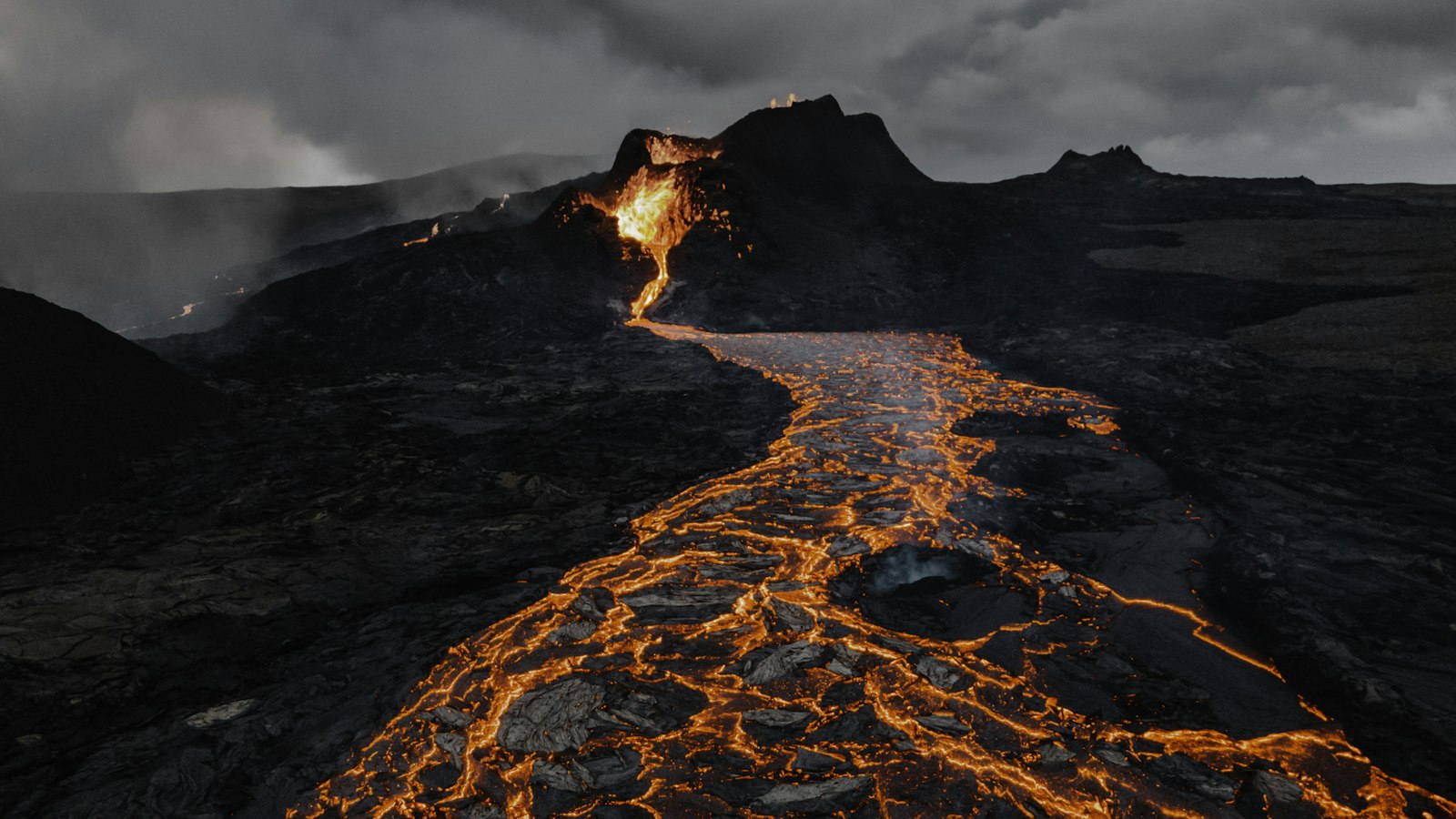
High in the central Highlands, surrounded by the volcanic Dyngjufjöll mountains, lies Öskjuvatn, a lake whose story is closely tied to some of Iceland’s most powerful geological forces. With a surface area of about 11 km², Öskjuvatn fills much of the caldera created by a violent eruption in 1875 within Askja volcano, its Icelandic name simply means “Askja lake.”
The landscape here changed rapidly after the 1875 eruption. The ground collapsed, opening up a vast depression which soon filled with water, creating a new lake. For over a century, Öskjuvatn held the record as Iceland’s deepest lake. Although Jökulsárlón lagoon has now edged ahead in depth, Öskjuvatn still reaches remarkable depths of up to 217 metres beneath the surface, nearly the height of a 70-storey building.
Scientific exploration and shifting shores
Öskjuvatn quickly drew the attention of explorers and scientists. Shortly after it formed, in 1876, the first survey described its nearly circular shape, light-green water shaded with volcanic pumice, and warmth caused by recent geothermal activity. Over the decades that followed, regular measurements captured the dynamic changes in the lake’s size and temperature. By the late 1800s, the water was cooling and the lakebed slowly sinking.
A curious episode in the lake’s history occurred in 1907 when two German researchers, Walter von Knebel and Max Rudloff, vanished while boating on Öskjuvatn. The lake at that time was described as about 5 by 3 kilometres in size and lying well below the caldera rim. Their disappearance sparked a search expedition led by Knebel’s fiancée, Ina von Grumbkow, joined by volcanologist Hans Reck. Though there were suggestions that volcanic tremors or underwater landslides played a part, the scientists were never found.
An evolving volcanic landscape
Throughout the 20th century, both the contours and the depths of Öskjuvatn continued to change, shaped by ongoing volcanic activity around Askja. Surveys, including the first complete bathymetric chart in 1963, showed gradual subsidence of the lake floor and adjustments along its shores. By 2012, fresh measurements hinted at even deeper points, though precise figures await correction for temperature.
The story of Öskjuvatn is still unfolding. It remains a vivid reminder of the power held beneath Iceland’s volcanoes, and of the lure such landscapes hold for explorers and researchers drawn to the ever-changing Highlands.
Sources
- Wikipedia
- Wikipedia (Icelandic) in Icelandic


