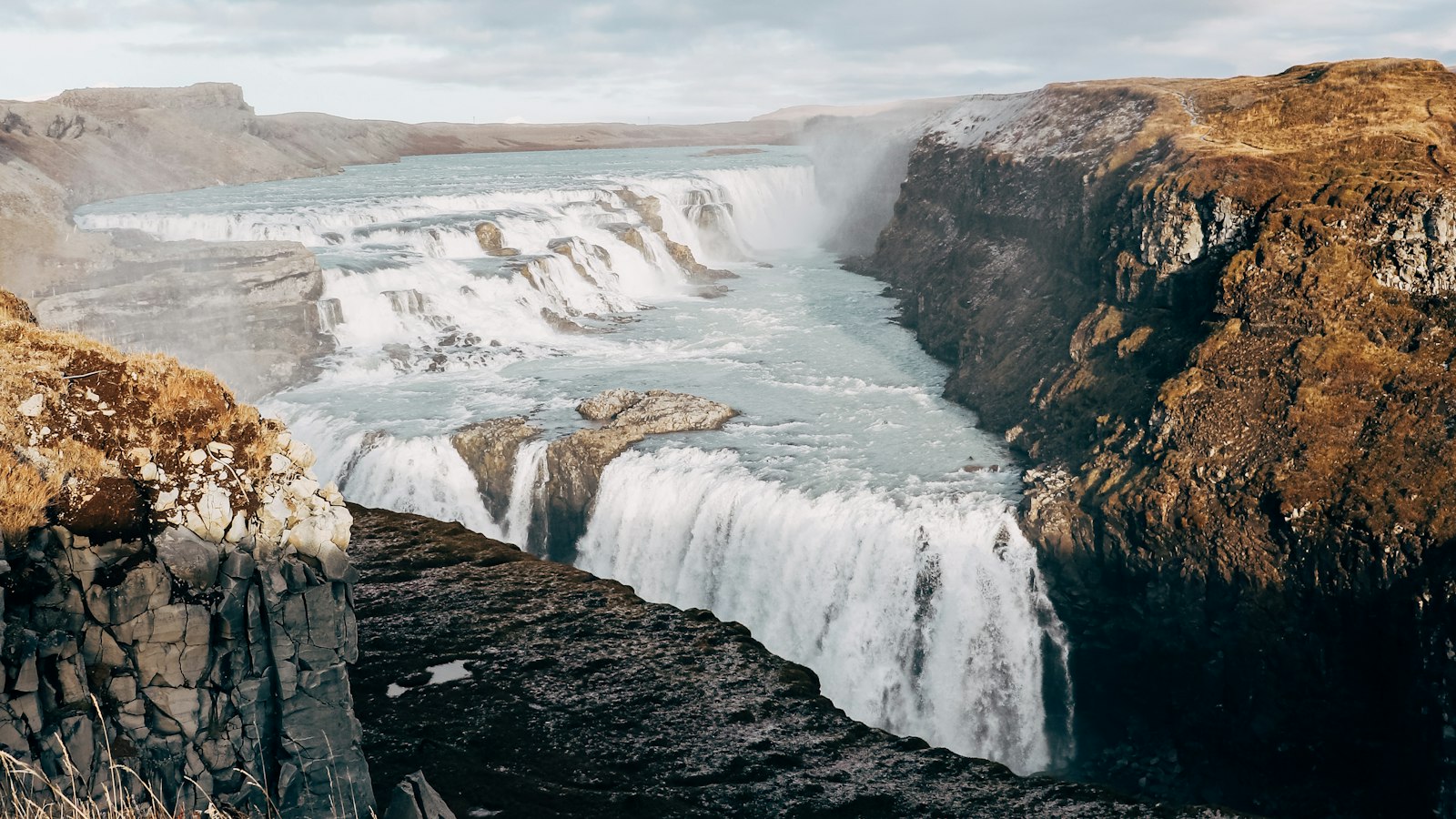
Gullfoss, or “Golden Falls,” lies within the canyon of the Hvítá river, marking a dramatic sweep of water in southwest Iceland. Situated between the municipalities of Bláskógabyggð and Hrunamannahreppur, Gullfoss forms a centrepiece of the landscape and is a key location on the route known as the Golden Circle near Reykjavík.
A river’s descent into history
Approaching Gullfoss, the Hvítá river takes a sudden turn about a kilometre upstream, cascading down a broad staircase made of three drops. The water then plunges in two stages, first 11 metres, then another 21 metres, into a crevice measuring 32 metres deep. This dramatic chasm is around 20 metres wide and stretches for about 2.5 kilometres at a nearly right angle to the river’s direction.
The volume of water coursing through Gullfoss shifts with the season: in summer, the average flow reaches 141 cubic metres each second, while in winter it is reduced to 80 cubic metres per second. During major floods, the flow has peaked at 2,000 cubic metres per second, reshaping the canyon repeatedly over the centuries.
Debates over power and preservation
In the early 20th century, as Iceland explored ways to harness its natural features for electricity and industry, Gullfoss came under consideration for hydroelectric development. The falls’ legal ownership became complex. Tómas Tómasson and Halldór Halldórsson, the landowners, leased rights first to others within Iceland and, indirectly, to foreign investors with ambitions to build power plants. Ultimately, financial and legal obstacles blocked these efforts.
During these years, Sigríður Tómasdóttir, daughter of one of the owners, became known for her determined stance against transforming Gullfoss into a power project. Tales of her advocacy, including her willingness to undertake dramatic actions to prevent industrial development, captured the imagination of many. Her involvement left a lasting mark: a memorial bearing her likeness overlooks the falls, commemorating the role she played in focusing public attention on the preservation cause.
Legal battles over water rights followed, involving claims and disputes between various leaseholders and owners. Even after the Icelandic state acquired the site around 1940, engineers and officials considered schemes to divert water for power production, but these plans never moved forward. By the late 1970s, with public sentiment increasingly in favour of conservation, Gullfoss was granted permanent protection, formally marking its transition from a source of industrial dreams to a symbol of environmental stewardship.
Today, Gullfoss stands not only as a natural wonder but also as a reminder of how Icelandic society’s priorities shifted. The falls continue to inspire, featuring in popular culture and attracting attention from around the world.
Sources
- Wikipedia
- Wikipedia (Icelandic) in Icelandic


