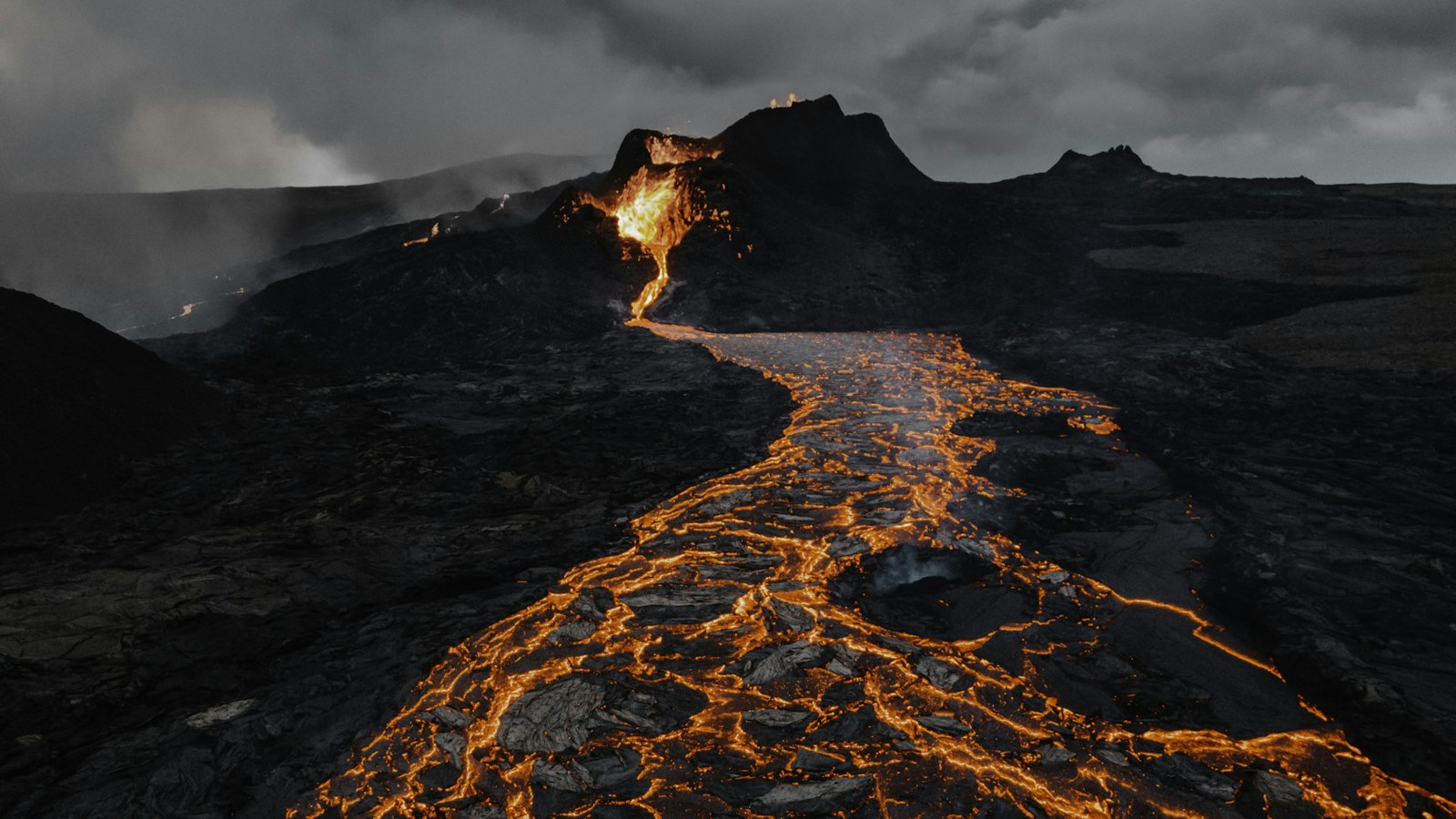
About 40 kilometres southwest of Reykjavík, the Fagradalsfjall volcano sits on the Reykjanes Peninsula, a region shaped by millennia of volcanic activity. Fagradalsfjall, whose name means “beautiful valley mountain” in Icelandic, describes both the tuya volcano itself and a broader volcanic system stretching 16 kilometres in length and 5 kilometres in width. Its highest point is known as Langhóll, which rises 385 metres above sea level.
A silent mountain awakens
Fagradalsfjall was formed during the last Ice Age when eruptions occurred beneath thick glaciers, shaping its flat-topped, steep-sided appearance. This mountain had remained dormant for around 6,000 years while the wider Reykjanes Peninsula last experienced a major episode of volcanic unrest in the 13th century.
That long silence ended dramatically on 19 March 2021, when a fissure opened in Geldingadalir, a valley to the south of Fagradalsfjall. This marked the first known eruption in the region in about 800 years. The event, known locally as “Geldingadalsgos,” began with a 600–700 metre long fissure vent expelling fresh lava. Over the next six months, lava flows spread into the surrounding valleys, periodically opening new fissures and forming a growing volcanic crater.
Distinctive eruptions and shifting plates
What set these eruptions apart was their effusive style, gentle outpourings of molten rock rather than explosive outbursts. Early studies of Fagradalsfjall’s 2021 eruption suggest its source was unusual: instead of a typical shallow magma chamber, the eruption may have been fed by a long and narrow magma channel linked deep into the Earth’s mantle. Some geologists have suggested this eruption could be the early stage of a new shield volcano.
Fagradalsfjall is located at the boundary where the Eurasian and North American tectonic plates are moving apart. This highly oblique rift zone causes both sideways and outward movement, shaping the volcanic landscape of southwest Iceland. Despite other volcanic systems nearby being more active in the past, the Fagradalsfjall system produced this unexpected event during a period of regional geological unrest, which included a series of strong earthquakes beginning in late 2019. One event in February 2021 reached magnitude 5.7 and caused minor damage to homes.
Eruptions continued into 2022 in Meradalir and again in 2023 near Litli-Hrútur, each time drawing interest from scientists and the public. The 2021 eruption, in particular, shifted the understanding of how magma can reach the surface in this part of Iceland.
The area has also witnessed other significant events. On 3 May 1943, a US Army Air Forces plane crashed on Fagradalsfjall, claiming 14 lives, including that of high-ranking officer Frank Maxwell Andrews. Andrews had an important role in Allied planning during World War II, and his successor, Dwight D. Eisenhower, would later become US president.
Sources
- Wikipedia
- Wikipedia (Icelandic) in Icelandic


