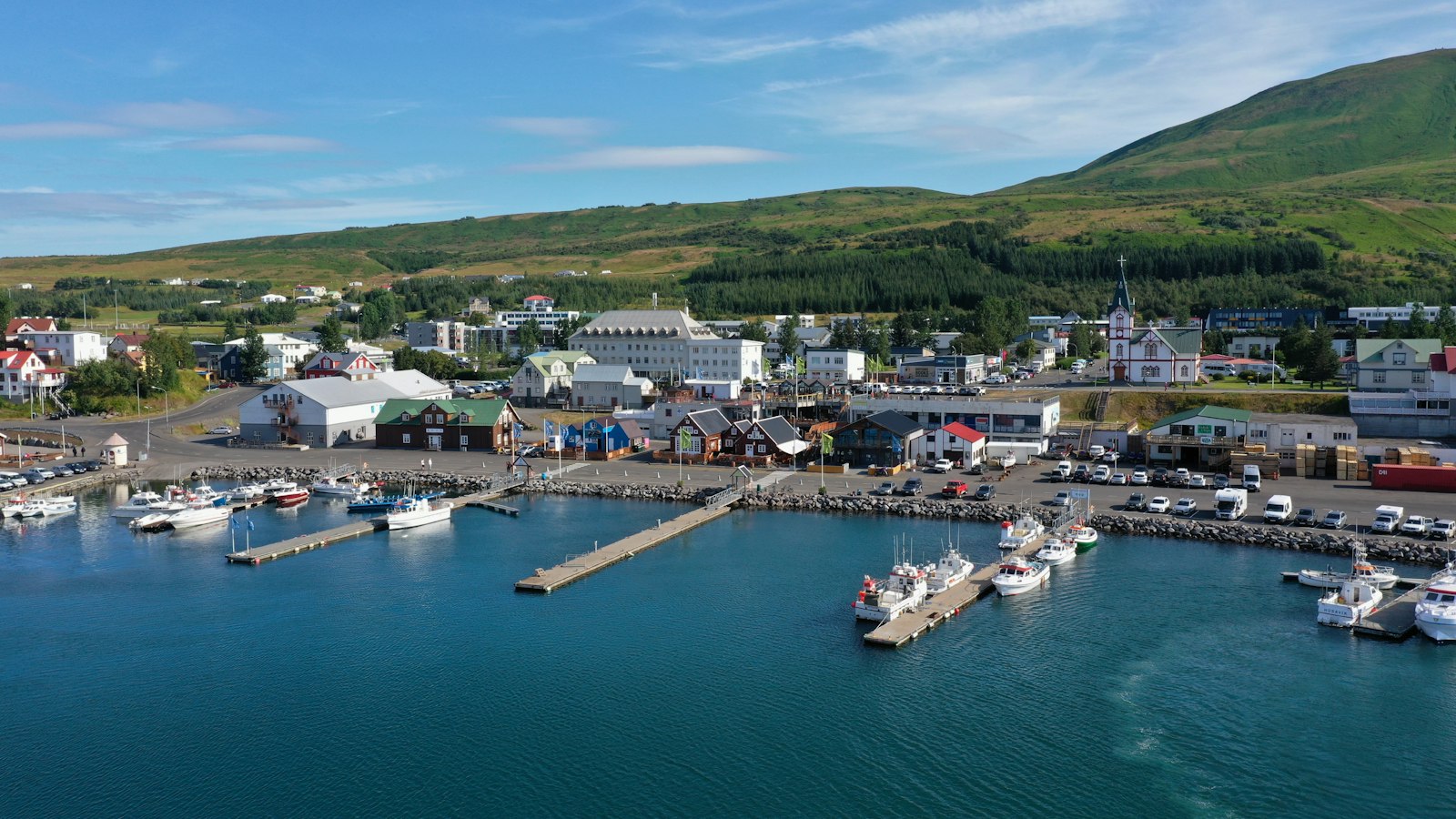
Along the windswept western expanse of the Skagi peninsula in northwestern Iceland, the village of Skagaströnd sits where land slips gently into Húnaflói, or “Húna Bay.” Although modest in scale, both the settlement and its surrounding coastline are layered with linguistic and historical significance, tracing their roots to the rhythms of sea and shore.
Skagaströnd is the single village within a municipality covering just under fifty square kilometres, one of the smallest self-governing regions in Iceland. This part of the country’s northwest is flanked by vast tracts of ocean and edged by neighbours Húnabyggð and Sveitarfélagið Skagafjörður. The closest town, Blönduós, lies a brief 18 kilometres to the south, but the journey to Sauðárkrókur, the regional capital, winding through rugged terrain, extends over fifty kilometres by road.
A shoreline steeped in tradition
The name Skagaströnd can be translated as “Coast of the Skagi”, a literal description but also a reference to a historical expanse. For generations, Icelanders used the term for a stretch of coastline from the far tip of the peninsula down to the mouth of a small river, the Laxá í Refasveit, north of Blönduós. This shoreline was dotted with verstöðvar, the communal fishing stations that shaped much of coastal Iceland’s economy and culture. Today, Skagaströnd marks both the municipality and its only village, but for many locals, it still evokes memories of traditional mooring sites and life around the sea.
Fishing continues to anchor Skagaströnd’s economy. In 1982, local fishers added a new chapter to the community’s maritime story by bringing the country’s first freezer trawler into service, a vessel built in Akureyri and known as Örvar HU-21.
Folklore at the foot of Spákonufell
Overlooking Skagaströnd is the mountain Spákonufell, known in English as “Seeress’ Mountain.” It stands 640 metres above sea level, more than a backdrop, the peak is woven into local lore and is a focal point for village identity. Legends tell of Þórdís, a seeress, giving her name to the mountain. From certain viewpoints, especially from the north or south, observers claim to discern Þórdís’s profile etched into the rock.
At the northwest edge of the settlement, the Spákonufellshöfði nature preserve covers a small headland, preserving both natural habitats and the sense of storied land meeting sea. Twinning with towns in Finland and Sweden links Skagaströnd to broader Nordic traditions, adding contemporary strands to the web of connections that define this coastal village.
Despite its scale, Skagaströnd’s place in Icelandic life is clear: a harbour town shaped by the pull of fish-rich waters, memorable landscapes, and enduring tales from the coast.
Sources
- Wikipedia
- Wikipedia (Icelandic) in Icelandic


