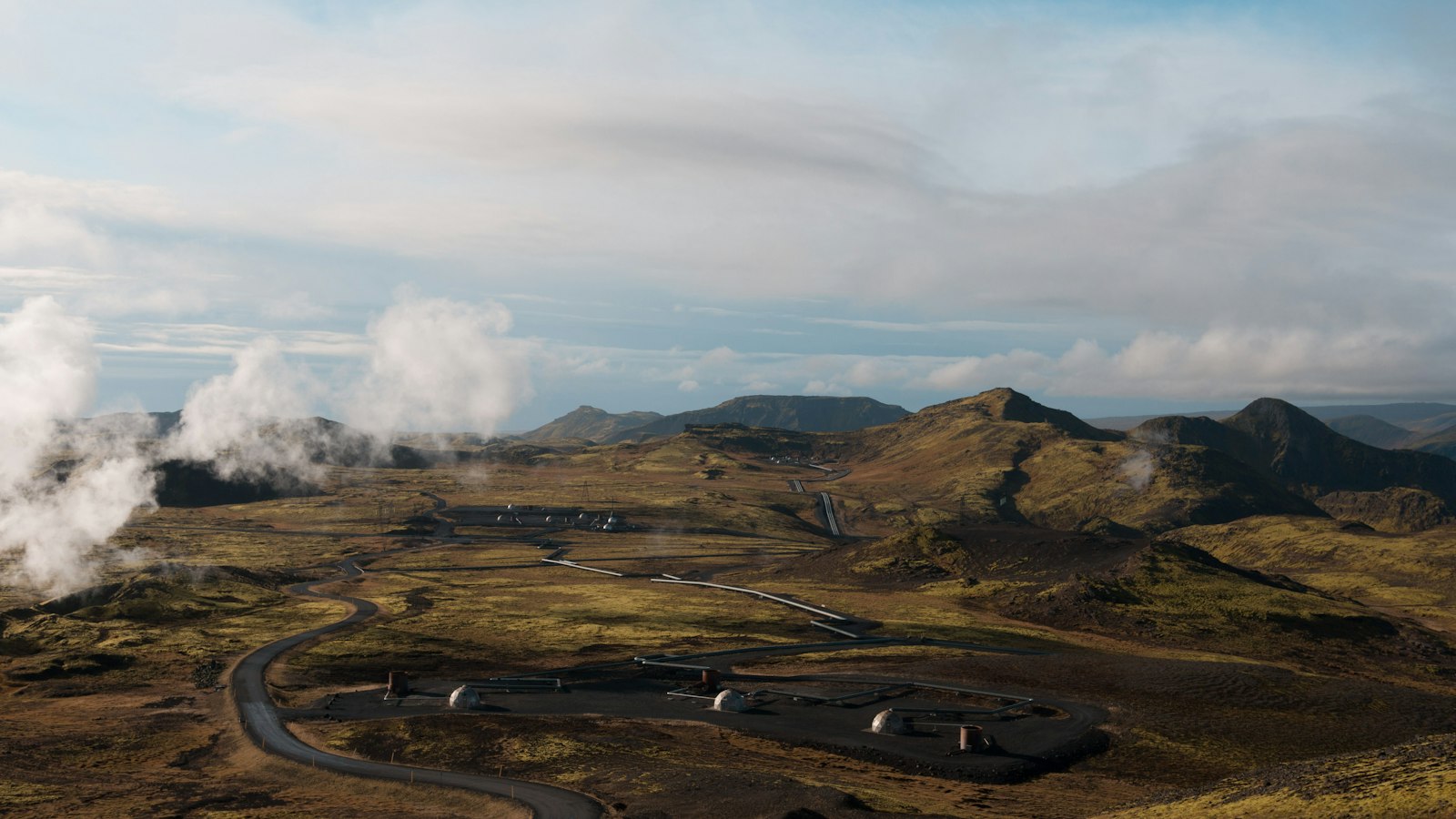
Among all nations, Iceland distinguishes itself with an electricity grid almost wholly powered by renewable energy. This outcome is not simply the result of policy, but a direct product of Iceland’s volcanic terrain and hydrological abundance. In 2025, the country’s electricity consumption reached 20,243 GWh, with 70.5% from hydropower, 29.4% from geothermal sources, and just 0.1% from fossil fuels.
Harnessing the power below and above ground
The country sits across the Mid-Atlantic Ridge, one of the world’s most tectonically active regions. Over 200 volcanoes and 600 hot springs populate the landscape, with more than 20 high-temperature steam fields (some exceeding 250 °C). These allow for extensive geothermal developments to heat buildings, provide hot water for swimming pools and fish farms, and drive electricity generation. A decade ago, geothermal sources supplied about 65% of Iceland’s primary energy, while hydropower contributed another 20%.
Industrial development followed the growth of hydroelectric infrastructure. After a pioneering small plant was built outside Reykjavík in 1904, larger municipal and government hydropower stations expanded capacity, especially after the founding of the state-owned Landsvirkjun in 1965. Projects such as the Kárahnjúkar Hydropower Plant (690 MW, completed in 2009) provided a basis for energy-heavy industries such as aluminium smelting. Landsvirkjun remains Iceland’s dominant producer, supplying 75% of the country’s electricity.
Energy at work in everyday life
Nearly every Icelandic home is heated using renewable resources, about 90% via geothermal energy and most others by electricity generated from renewables. Domestic heating was among the first applications: an early effort in 1907 channelled steam from a hot spring into a farmhouse. By the mid-20th century, extensive district-heating systems supplied hot water to major portions of Reykjavík.
With such ready access to energy, Iceland produces more electricity per capita than any other country, around 55,000 kWh per person per year (compared to less than 6,000 kWh in the European Union on average). Most of Iceland’s electricity is consumed by the aluminium industry and other energy-intensive activities, possible because of the low costs of locally sourced power.
While Iceland’s ambition is to reach carbon neutrality by 2040, the remaining use of fossil fuels, especially in transportation and fishing, persists as a challenge. Only the offshore islands Grímsey and Flatey remain outside the national grid, relying primarily on diesel power.
Wind energy, still nascent in Iceland, shows promise, with trial turbines demonstrating very high output rates for their size. There is also considerable untapped potential for both hydropower and geothermal energy, balanced carefully against environmental concerns.
Iceland’s landscape and climate make these achievements possible. Its energy story is shaped as much by geological forces from below as by human ingenuity above ground.


