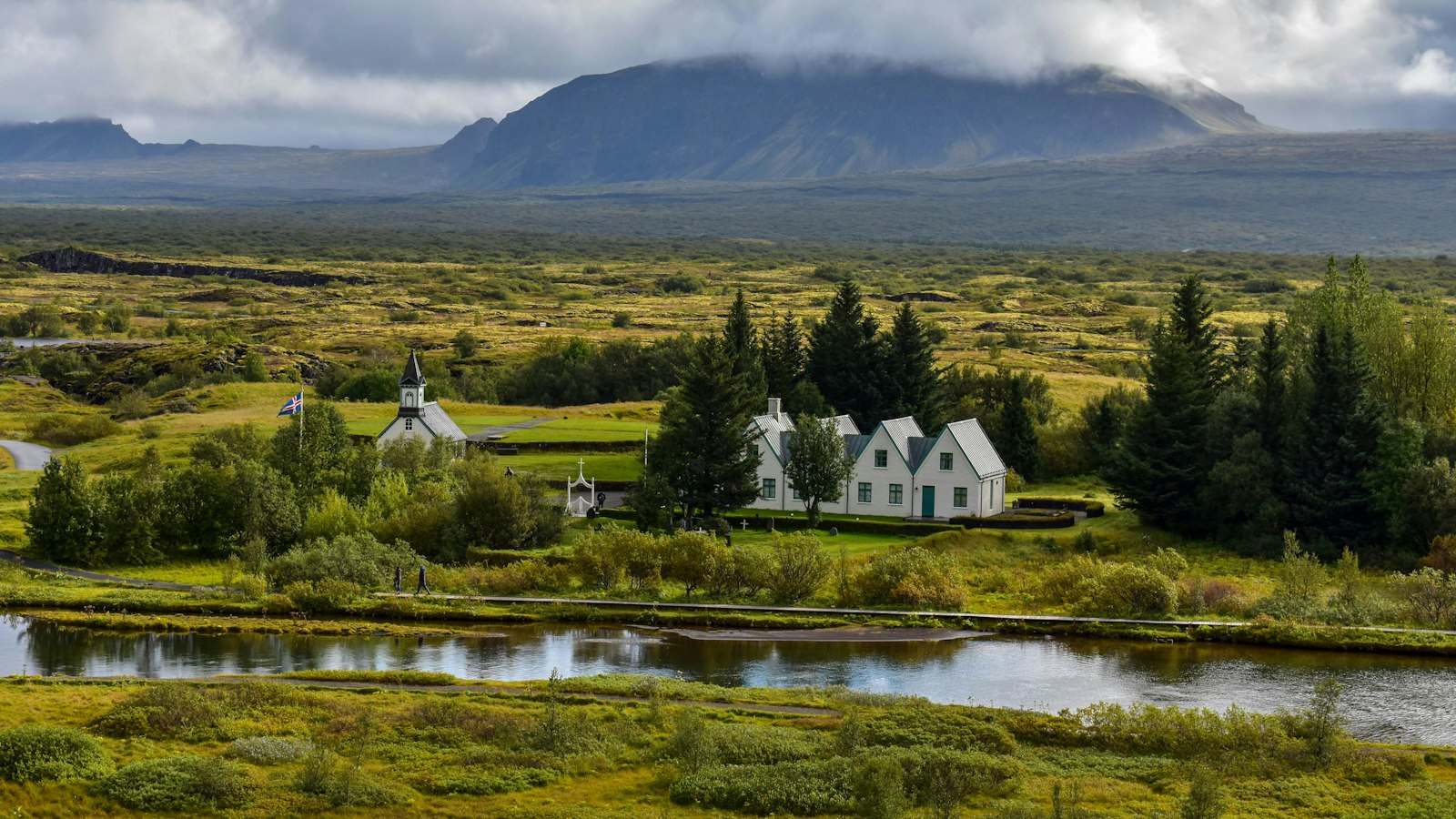
Borg á Mýrum sits just west of the town of Borgarnes, holding its place among Iceland’s oldest continuously inhabited sites. Tracing its history back to the earliest chapters of Icelandic settlement, Borg á Mýrum is woven into the nation’s story in ways that few other places can rival.
Roots in the sagas
The land first became notable during the ninth and tenth centuries, when Skallagrímur Kveldúlfsson settled there, as described in the medieval saga Egils saga. After claiming the land, Skallagrímur built his farm at Borg and established a household that would resonate through the centuries. His son, Egill Skallagrímsson, renowned both for his poetry and his fierce temperament, later lived and farmed on the estate. Generations of their descendants are believed to have remained at Borg á Mýrum, binding the location ever more tightly to Icelandic family history.
Borg á Mýrum is linked to further figures central to Iceland’s literary tradition. Snorri Sturluson, the famous historian and saga writer, is thought to have begun his farming life at Borg, possibly composing some of his works there. In the tale Laxdæla saga, Kjartan Ólafsson is said to be buried at Borg, connecting the place to a network of saga heroes and genealogy.
Art, memory and unusual church traditions
Over the centuries, Borg á Mýrum has been recognised as a major farm and a spiritual centre. A church has existed there since Christianity became law in Iceland around the year 1000, shortly after the time of Egill. The present church, built in 1880, stands out for its north–south alignment, an orientation rare among Icelandic rural churches. Another unusual feature is the separation of the church building from its graveyard by farm buildings, a layout that catches the attention both of residents and visitors.
Borgarkirkja’s altar painting, which depicts Christ blessing the children, was created by the British antiquary and artist William Gershom Collingwood after his journey to Iceland in 1897. Collingwood, already drawn by Icelandic history, captured the scene in a style influenced by the Pre-Raphaelite movement, a unique example of its kind in Iceland. In the late nineteenth century, Collingwood also reported seeing part of the old homestead constructed from ancient oak beams, although none now remain.
The memory of Egill Skallagrímsson is kept alive not only through sagas but also by a twentieth-century monument on the site. Icelandic sculptor Ásmundur Sveinsson created an abstract sculpture showing Egill mourning for his sons Gunnar and Böðvarr, an event immortalised in Egill’s poetic work, Sonatorrek.
Sources
- Wikipedia
- Wikipedia (Icelandic) in Icelandic


