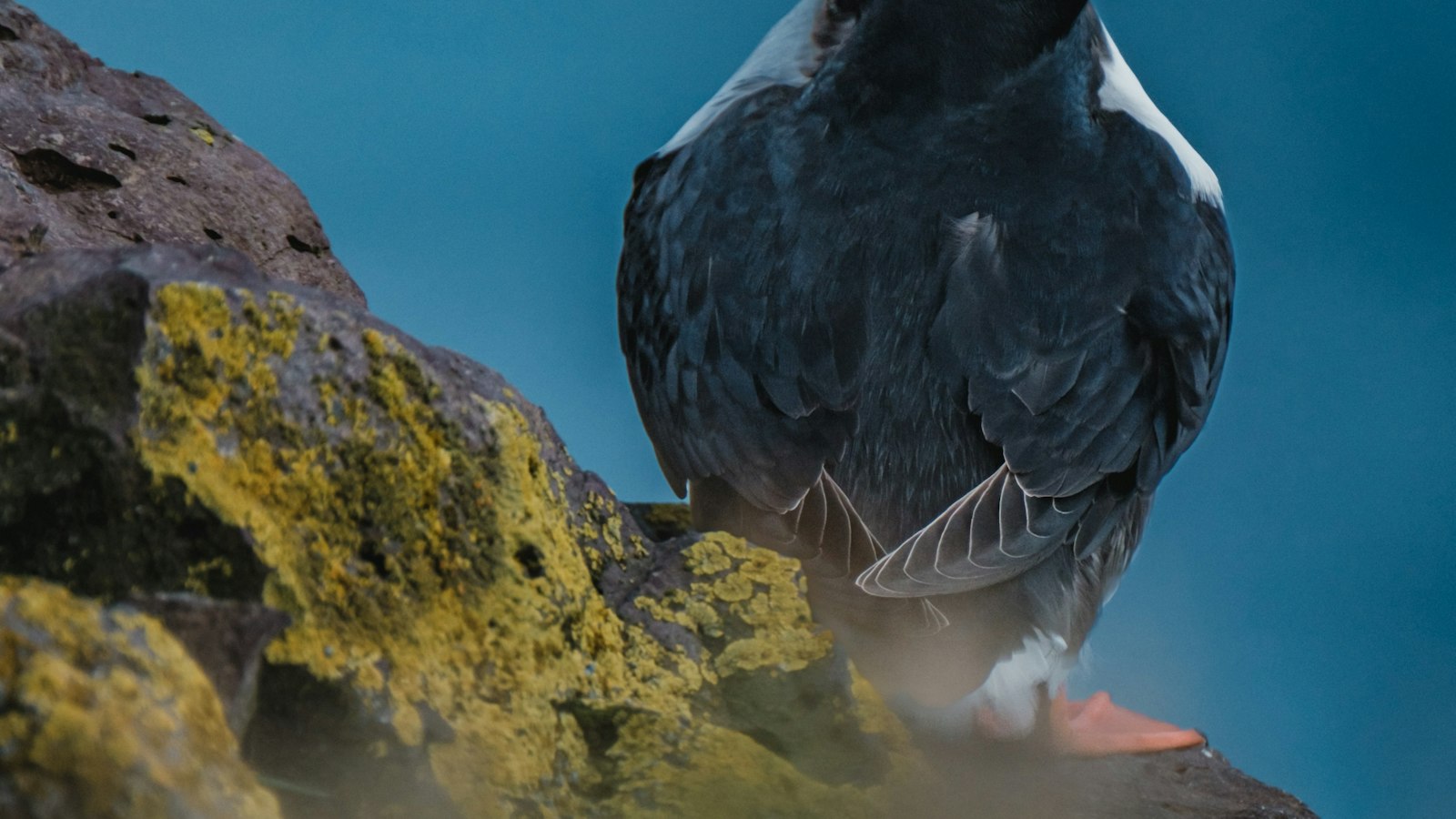
Clinging to the northern coasts of the Atlantic and Pacific, the black-legged kittiwake (Rissa tridactyla) leads a life shaped by wind, waves and isolation. This gull has a deep connection to Iceland, not only in its abundant presence but also in language: its genus name, Rissa, comes directly from the Icelandic “rita,” the word for kittiwake.
Language, lineage and life at sea
The black-legged kittiwake is a member of the Laridae, or gull family, and stands out for its almost exclusively marine existence. It was first formally described by Carl Linnaeus in 1758, who placed it in the genus Larus with the name Larus tridactylus. The name ‘tridactyla’ is from ancient Greek and means ‘three-toed’, a nod to its reduced or missing hind toe, unusual among gulls. Later, it was moved into the genus Rissa by the naturalist James Stephens in 1826.
In North America, the bird is called the black-legged kittiwake to distinguish it from the red-legged kittiwake found in the northern Pacific. In Europe and Iceland, where the red-legged species does not occur, it is often simply known as kittiwake. The distinctive English name comes from its raucous, repeated calls: “kittee-wa-aaake, kitte-wa-aaake.”
Nests among cliffs and daily behaviour
Kittiwakes are uniquely adapted to life at sea, often remaining far from land except during the short breeding season from May to September. They are the most pelagic of all Laridae, spending most of the year on the wing and rarely venturing inland except for the occasional vagrant.
Breeding offers one of the best opportunities to observe these birds. Kittiwakes prefer sheer sea cliffs for nesting, forming dense colonies that become alive with noise and activity as adults defend their nests or greet mates with a display of open, vividly red mouths. Both partners help in building the nest, incubating eggs (usually one to three), and rearing chicks, a model of shared parental effort in the bird world.
Their calls are not just namesakes; they serve as constant communication, whether a greeting, a mating call or an alarm when predators threaten. Colonies can fill the cliffs with their layered calls from sunrise to sunset.
Adult kittiwakes measure 37–41 centimetres in length, with a wingspan stretching 91–105 centimetres. Their white head and body contrast with a soft grey back, dark-tipped wings, black legs and a yellow bill. Though rare, individuals with pinkish legs can appear, and juveniles display a black ‘W’ across the wings and a solid black bill until adulthood at four years old.
The breeding kittiwake population in Iceland is thought to exceed 630,000, reflecting their success in this environment. While natural cliffs are their ancestral sites, rare examples from elsewhere show some adaptation to buildings, though not traditionally in Iceland.
With their acrobatic flight, gregarious nature and ancestral call echoing over North Atlantic cliffs, black-legged kittiwakes embody the rugged, sea-bound ecology that so strongly shapes Iceland and its coasts.
Sources
- Wikipedia
- Wikipedia (Icelandic) in Icelandic


