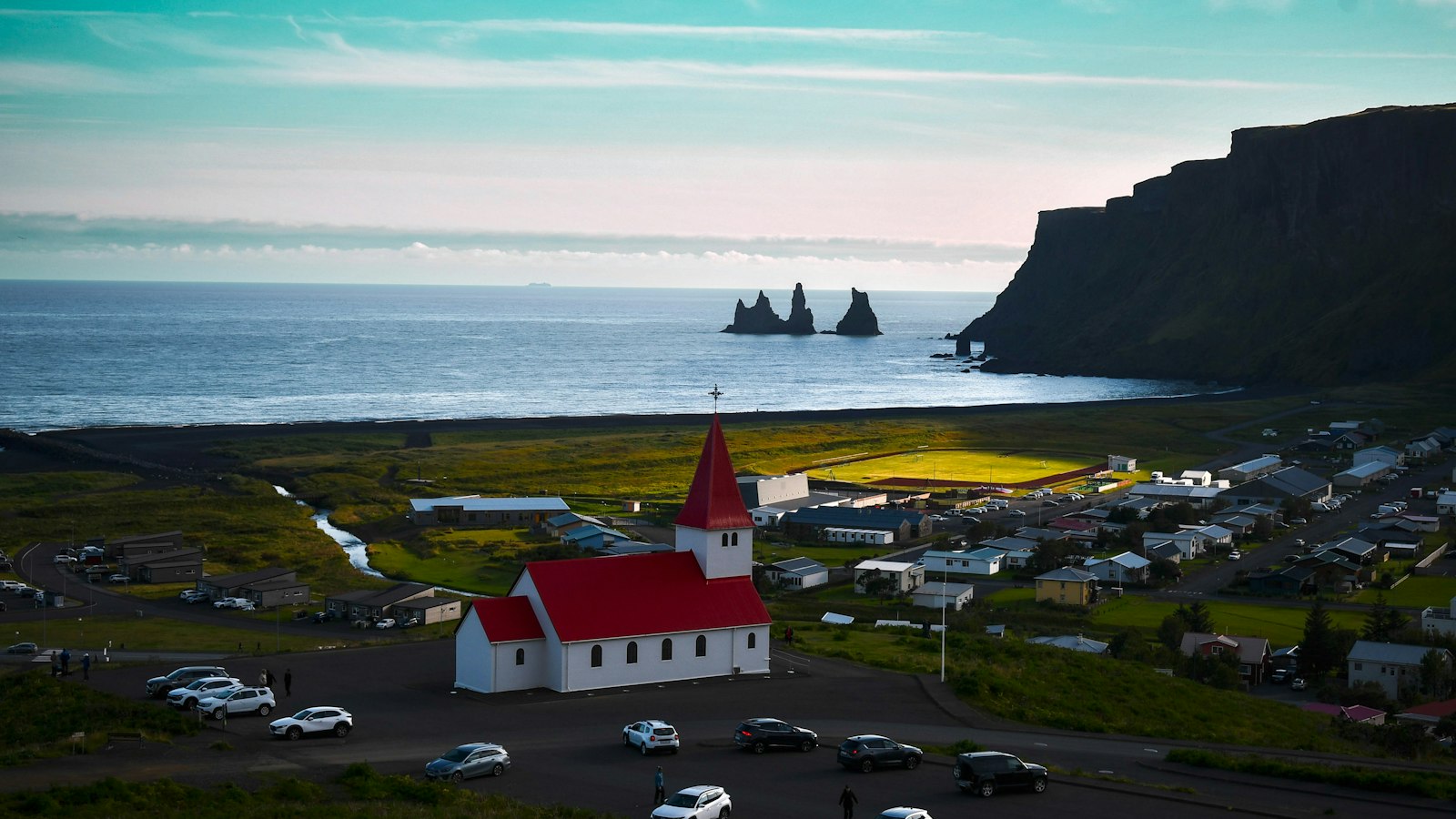
Strandarkirkja stands above the windswept coastline of Selvogur, in southwest Iceland, where land and sea have shaped lives for centuries. While modest in appearance, the church is loaded with significance, not only for Icelanders but for supporters spanning the globe. It is often called the ‘miracle church’ and remains a powerful symbol for many who still believe in its extraordinary powers.
Origin tales and seafaring drama
The story of Strandarkirkja began sometime in the 12th century, rooted in both ordeal and gratitude. According to tradition, sailors caught in a violent storm off Iceland’s southern shores prayed for survival, vowing to build a church wherever they landed if they made it ashore alive. Their prayers were answered when a shining figure, like an angel, appeared at the bow of their ship and guided them safely through the hazardous coastline to a sheltered inlet. Honouring their promise, the sailors built a wooden church on the spot, naming it Strandarkirkja. The adjacent bay was named Engilsvík, or Angel’s Bay, as a token of the miraculous rescue.
Over the centuries, many other stories and legends gathered around the church’s origins. Some tales credit Gissur hvíti, who in the late 10th or early 11th century is said to have built a church with timber from Norway, while others tell of a young farmer who promised wood for a church in exchange for his survival after being lost at sea. In all accounts, divine intervention is a central theme, making the site a focus of faith for seafarers and Icelanders far beyond the local parish.
A changing community
The church was once at the heart of a thriving settlement. The surrounding land, called Strönd (‘the coast’ in Icelandic), was a prosperous farming region with rich pastures shielded from northern winds by Hlíðarfjall mountain, and access to fruitful fishing grounds. Settlers in Selvogur made a living from both land and sea, sometimes even collecting timber from local woods and harvesting seabirds and eggs from the nearby cliffs at Krísuvíkurberg.
Selvogur’s place in Icelandic history is noted as early as the 13th century in the Sturlunga Saga. Yet, as wind and sea gradually eroded both land and livelihood, the once-bustling community dwindled. Around the turn of the 20th century, only about 110 people remained, falling to just 14 residents in 2015. Electricity reached the area relatively late, in 1970. Today, only a handful of farms remain among deserted houses and ruins, giving physical reminders of earlier days.
Despite the area’s changing fortunes, Strandarkirkja endures. It continues to be used for church services, especially during the summer months, with special masses during Easter, Christmas and Pentecost, as well as annual celebrations marking the harvest and the lives of fishermen and hunters who still feel connected to the site.
A notable feature beside the church is the statue Landsýn (‘Land in Sight’), sculpted by Gunnfríður Jónsdóttir in 1950. Carved from Norwegian granite, it commemorates the legendary angelic guidance that saved the seafarers centuries ago. Jónsdóttir herself is buried in the churchyard, adding another layer to the sense of history and remembrance that infuses the coastline here.
Sources
- Wikipedia
- Wikipedia (Icelandic) in Icelandic


