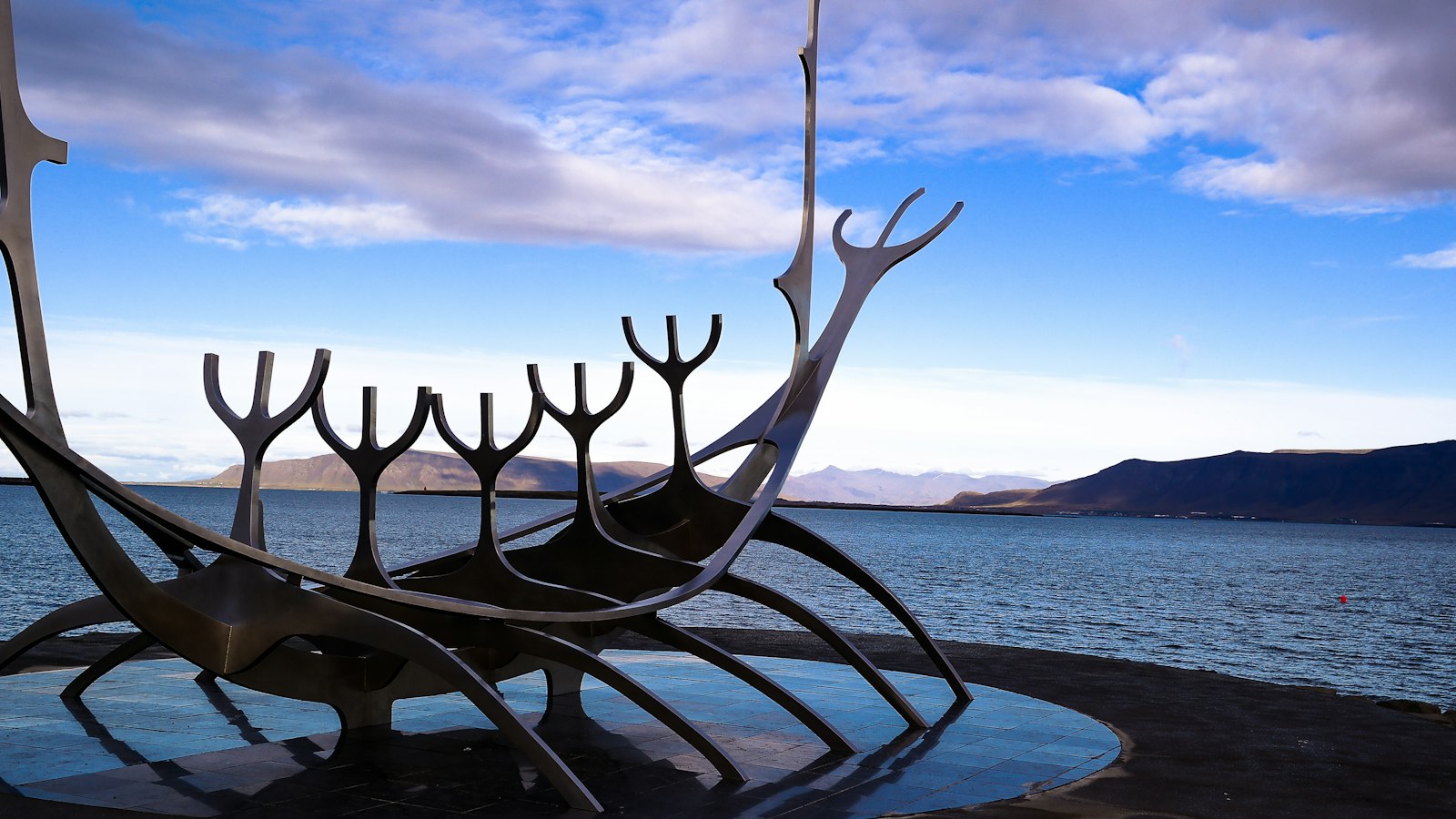
Beside the Sæbraut road in Reykjavík stands the Sun Voyager, known in Icelandic as Sólfar. This sculpture is not a Viking ship, as many first suppose. Instead, its creator, Jón Gunnar Árnason, imagined it as a “dreamboat”, a vessel meant to capture the promise of new worlds, hope and the light of the Sun.
A vision shaped by ancient journeys
Árnason’s inspiration reached across time and myth. His thoughts were influenced by Scandinavian art collaborations in the 1980s and by his own meditations on human migration and exploration. He spoke of a profound feeling during a visit to Bockholm, Finland, where he envisioned ancestors traveling westward across mountains, lakes and forests. This imaginary journey, enriched by history’s speculations about the Mongolian roots of some Icelanders, shaped the concept of a “sun ship,” a symbol of exploring and settling new lands.
At the heart of the Sun Voyager’s concept is not nostalgia, but forward-looking energy, an ode to the Sun that signifies progress and freedom. This focus on discovery and the unknown is what Árnason hoped the sculpture would invite viewers to imagine.
Creation, controversy and participation
The story of Sun Voyager’s creation began in 1986, when a competition was organised to celebrate Reykjavík’s 200th anniversary. Árnason’s entry was chosen, and his original aluminium model was used as the basis for the much larger final work. Construction followed his full-scale hand-drawn plans, with assistance from other Icelandic artists and engineers. Completed in stainless steel, the finished sculpture rests on granite surrounded by what is locally known as “town-hall concrete.” It was officially unveiled on 18 August 1990, the city’s birthday.
Placement of the sculpture stirred debate. Originally, Árnason envisioned his ship pointing west toward the setting sun or located near Reykjavík’s harbour, but changes in urban planning led to Sæbraut being chosen instead. The artist accepted that its prow would face north, jokingly dubbing its headland “Jónsnes” or Jón’s Peninsula. For Árnason, the direction mattered less than the work’s resonance with the observer.
The Sun Voyager’s irregular, flowing lines and sense of motion are typical of Árnason’s style. Looking at the ship, sea and sky seem to merge, inviting viewers to construct their own meaning. Rather than handing viewers a clear message, Árnason believed art should offer an opportunity for new discoveries, with each person’s imagination setting the course.
Though Árnason died in 1989, before the sculpture’s completion, the Sun Voyager remains faithful to his vision: a symbol of hope and light, not of mortality. It continues to encourage new interpretations, letting each onlooker become a participant in its ongoing story.
Sources
- Wikipedia
- Wikipedia (Icelandic) in Icelandic


