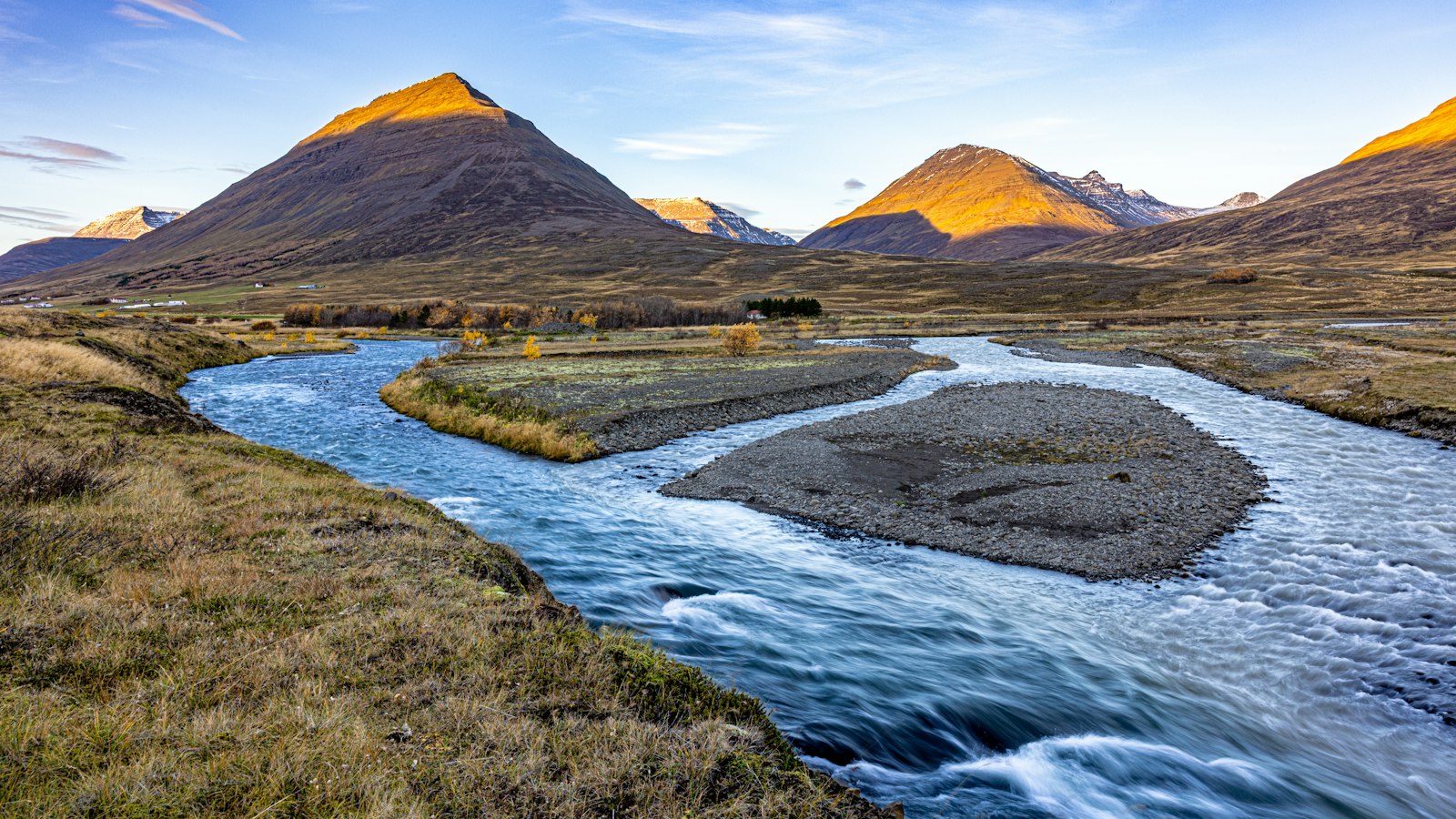
Vatnsdalur, a glacial trough valley in the north of Iceland, stretches roughly 25 kilometres between the mountains Vatnsdalsfjall and Víðidalsfjall. Though broadest at just under two kilometres wide, the valley is defined by features both natural and historical, earning recognition in Icelandic rural lore and literary heritage alike.
A landscape formed by ice, water and earth
The valley’s geography is marked by constant movement and ancient forces. Its floor is threaded by the Vatnsdalsá, a salmon-rich river travelling 74 kilometres northward from the highlands. The river’s journey is punctuated by a series of waterfalls, the highest being Skinandi, while other falls such as Kerarfoss and Rjukandi add to the soundscape.
On the valley’s western edge lie the Vatnsdalshólar, a complex of hillocks that Icelanders consider “uncountable”, a proverb referencing their multitude. Most of these mounds, which reach up to 18 metres high, were created by landslides around 10,000 years ago. During Icelandic settlement, the area experienced further dramatic earth movements, including one in 1720 that obliterated the Bjarnastaðir farm and formed the lake Flóðið when debris dammed the river and flooded the land.
The Flóðið, a 2.6 square kilometre lake at the valley’s northeast entrance, hides within it three former ponds submerged by the 1720 landslide. Changes in the river’s path redirected part of the flow through what is now known as the Hnausakvísl stream.
A particularly curious natural feature, Kattarauga or “Cat’s Eye”, is a small, spring-fed pond about 15 metres deep. Floating islets drift across its clear water, while a refractive spring at the bottom lends the pond its name. Protective status was given to Kattarauga in 1975, classifying it as a natural monument.
Saga, settlement and haunting stories
Vatnsdalur is inseparable from its saga. The Vatnsdæla saga, one of the Icelandic sagas, tells of the pioneering settler Ingimundr the Old, who established his farm at Hof í Vatnsdal. His wife, Vigdís, gave birth to Þórdís, the first child born in Húnavatn, beside a grove at the valley’s mouth. This location is commemorated by a small wood known as Þórdísarlundur and a memorial stone, alluding to the enduring bond between the land and its earliest inhabitants.
Archaeological research has reaffirmed several locations from the saga. The family’s manor, Hof, featured a temple perched on a prominent hill, and a nearby Christian cemetery was in use from at least 1104. The saga’s blend of family history, magic, and rooted geography gives the valley an air of tangible legend.
The valley bears traces of more recent history as well. At three small hills called Þrístapar, on the edge of Vatnsdalshólar, the last execution in Iceland took place in 1830. Two individuals, Friðrik Sigurðsson and Agnes Magnúsdóttir, were beheaded for their roles in a murder. The event, grim and memorable, has inspired fiction and film, most notably the novel “Burial Rites” by Hannah Kent.
Amid its natural flux and stories, Vatnsdalur remains a living rural community. Agriculture continues alongside echoes of sagas and shifting landforms, making the valley a layered part of Iceland’s landscape and memory.
Sources
- Wikipedia
- Wikipedia (Icelandic) in Icelandic


