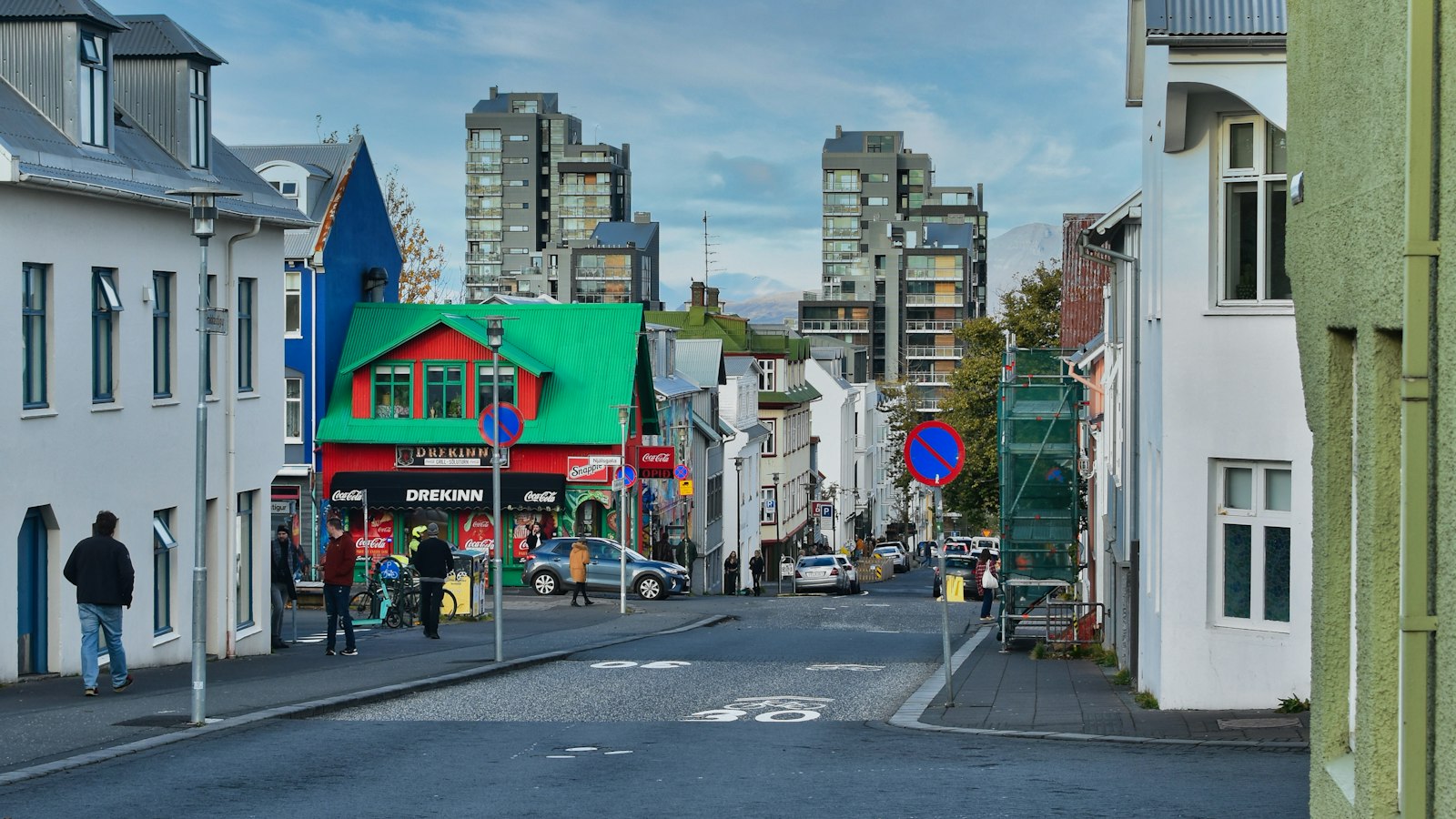
Reykjavík, on Iceland’s southwestern coast, is the country’s only city, its largest settlement, and its capital. It sits on the southern edge of Faxaflói bay at 64°08′ N, making it the northernmost capital of any sovereign state. With a population of about 140,000 and a metropolitan area near 252,000, it is home to the majority of Icelanders, over half live in this region.
The story of Reykjavík begins in 874 AD, when Norseman Ingólfur Arnarson is said to have arrived from Norway, becoming the island’s first permanent settler. According to tradition, he undertook a decision-making ritual common to Norse explorers: casting his seat pillars into the sea and vowing to make his home wherever they landed. After years of searching, his servants recovered the pillars on a smoky bay, which he named Reykjavík, meaning “smoky bay” from the Old Norse “reykr” (smoke) and “vík” (bay), inspired by steam rising from geothermal vents.
Over the centuries, Reykjavík remained farmland. The landscape was dotted by scattered homesteads rather than any village. That began to change in the 18th century, when the Danish king gave the land to a corporation known locally as the Innréttingar. This sparked the first steps toward urban life with industrial endeavours in textiles and later in fisheries and shipbuilding. Reykjavík was formally made a trading town in 1786 after the Danish Crown’s trading monopoly ended. This is marked as the city’s official founding, eventually outlasting the other five trading towns of the time to become Iceland’s central urban hub.
National sentiment flourished in the 19th century, and Reykjavík’s importance grew with it. The Alþingi, Iceland’s historical parliament dating to 930 but suspended for decades, was reinstated here in 1845. This step helped cement Reykjavík as the nation’s political and administrative centre. By the early 20th century, as independence movements gained ground, Reykjavík’s population and influence expanded. Fishing, especially cod, drove much of the early economy.
The outbreak of the Second World War transformed the city overnight. In May 1940, British forces arrived without resistance, swiftly occupying Reykjavík. Their presence, soon joined by Americans, equaled the local population at times. They set up important infrastructure, including Reykjavík Airport (still used for domestic flights) and the larger Keflavík Airport outside the city, which serves international routes.
Rapid change continued after the war. Technological advances and improved living conditions prompted migration from the countryside, spurring new neighbourhoods and city growth. In the postwar decades, the city’s population soared. Utility projects like the city’s geothermal heating system, inaugurated in 1946, made life more comfortable and efficient for Reykjavík’s residents.
Reykjavík has also played an outsized role in world affairs. It hosted landmark events such as the 1972 World Chess Championship and the 1986 summit between Ronald Reagan and Mikhail Gorbachev. More recently, its economy has diversified into finance and IT. Today, Reykjavík’s blend of urban space, distinct geography, and layers of history make it the island’s social and cultural heart.
The city itself is spread across a series of peninsulas with low-density suburbs, and is surrounded by nature shaped by ancient glaciers, volcanic activity, and the Atlantic. Salmon run in city rivers, and Mount Esja stands watch just across the bay. Yet despite its far north setting, Reykjavík remains the pulsating centre of Icelandic life, developed but never far removed from its land and past.
Sources
- Wikipedia
- Wikipedia (Icelandic) in Icelandic


