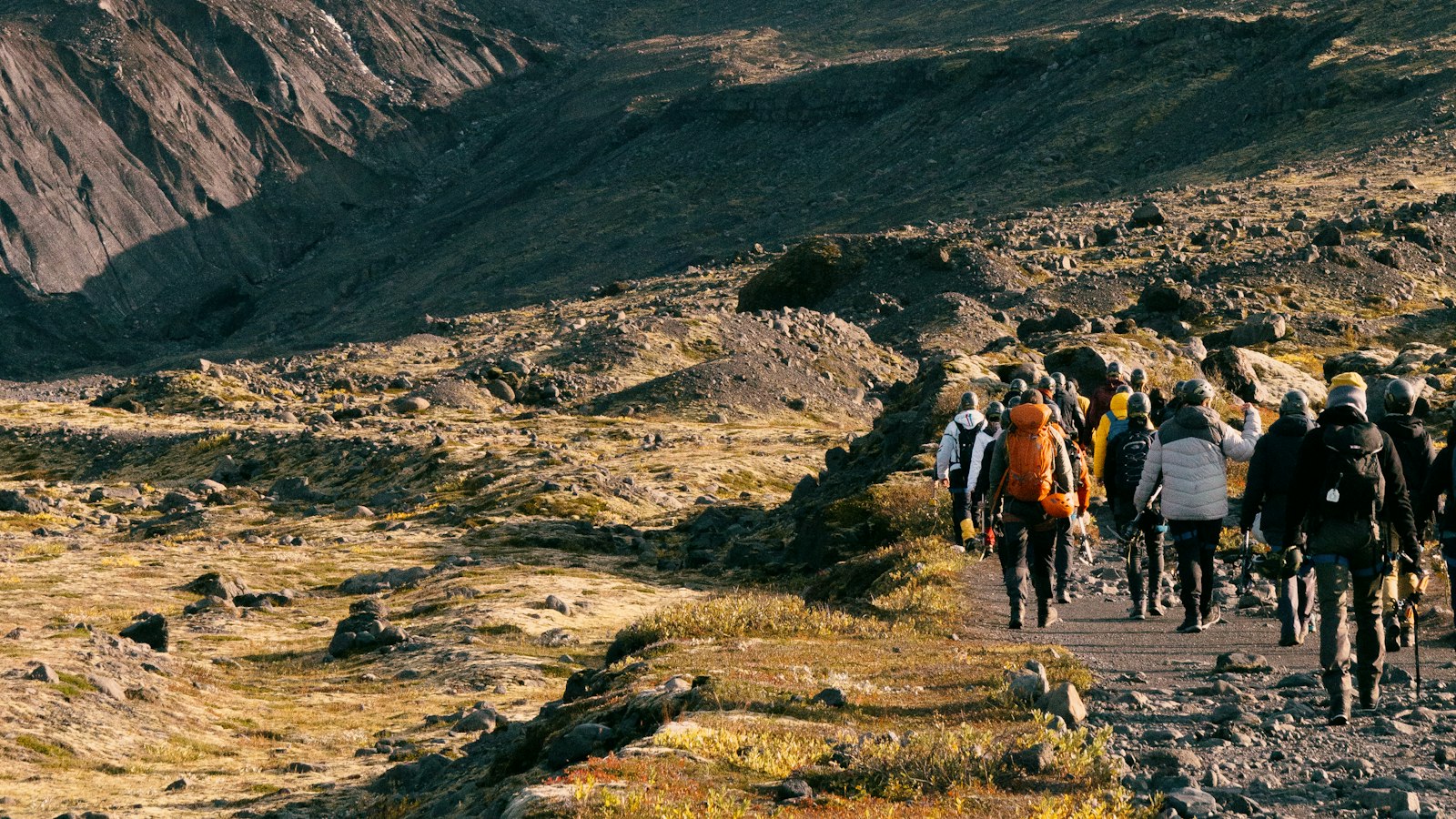
Nestled northwest of the vast Langjökull ice cap, Eiríksjökull stands out in Iceland’s diverse geography. Its name means “Eirík’s glacier” in Icelandic, and its distinct shape is visible from miles across the highlands. While its white glacier crown rises to 1,675 metres, what truly sets Eiríksjökull apart is the immense table mountain beneath, a unique geological structure and the largest of its kind in the country.
A table mountain forged in fire and ice
The story of Eiríksjökull began with volcanic forces beneath a thick ice sheet. The mountain is classed as a tuya, a rare kind of volcano that forms when eruptions break through glaciers, producing flat-topped mountains surrounded by steep cliffs. Its foundation is composed of hyaloclastite, or móberg, which makes up the lowest 350 metres. Above this, a basaltic lava shield 750 metres thick forms the upper layers, a testament to repeated eruptions under an ancient ice cap.
Eiríksjökull’s volcano, located within Iceland’s Western Volcanic Zone, is much larger than the glacier capping it, covering three times as much ground. Rising more than 1,000 metres above the surrounding land, the volcano itself is now considered dormant or possibly extinct. Its composite structure reveals how subglacial volcanic activity can sculpt landscapes unlike anywhere else in the world.
Glacial outflow and shifting names
Covering 22 square kilometres as measured in recent decades, the glacier’s edge has receded to about the 1,300 metre contour. Several outlet glaciers branch out from Eiríksjökull, but only the Klofajökull outlet northeast of the main plateau is readily accessible. Others, like Brækureystri, Vestri-Brækur, Þorvaldsjökull and Ögmundarjökull, spread to the north, northwest and east. Some of these, such as Ögmundarjökull and Þorvaldsjökull, are so closely connected that they are often discussed as a single unit.
The name Eiríksjökull is relatively recent. While it was once called Baldjökull (or Balljökull), sources suggest the name changed around 1700, likely influenced by the prominence of the neighbouring peak Eiríksgnípa. There is little certainty about the Eiríkur who lent his name to the glacier and the nearby mountain. Local lore, however, tells of an outlaw or fugitive evading his pursuers by fleeing into the mountains, thus giving rise to the name immortalised in both ice and legend.
Sources
- Wikipedia
- Wikipedia (Icelandic) in Icelandic


