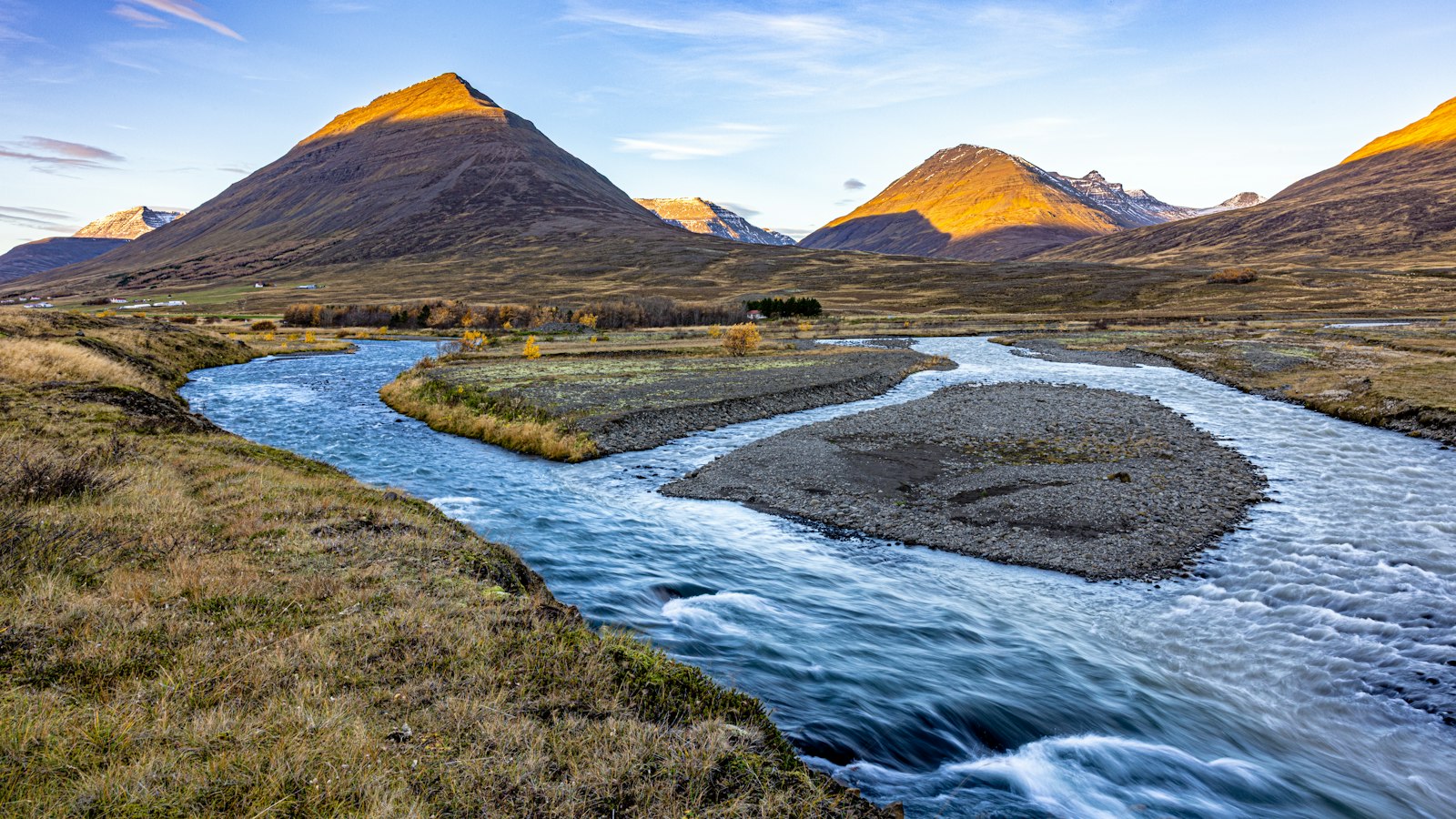
In the broad valleys of northern Iceland, Blönduós marks a point where the glacial river Blanda empties into the sea. With just over 800 residents, Blönduós may seem modest in size, but its location and history make it a distinct settlement on Iceland’s main travel route, Route 1.
A town divided by water and history
Blönduós developed slowly, with its origins traced to the late 1800s. The river cuts through the settlement, creating a clear division between its old and new quarters. The south bank, known locally as the “old town” or gamli bærinn, still features residences from the late nineteenth and early twentieth centuries. Across the bridge, the north bank is the heart of daily life, hosting the town’s main shops, schools, community centre, and a modern outdoor heated pool.
Above it all stands a church with an unusual volcanic crater-inspired design, visible from much of the town. The old church, relocated from Hjaltabakki in the 1890s and now protected, lies on the south bank as a reminder of earlier days.
Textiles, trade, and transformation
Blönduós’s early role as a trading site was formalised in 1876. Throughout the late nineteenth century, storehouses and homes rose up around the new shops, gradually forming a true village. The completion of a river bridge in the late 1890s greatly improved transport, linking the two halves of the community and enabling further growth. By 1920, the town featured a mix of stone, timber, and traditional turf buildings. Many changes followed as Blönduós developed into a centre for regional administration, from the presence of a sheriff and hospital to secondary education and religious services.
More recently, Blönduós has earned a reputation for textile arts. The town hosts Iceland’s only textile museum, Heimilisiðnaðarsafnið, as well as a centre dedicated to research and artist residencies in textile art. This creative focus took hold in buildings that once housed a women’s school operating from 1901 to 1978.
Life on the tundra edge
Blönduós stands on bluffs about forty metres above the river, with the settlement spreading across land that was once several farms. The climate here is subarctic, shaped by the cold air draining from inland glaciers and the proximity to the northern sea. Since the late twentieth century, the Icelandic Meteorological Office has kept an automated weather station in town.
A short pedestrian bridge leads from the ring road to Hrútey, an island in the river managed as a nature reserve. Along with its role as a service hub for farming and food processing, Blönduós is linked to the surrounding countryside by both tradition and daily life.
While it is now part of the larger municipality Húnabyggð, Blönduós maintains its identity, not only as a historic stop for ships and traders but as a modern small town shaped by rivers, creativity, and the land’s quiet persistence.
Sources
- Wikipedia
- Wikipedia (Icelandic) in Icelandic


