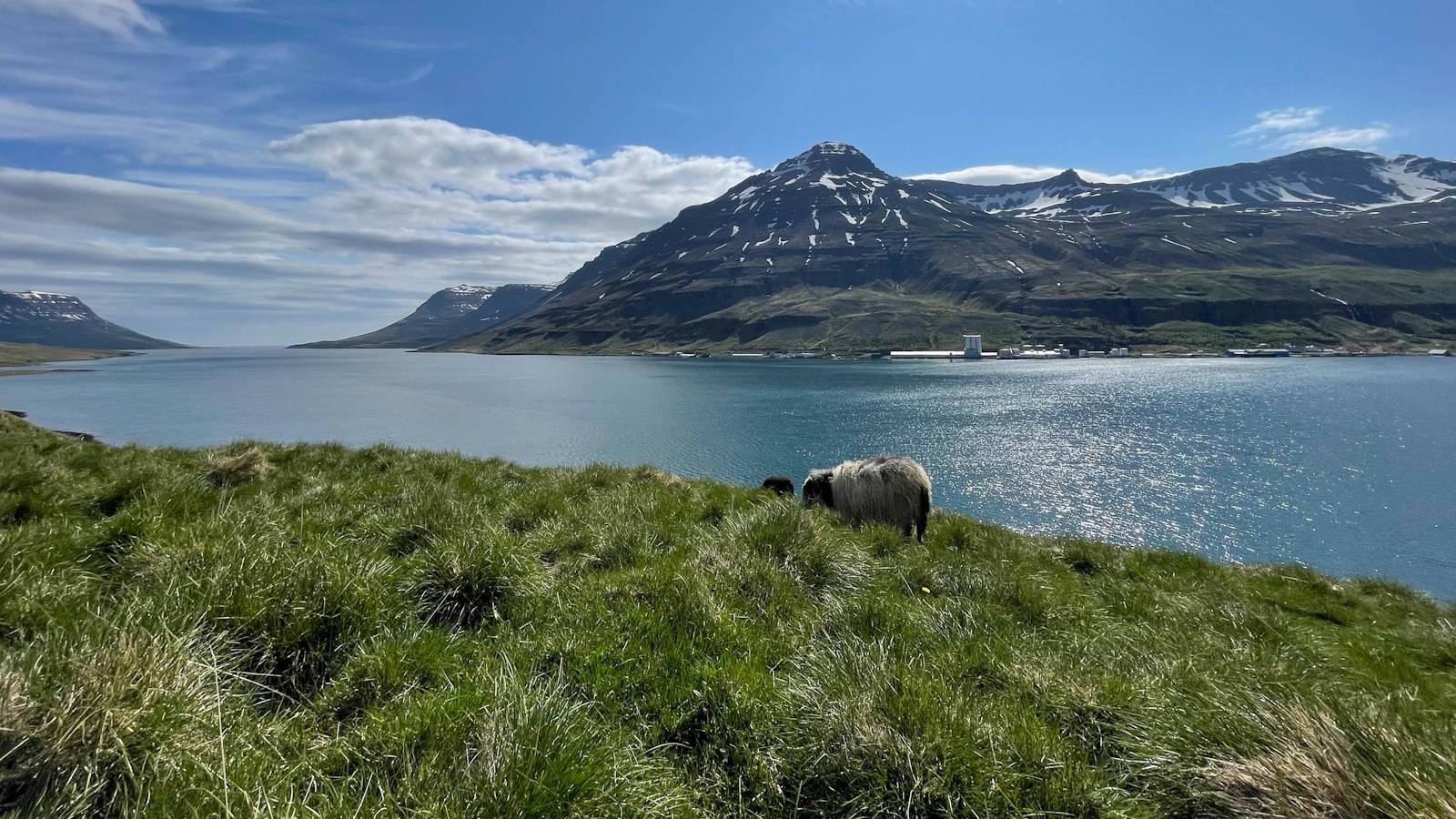
In the far north of Iceland, above the sweeping bay of Skagafjörður, lies the district of Fljót. Here, at the very outer edge of settled land, the farmstead of Hraun occupies a distinctive place in both geography and history. “Hraun” is the Icelandic word for “lava,” but in this case, it refers not to fire and stone, but to the enduring presence of people at the margin of land and sea.
A farm with views and a legacy
The Hraun farm looks out over Fljót and Skagafjörður, set partway up a hillside above Miklavatn, a large lake whose name means “big lake.” Between the farm and the ocean, a long gravel isthmus called Hraunamöl runs between fresh and salt water. In the past, residents used this stretch as a base for fishing, forming a key part of the farm’s way of life.
Just north of Hraunamöl is a small bay named Hraunakrókur. This quiet stretch of coast became part of local lore in 1870, when a polar bear came ashore and was killed here, a rare but notable event for Icelanders.
Connections and community
Hraun was more than an isolated outpost. The main road to Siglufjörður, an important fishing town, still passes near the farm. Historically, the route climbed through Hraunadalur valley and over the Siglufjarðarskarð pass before modern tunnels and roads shifted the path, but Hraun remained a place where travellers passed and met.
In the late 19th century, a general store was established at Hraun, marking its role as a local gathering point. Although the business later moved to Haganesvík, the farm’s reach had already grown beyond agriculture.
The land of Hraun provided not only fishing rights in the lake but also access to an eider duck nesting site, commodities highly valued in rural Iceland. Historically, Hraun was considered the second most valuable farm in the Skagafjörður region after Hólar in Hjaltadalur, owing to these resources.
A notable family and shifting names
Among Hraun’s residents, Einar Baldvin Guðmundsson (1841–1910) stands out. He was both a member of parliament and a merchant, marrying three times and fathering many children. His large family became known locally as the “Hraun Clan.”
Names reveal another layer of complexity in this region. While Hraun in Fljót is plural, another farm called Hraun lies to the west on the tip of the Skagi peninsula, with the name in the singular. Interestingly, in two of Icelandic’s grammatical cases, the word ‘hraun’ is spelled the same whether singular or plural, illustrating the subtlety of Icelandic naming and language.
Today, Hraun continues to sit quietly where lake, land and sea meet, carrying the stories of its landscape and people into the present.
Sources
- Wikipedia
- Wikipedia (Icelandic) in Icelandic


