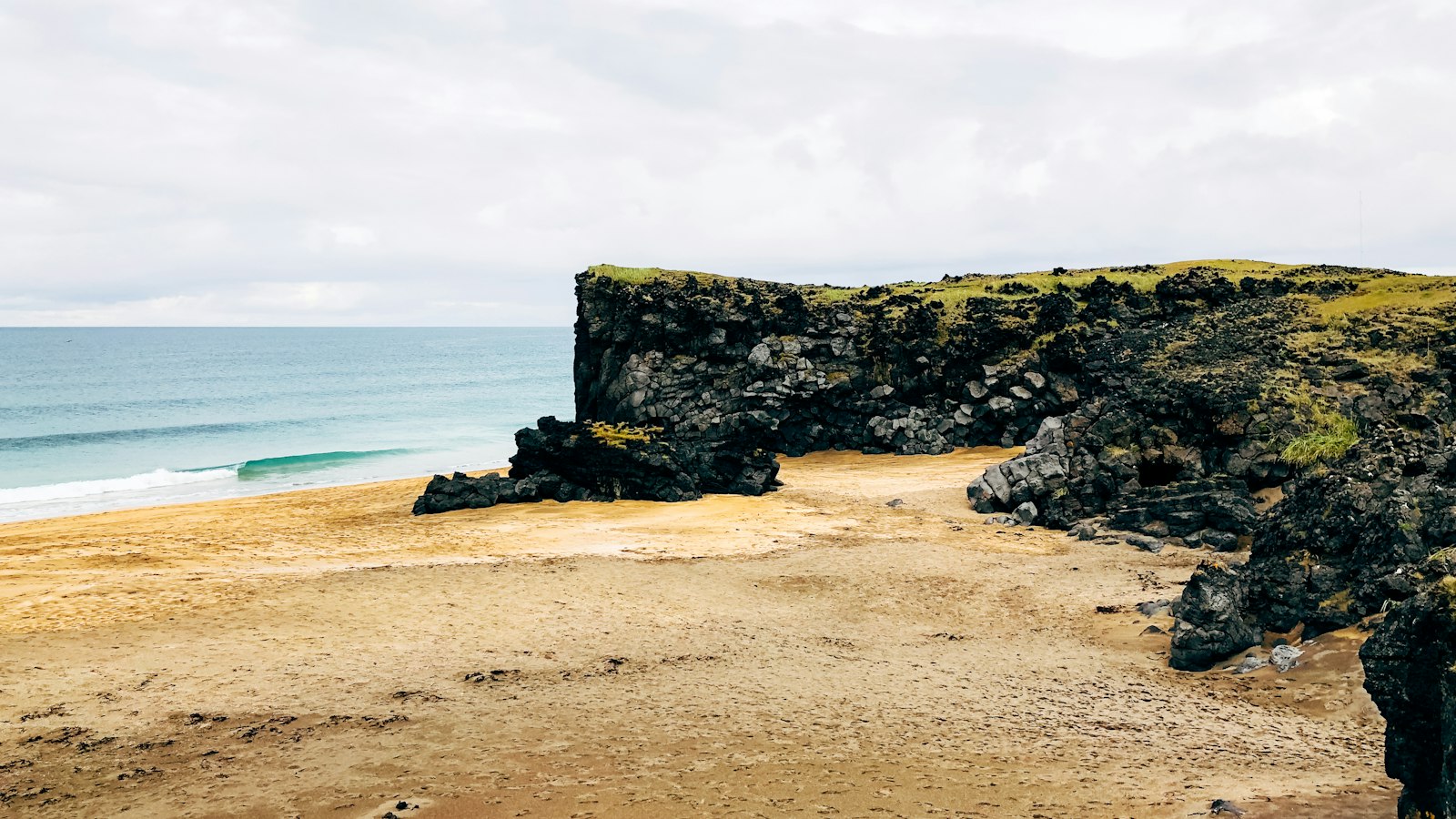
On the southern shore of the Snæfellsnes peninsula, Arnarstapi occupies a dramatic patch of ground overlooked by the peak of Stapafell. The village sits between its neighbour Hellnar and the historic farms of Breiðavík, acting for centuries as a hub for the communities who made their living at the foot of the volcano-capped peninsula.
Place names around Arnarstapi draw from the ancient Bárðar saga Snæfellsáss, a story in which the figure of Bárður, part-man and part-ogre, roams the peninsula. Evidence of this folklore is visible throughout the area, and in the village itself stands a stone sculpture depicting Bárður Snæfellsás, crafted by artist Ragnar Kjartansson.
The village’s prime coastal site made it a key outpost for fishing and local trading from early times. In the era when Iceland was part of the Danish realm, officials granted exclusive trading rights came to control these harbours, and from 1565 until the early 1800s, Danish agents maintained a monopoly over commerce in the region. The land itself, once the property of the Helgafell monastery, passed into the hands of royal representatives who governed and conducted trade from Arnarstapi for centuries.
Among the sheeted turf and modern dwellings, several old buildings recall these days of Danish rule. Notably, the Amtmannshús, once the residence of the Danish prefect, was constructed between 1774 and 1787, one of Iceland’s oldest wooden houses. After years away, it returned to its original place in the 1980s and was recognised as a protected historic site in 1990. The house became home to several prominent Icelanders, including Bjarni Thorsteinsson, whose son Steingrímur Thorsteinsson would gain fame as a poet.
Fishing still provides a summer rhythm in Arnarstapi, supported by the only harbour on the southern Snæfellsnes. The dock, renovated in 2002, hosts local boats chasing daily coastal catches, echoing the village’s earliest days.
Beyond history, the region attracts interest with a landscape of lava fields and odd coastal formations. The beach-walking trail between Arnarstapi and Hellnar traces an historic horse path across Hellnahraun, through a nature reserve created in 1979. Along this stretch, natural wonders such as the pierced stone cliff Gatklettur and fissures called Hundagjá, Miðgjá and Músagjá interact with the Atlantic in displays of tidal force, visible as seawater bursts through rocks during rough weather.
Nearby, features like Rauðfeldsgjá ravine, Dritvík cove, the waterfall Bjarnarfoss, and the basalt pillars of Lóndrangar mark out the snail-shaped peninsula for those interested in geology and legend. Arnarstapi’s story, interwoven with history, saga and volcanic terrain, offers a lens into the layered character of Iceland’s west.
Sources
- Wikipedia
- Wikipedia (Icelandic) in Icelandic


