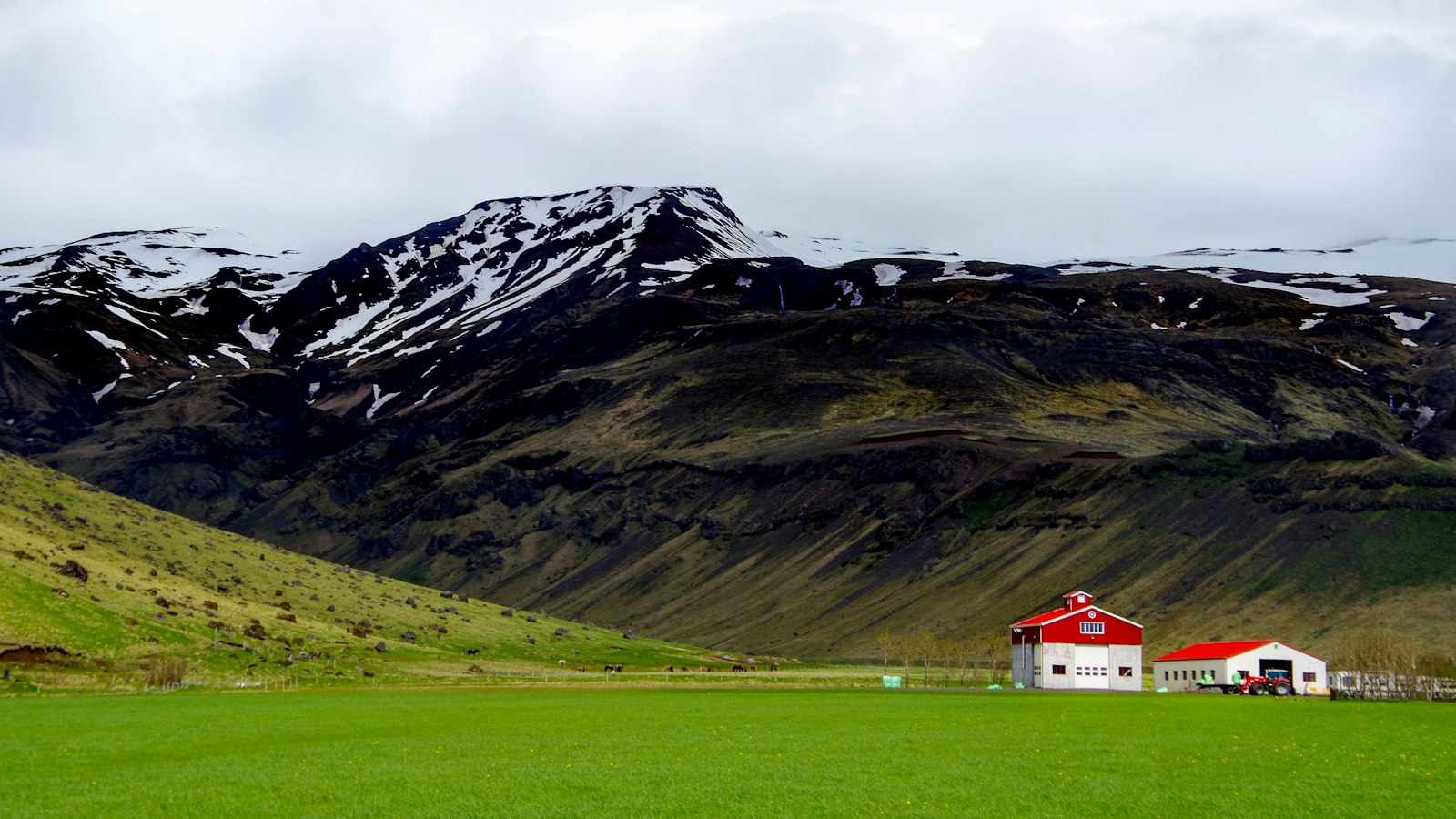
The district of Blönduhlíð in Skagafjörður is home to Akrar, a notable cluster of farms gathered below Akrafjall mountain. Known locally under several names, including Akrar, Akratorfa and Stóru-Akrar, this area has long served as both a centre of agriculture and a living record of north Iceland’s rural history.
A tapestry of farms and families
Four farms make up the heart of Akrar, tightly grouped together and collectively referred to as Akratorfa. These are Minni-Akrar, Stóru-Akrar, Höskuldsstaðir and Miðhús. Each farm is close enough to the others that, over generations, their histories and families have become deeply intertwined. The valley called Akradalur extends from here far into the eastern mountains, anchoring the settlement to the dramatic landscape.
Stóru-Akrar, meaning “Big Akrar,” has long held particular significance. This was once a manor house, recognised both for its size and for the people who lived there. Over the centuries, notable figures such as chieftains, churchmen, and legal officials found their home at Stóru-Akrar. The priest Björn Brynjólfsson resided there in the early 1300s, with several generations of his descendants continuing his association with the farm.
Links to Greenland and changing times
A striking piece of history tied to Stóru-Akrar is the story of Sigríður, who was married in Greenland’s Hvalsey Church in 1408. That union provides the last reliable written evidence of Norse life in Greenland. Sigríður’s family remained influential at Akrar for generations, her descendants including lawyers and governors who managed both the land and legal matters in the region. Ownership of the farm eventually passed to Eggert Jónsson in 1630 and later to Skúli Magnússon in the mid-1700s. Between 1743 and 1745, a sizable turf house was built at Stóru-Akrar; this building, which was used as a residence until 1938, has since been restored and preserved under the care of Iceland’s National Museum.
A church served Stóru-Akrar from early times until 1765, when it was closed by royal decree from Denmark. The community centre Héðinsminni, constructed in the early 1920s through a donation in memory of Skarphéðinn Símonarson, became both a social hub and a school for the area. Though Héðinsminni stopped functioning as a school in the early 2000s, it remains a symbol of the community’s resilience.
Each farm in Akratorfa carries its own legacy. Minni-Akrar, “Smaller Akrar,” is known as the long-time residence of poet Hjálmar Jónsson, or Bólu-Hjálmar, whose verse reflected the rural life he experienced there. Höskuldsstaðir became the home of Stefán Jónsson, a prolific scholar whose writings provided insights into Skagafjörður’s culture and history. These personal stories and contributions illustrate how Icelandic farms were often more than agricultural units: they were places of creativity, learning and memory.
Sources
- Wikipedia
- Wikipedia (Icelandic) in Icelandic


