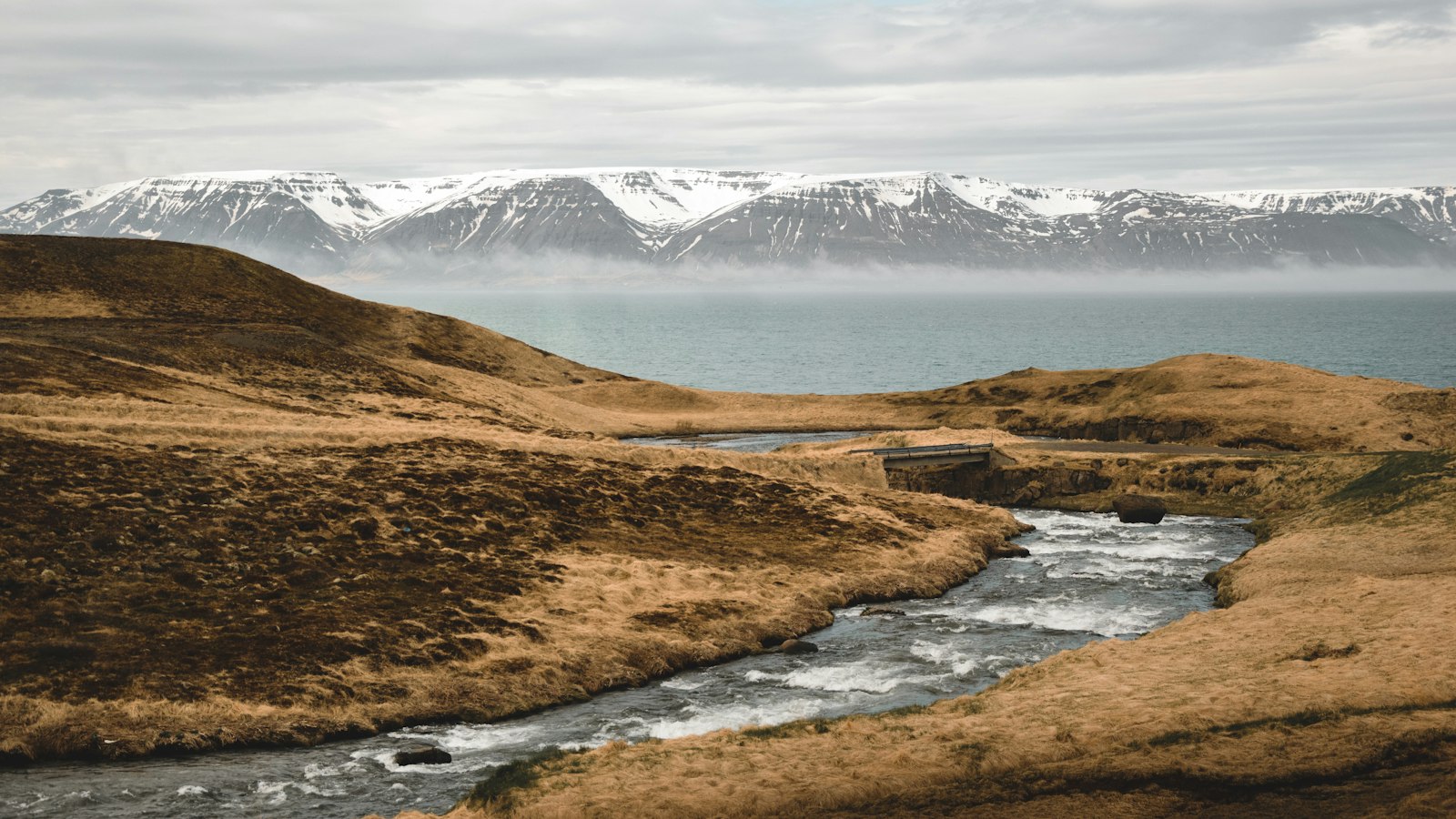
On the eastern edge of Skagafjörður, where the Hjaltadalur valley opens toward the plains and Hjaltadalsá river runs nearby, lies the farm and historical site of Viðvík. This seemingly quiet place in northern Iceland tells stories that stretch from medieval Christianity to the dramatic events of Iceland’s great sagas.
Roots in early settlement and saga history
Viðvík’s origins are closely connected to the early settlement of the surrounding region, known as Viðvíkursveit. The first settler of the area was Öndóttur, who chose this land as his homestead. Over time, Viðvík became an important manor in the valley, a position that would see it mentioned repeatedly in the island’s history.
Perhaps one of the farm’s most intriguing episodes is linked to Grettir Ásmundarson, a legendary outlaw from Grettis saga. Þorbjörn “the fishhook” Þórðarson, a later inhabitant of Viðvík, was Grettir’s slayer. According to the saga, after killing Grettir, Þorbjörn brought Grettir’s head to Viðvík and preserved it in salt for the winter inside a storehouse. This unusual act led to the storehouse being called Grettisbúr, or “Grettir’s cage,” a name remembered in the region.
Church life and medieval community
Viðvík’s significance extends beyond its role in the sagas. It has long been a religious centre, hosting a church site that dates back to at least 1189. At that time, Guðmundur “the good” Arason, later one of Iceland’s most revered bishops, served as the home priest. For centuries, Viðvík was the site of the parsonage, but today the church is served by clergy from Hólar. The current church building stands as a testament to these centuries of service: its main structure was built in 1886, with the tower added in 1893.
In the 13th century, during Iceland’s so-called Age of the Sturlungs, Viðvík again became a focal point. Þorgils skarði Böðvarsson, a chieftain during these turbulent years, resided here for a time. Sturlunga saga records both the land’s social significance and its role as a gathering place. In 1255, a notable event captured the unique spirit of the community: crowds gathered at Viðvík for dancing and merriment. Hámundur, a priest from Hólar, visited to dance after singing at Miklibær church that same day. News of his participation in the festivities caused friction with Bishop Heinrekur, who expelled him from the church in disapproval. The community, through Þorgils’s intervention, eventually prompted a reconciliation, though the bishop’s esteem for Hámundur was never fully restored.
This blend of religious tradition, saga lore, and lively social life has helped Viðvík stand apart from many other Icelandic farms. Its story offers a glimpse into how Iceland’s rural communities were often not only agricultural centres but also stages for history, faith and dramatic human stories.
Sources
- Wikipedia
- Wikipedia (Icelandic) in Icelandic


