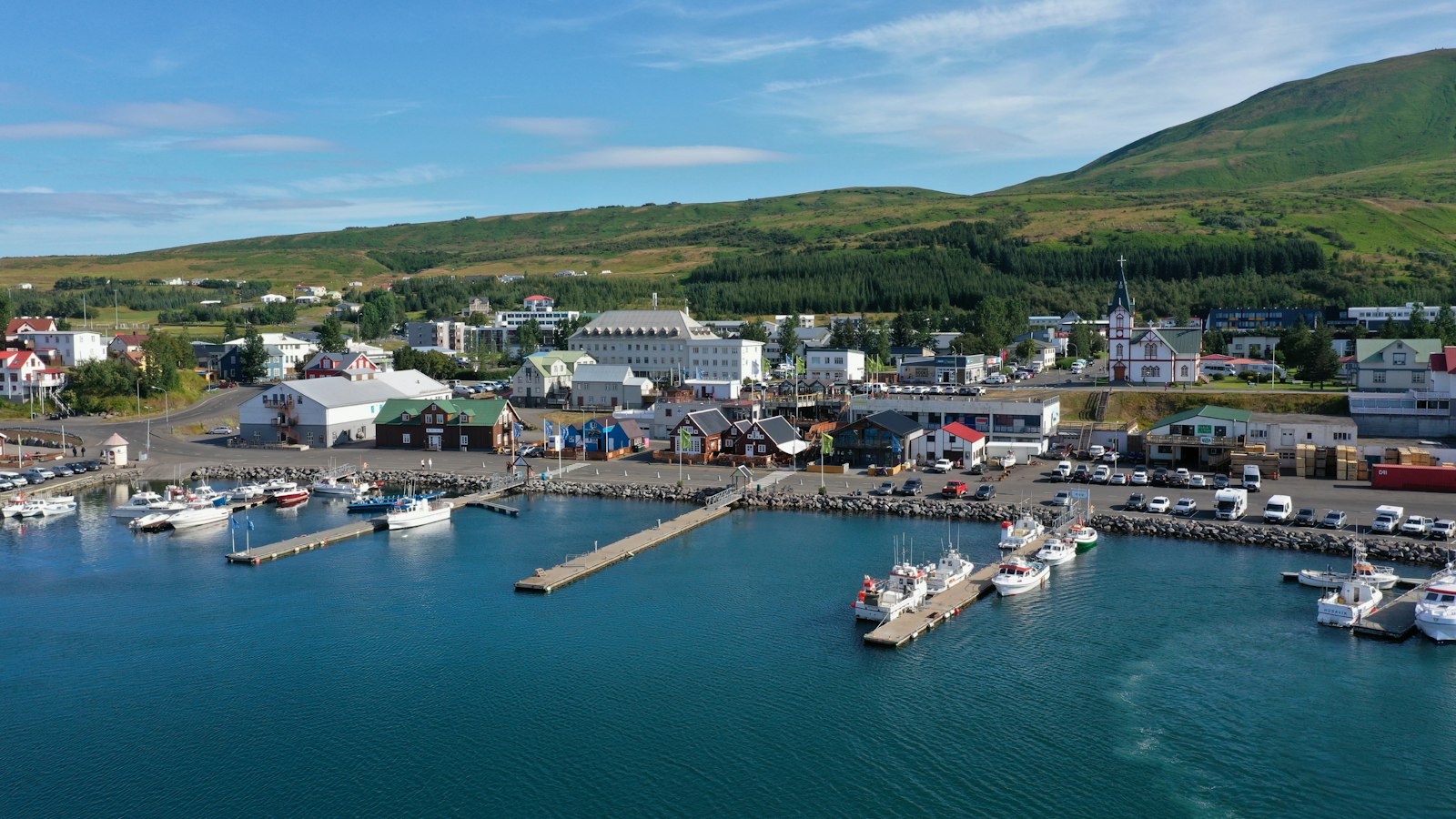
Nestled at the end of Skagafjörður in northern Iceland, Sauðárkrókur stands as the largest town in the northwest region and the second largest along Iceland’s north coast. Home to 2,672 people, it serves as a commercial and administrative centre for the larger farming communities spread across Skagafjörður. Its name, Sauðárkrókur, literally means ‘Sheep-river-hook’, referencing the Sauðá creek that winds through the valley and meets the sea here.
From Viking disputes to modern settlement
Although Iceland was settled during the late 9th century, Sauðárkrókur’s location was not continuously inhabited from those early days. Viking settlers Sæmundr Suðureyski, whose byname refers to the Hebrides islands off the Scottish coast, and Skefill both claimed rights to the land, but neither established a permanent home here. It would take nearly a millennium before the area saw sustained settlement.
The challenges of maritime trade shaped much of the town’s history. The fjord’s west bank offered few natural harbours, so early activity centred on the east coast. Throughout the Danish trade monopoly from 1602 to 1787, only specific ports like Hofsós were permitted for commerce. West side farmers risked their lives crossing the broad Héraðsvötn river for market days, leading some private traders to operate illegally from the shores of Sauðárkrókur. In 1856, Sauðárkrókur was finally established as a legal trading post.
Lasting settlement began in 1871, when the blacksmith Árni Árnason arrived with his family. His blacksmithing and guesthouse business nurtured the early community. By the turn of the 20th century, Sauðárkrókur had grown to a thriving village with essential services: a hospital, school, and church. Population increases marked its transformation into a hub for the surrounding region.
Industry, daily life and a distinct climate
Today, the economy is diverse. Fisheries have long provided jobs, joined by dairy production, food processing and a range of modern services, from engineering and design to computer services. The largest company is the local cooperative society, which manages shops as well as processing plants for milk and meat. Public services, a large secondary school, and health infrastructure contribute to the town’s role as a local centre.
Sauðárkrókur experiences a mild subarctic climate, with an average annual temperature of about 3.2°C (37.8°F). Winters bring lows near −5°C (23°F), and spring through early summer are the driest periods. Wind is a constant feature, averaging 6.7 metres per second. Although it lies just south of the Arctic Circle, atmospheric effects produce four to five days of midnight sun in midsummer, and daylight in midwinter shrinks to just over three hours.
Connection to the wider world comes by road to Akureyri, 120 kilometres away, or Reykjavík, some 300 kilometres to the south. Sauðárkrókur Airport serves the area but has no scheduled flights.
The town is home to a lively community of artists, athletes, and public figures, including painter and poet Sigurlaugur Elíasson, football figure Eyjólfur Sverrisson, and musician Ásgeir Ægisson, who performs under the name Ouse.
From its legendary Viking disputes to its present-day economic and cultural life, Sauðárkrókur represents both the continuity and evolution of settlement in northern Iceland.
Sources
- Wikipedia
- Wikipedia (Icelandic) in Icelandic


