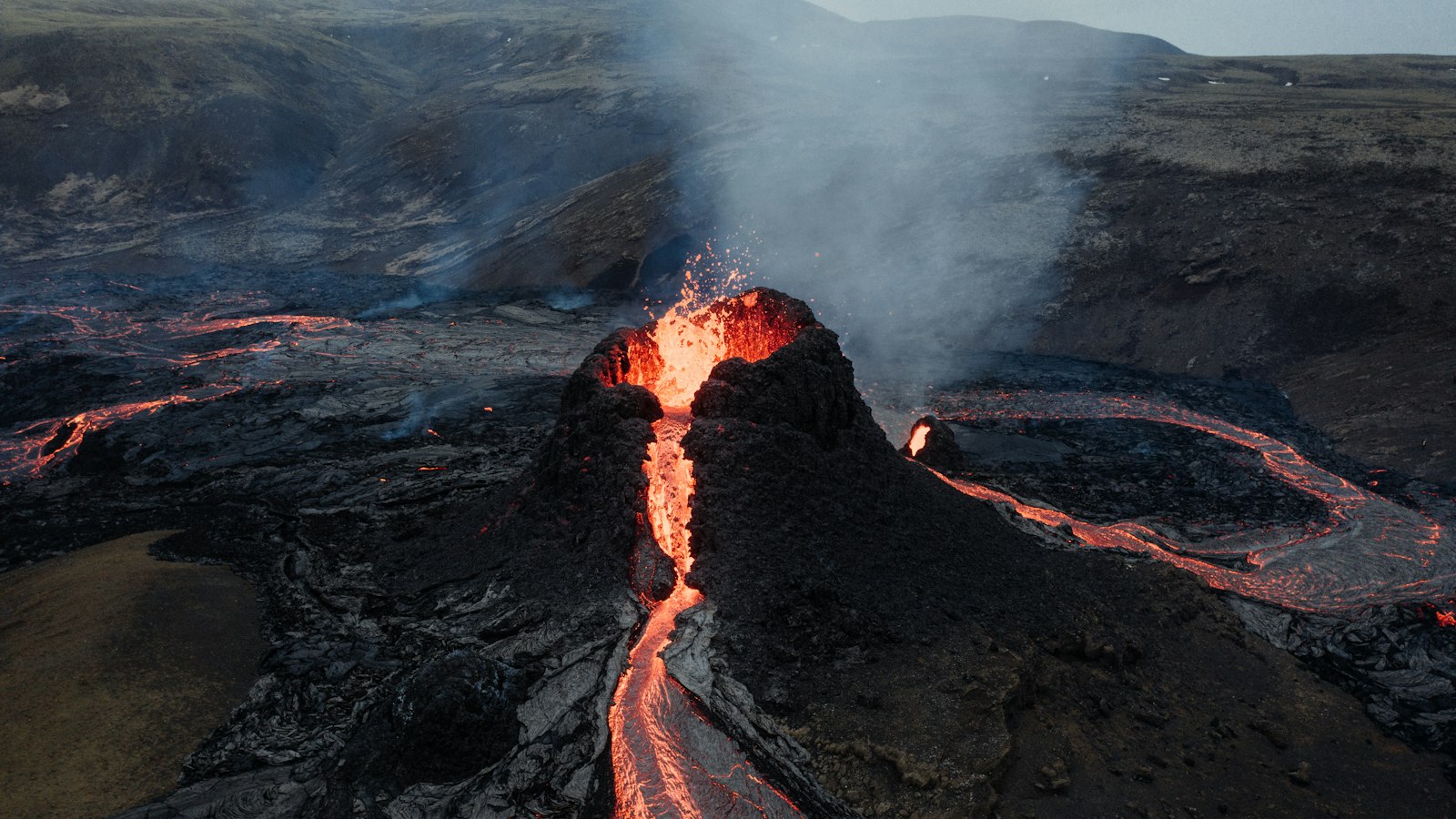
On the outskirts of Reykjavík, a little over 30 kilometres from the capital, layers of the Earth’s violent past lie hidden beneath the moss and volcanic rock. Raufarhólshellir, the fourth-longest lava tube in Iceland, opens a window onto the island’s volcanic history and the ways humans have interacted with these unique underworlds.
An underground corridor shaped by eruption
Raufarhólshellir stretches for 1,360 metres beneath the ground, with heights that reach at least 10 metres and a width that can span up to 30 metres. Its origins go back 5,600 years to the Leitahraun eruption, whose lava flowed downhill for ten kilometres before hollowing out the tube known today. This makes it both a geological landmark and a time capsule from the active past of the region.
The structure itself is remarkable, a tunnel carved by molten rock, with multiple skylights that illuminate its depths. These openings in the ceiling create columns of snow in winter, an unexpected feature of an otherwise hidden world. Above ground, Route 39 passes over a part of the cave where its diameter measures about 15 metres, barely hinting at the scale beneath.
A legacy shaped by visitors and nature
Microbial mats cling to the rocks inside the cave, hosting communities of microorganisms such as actinomycetota and acidobacteriota. These life forms thrive in the dim interior, adapting to mineral-rich and cool conditions seldom interrupted by sunlight.
In modern times, the proximity to the capital has made the cave a focal point for curiosity. By 2015, over 20,000 people visited annually, and its alien landscape has appeared on screens in the film “Noah” and the series “Sense8.” But increased attention led to problems: trash accumulated, fragile features such as the cave’s lava straws were ruined, and rescues became more frequent.
A major intervention occurred in 2016. The owners, land managed by the Seventh-day Adventist Church, closed Raufarhólshellir to clean up and protect what remained. Several tons of waste were taken out, lighting was installed, and walkways were carefully constructed to avoid further harm. The cave reopened by mid-2017 with a new rule: access only possible as part of a guided tour, balancing the delicate underground world with public interest.
Raufarhólshellir’s legacy also includes culture. In 2017, the cave hosted two concerts during the Secret Solstice music festival, including a small performance by Helgi Björnsson deep within its chambers, with only 50 listeners. The cave’s layers of lava, life, and human history continue to intertwine beneath the Icelandic surface.
Sources
- Wikipedia
- Wikipedia (Icelandic) in Icelandic


